
The Ultimate Guide to Altruist Financial Planning Software and Fees
Discover how Altruist tax loss harvesting automates tax-efficient rebalancing to boost after-tax returns and reduce drag.
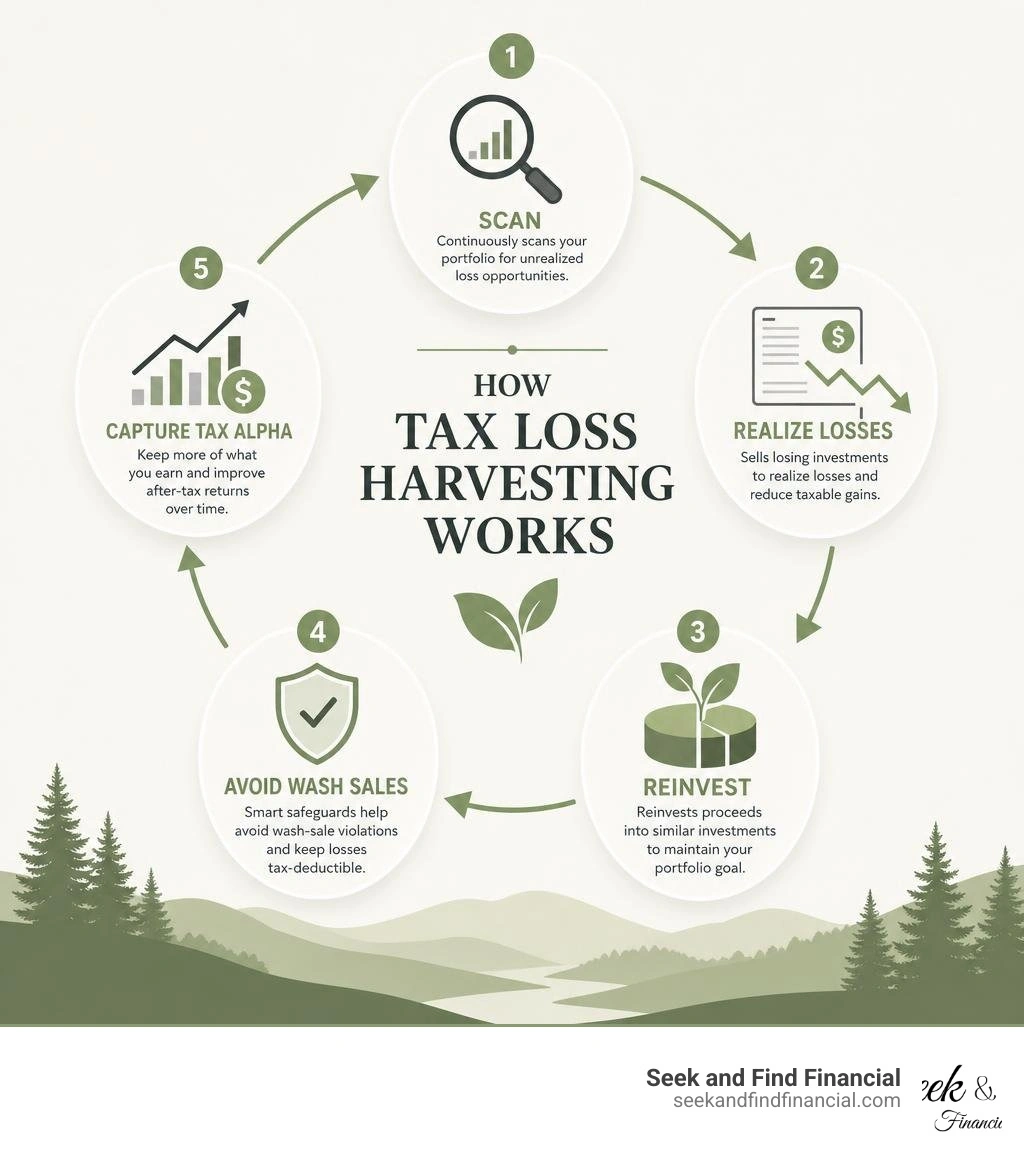
Altruist tax loss harvesting is an automated process that scans your clients' taxable portfolios for unrealized losses, realizes those losses strategically, and reinvests the proceeds — all without triggering wash-sale violations. Here is a quick summary of how it works:
If you earn $400K or more, taxes are likely one of your biggest financial drags. Generic investment strategies don't account for your specific tax situation. That's where a platform built for precision — not cookie-cutter portfolios — makes a real difference.
Americans pay roughly a third of their lifetime earnings in taxes. For high earners, that number can feel even heavier. Most traditional investment platforms treat tax management as an afterthought. Altruist was built to treat it as a core feature.
The difference is not small. Every dollar you keep from unnecessary taxes compounds over time. A 1% to 2% annual improvement in after-tax returns, sustained over decades, can mean hundreds of thousands of dollars in additional wealth.
I'm Daniel Delaney, founder of Seek & Find Financial, where I've spent my career helping high earners use tools like Altruist tax loss harvesting to build smarter, more tax-efficient portfolios. My experience at established financial institutions gave me a clear view of how powerful — and historically inaccessible — these strategies have been for all but the wealthiest clients.
Investing involves risk, including possible loss of principal. No investment strategy can ensure financial success or guarantee against losses. Past performance may not be used to predict future results. Provided content is for overview and informational purposes only, reflect the opinions of the author, and is not intended and should not be relied upon as individualized tax, legal, fiduciary, or investment advice.
This information is being provided only as a general source of information. These views may change as market or other conditions change. This information is not intended and should not be used to provide financial advice and does not address or account for an individual's circumstances. Past performance does not guarantee future results and no forecast should be considered a guarantee. Please seek the guidance of a financial professional regarding your particular financial concerns.
Investment advisory services offered by duly registered individuals through Seek & Find Financial LLC a Registered Investment Adviser. Licensed Insurance Professional
Tax management is a vital part of building wealth. It is about more than just filing your taxes in April. It is about making smart choices with your investments every single day.
Altruist has a powerful suite of tools called TaxIQ. This suite is also known as the Tax Management suite. It helps us run portfolios with high tax efficiency. When we manage your wealth, we want to keep your tax drag as low as possible. You can learn more about this on our page about Tax-Efficient Wealth Management.
The Altruist Tax Management suite works in the background. It uses automated rebalancing to keep your portfolio on track. When your portfolio drifts away from its target mix, the software fixes it. But it does not just buy and sell blindly. It looks at the tax impact of every single trade.
This tool uses three main strategies to protect your money:
By automating these choices, the software helps you keep more of your hard-earned money. It takes the guesswork out of tax planning.

Tax-loss harvesting is a simple concept. When an investment goes down in value, you sell it to lock in the loss. You then use that loss to offset your capital gains. If you have extra losses, you can even use up to $3,000 of them to offset your regular income.
But doing this by hand is very hard. It takes a lot of time. If you only do it once a year, you might miss the best opportunities. Markets move fast. An investment might drop in value in May and go back up by December. If you only check your account in December, that opportunity is gone.
Altruist solves this with daily scans. The software looks at your accounts every day. It checks if any investments have dropped below a certain limit. This is called the loss threshold.
If an investment hits that threshold, the system sells it to capture the loss. It immediately buys a similar investment to keep your portfolio balanced. This is called a replacement security.
Daily scans are much better than traditional rebalancing. Traditional systems only look at your accounts on a set schedule, like once a quarter. They might also only check when your portfolio drifts too far from its target. Altruist's daily scans catch fleeting losses during market volatility. This helps us maximize your tax savings.
You can read more about how this software works on the Tax management and tax-loss harvesting software - Altruist page.
For high earners, direct indexing is a powerful tool. Instead of buying a single mutual fund or ETF, you buy the individual stocks that make up the index.
With Altruist, we can use Personalized Indexing. This allows us to customize your portfolio. We can set custom exclusions. For example, if you own a lot of tech stock from your business, we can exclude tech stocks from your index. We can also use values screens to avoid industries you do not want to support.
Personalized Indexing makes Altruist tax loss harvesting even more powerful. In a standard ETF, you cannot harvest losses on individual stocks. If the overall ETF is up, you cannot capture any losses. But with direct indexing, you own the individual stocks. Even if the overall market is up, some individual stocks will be down.
The Altruist software scans these individual stocks daily. It harvests losses at the stock level. It does all of this while keeping your tracking error low. Tracking error is how much your portfolio deviates from the target index. The software balances tax savings with portfolio risk. It also uses fractional shares. This means we can offer this high-end strategy with account minimums as low as $2,000.
In the past, high-end tax management was expensive. It was only available through Turnkey Asset Management Programs (TAMPs). These traditional TAMPs often charge high fees, sometimes between 0.45% and 0.50% (45 to 50 basis points) of your assets every year.
Altruist is different. It is built to be simple and affordable. You can learn more about their platform at Altruist: Welcome .
Here is how the pricing works for Altruist's tax tools:
To help you understand the difference, let us compare traditional rebalancing with Altruist's advanced suite.
| Feature | Traditional Rebalancing | Altruist Tax Management |
|---|---|---|
| Frequency | Quarterly or annual checks | Daily automated scans |
| Cost Basis Method | FIFO (First-In, First-Out) | MinTax (Minimize tax impact) |
| Tax-Loss Harvesting | Manual, end-of-year | Automated, year-round |
| Capital Gains Control | None (advisor must calculate) | Capital gains budgeting |
| Direct Indexing Support | Rare or very expensive | Built-in with low minimums |
Altruist's suite gives us fine-tuned control over your taxable accounts. We can set custom tax rates for your short-term and long-term gains. This helps the software calculate the true tax impact of every trade.
We can also set a capital gains budget. If we are transitioning a large account into a new portfolio, we can set a limit on how much capital gains we want to realize each year. The software will trade up to that budget limit and no further. This lets us spread your tax bill over several years.
Finally, we get clear gain/loss summaries. This reporting shows us exactly how much tax alpha we have generated for you.
When you harvest a loss, you must follow the wash-sale rule. This IRS rule says you cannot buy the same security, or a "substantially identical" one, within 30 days before or after the sale. If you do, you lose the tax deduction.
Altruist's software is built to avoid this mistake. When it sells an asset for a loss, it automatically buys an approved fund substitute. This substitute is similar enough to keep your asset allocation correct, but different enough to satisfy the IRS.
In May 2025, Altruist released a major upgrade called cross-account Wash Sale Sensitivity.
Before this update, automated systems could only look at one account at a time. If you sold an asset in your individual account, but bought it in your joint account, you might trigger a wash sale.
Now, we can group your accounts into households. The software looks across all accounts in your household. It tracks trades in your taxable accounts to ensure we do not trigger a wash sale anywhere in your portfolio. This automation saves hours of manual checking and protects your tax deductions.
When we talk about "tax alpha," we mean the extra return you get by managing taxes wisely. It is just like getting a higher investment return, but without taking on more market risk.
How much value can tax management add? Many academic and industry studies show that holistic tax management can enhance after-tax performance. The benefits tend to range between 1% and 2% of additional annualized return for some investors.
A well-known study by Vanguard supports this. It shows that more frequent portfolio rebalancing, such as daily tax-loss harvesting, can achieve greater average tax alpha compared to monthly, quarterly, or annual harvesting.
Another study published in The Journal of Wealth Management (2016) highlighted how active tax management using ETFs can significantly boost after-tax returns.
For a business owner or high earner making $400K or more, this 1% to 2% difference is huge. It means your portfolio is working more efficiently. We use these Advanced Tax Strategies to help you build a stronger financial foundation.
While automated tax-loss harvesting is a great tool, it is not a perfect fit for everyone. We must look at your unique situation before turning it on.
Here is who benefit the most:
You can learn more about matching your investments to your tax situation in our Tax-Efficient Investing guide.
There are also a few limitations to keep in mind:
Yes. Thanks to the May 2025 updates, Altruist has cross-account Wash Sale Sensitivity. We can group your family's accounts into a single household. The software will then track buying and selling across all those accounts. This prevents you from triggering a wash sale by buying a security in one account while selling it for a loss in another.
Yes. We can configure this fee at the firm level or the individual account level. If we decide to pass the 10 bps fee to the client, it is billed automatically. However, if we use fee-based models from the Altruist Model Marketplace, this fee is waived.
Altruist is constantly updating its platform. On their roadmap, they are working on a rebalance preview tool. This will let us see the exact tax impact of a rebalance before we click "approve." They are also working on more proactive scanning tools and deeper reporting to show clients their exact tax savings over time.
Building wealth is not just about choosing the right investments. It is about keeping as much of your return as possible. For high earners in Indiana and Illinois, managing the drag of taxes is a critical step.
Using Altruist tax loss harvesting allows us to put your tax savings on cruise control. It combines daily scans, direct indexing, and household wash-sale protection to build a highly efficient portfolio.
At Seek & Find Financial, we specialize in helping entrepreneurs and high earners design personalized, technology-driven wealth strategies. We do not believe in generic advice. We build structured systems to help your wealth grow.
If you want to see how a structured plan can improve your after-tax returns, explore our guide on retirement plans. Let us build a strategy that works as hard as you do.
Investing involves risk, including possible loss of principal. No investment strategy can ensure financial success or guarantee against losses. Past performance may not be used to predict future results. Provided content is for overview and informational purposes only, reflect the opinions of the author, and is not intended and should not be relied upon as individualized tax, legal, fiduciary, or investment advice.
This information is being provided only as a general source of information. These views may change as market or other conditions change. This information is not intended and should not be used to provide financial advice and does not address or account for an individual’s circumstances. Past performance does not guarantee future results and no forecast should be considered a guarantee. Please seek the guidance of a financial professional regarding your particular financial concerns.
Investment advisory services offered by duly registered individuals through Seek & find Financial LLC a Registered Investment Adviser. Licensed Insurance Professional