

The Good, The Bad, and The Bulletproof: Unpacking Asset Protection Strategies
Discover asset protection strategies: umbrella insurance, LLCs, trusts & more to shield wealth from lawsuits and creditors.
Asset protection strategies are legal tools and financial structures that shield your wealth from lawsuits, creditor claims, divorce, and unexpected financial threats.
Here are the core strategies most people use:
Think about this: a new lawsuit is filed in the U.S. roughly every 30 seconds. And when business owners leave personal assets unprotected, creditors target them directly in 70% of cases. That is not a small risk. It is a near-certainty for high earners without a plan in place.
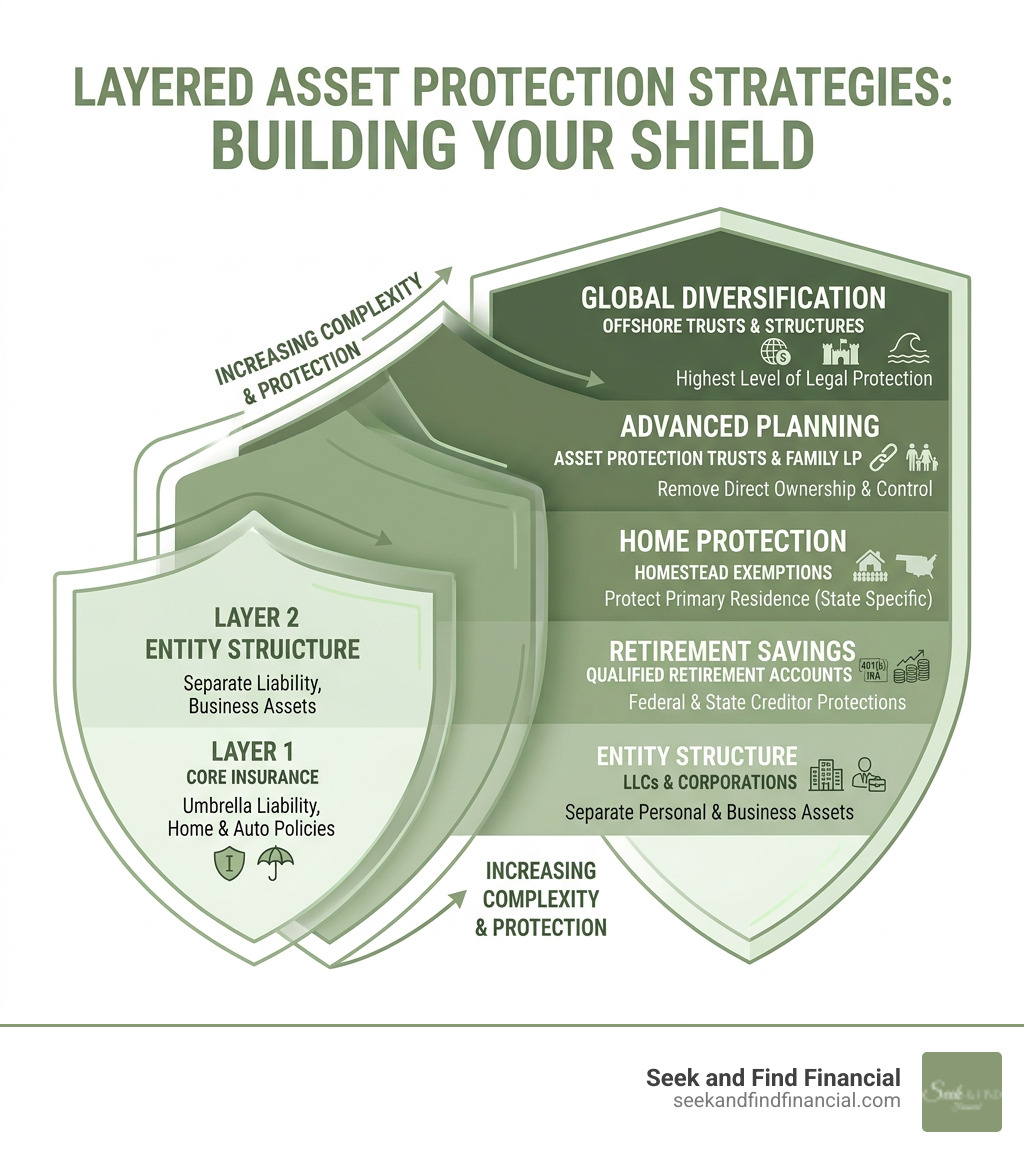
The hard truth is that most people wait too long. They build significant wealth, then assume a good accountant or a solid business structure is enough. It rarely is. Real protection requires multiple layers, each designed to make your assets harder, costlier, and less attractive to pursue.
I'm Daniel Delaney, founder of Seek & Find Financial. Throughout my career in financial services at various established firms, I've seen how critical well-structured asset protection strategies are for business owners and high earners who want to keep what they've built. Below, I'll walk you through every major tool available, from the basics to the advanced, so you can build a plan that actually holds up.
Investing involves risk, including possible loss of principal. No investment strategy can ensure financial success or guarantee against losses. Past performance may not be used to predict future results. Provided content is for overview and informational purposes only, reflect the opinions of the author, and is not intended and should not be relied upon as individualized tax, legal, fiduciary, or investment advice.
This information is being provided only as a general source of information. These views may change as market or other conditions change. This information is not intended and should not be used to provide financial advice and does not address or account for an individual's circumstances. Past performance does not guarantee future results and no forecast should be considered a guarantee. Please seek the guidance of a financial professional regarding your particular financial concerns.
Investment advisory services offered by duly registered individuals through Seek & Find Financial LLC a Registered Investment Adviser. Licensed Insurance Professional
When we talk about asset protection strategies, we often start with the basics. You do not need a complex offshore trust on day one. You need a solid foundation. This foundation is built on insurance and how you own your property.
Think of your wealth like a house. Insurance is the fence around the yard. Titling is the lock on the front door. If you do not have these in place, the rest of the structure is at risk. For high earners in places like Valparaiso or Crown Point, these simple moves can save millions of dollars.
Insurance is your first line of defense. It is the easiest way to transfer risk to someone else. Most people have home and auto insurance. But for a business owner or a professional, those are rarely enough.
An umbrella policy is non-negotiable. It sits on top of your other policies. If you are in a bad car accident and the costs go over your auto limit, the umbrella policy kicks in. Without it, a single accident could wipe out your retirement savings. We recommend a policy equal to or greater than your net worth. It is a small price to pay for peace of mind.
How you title your assets matters just as much as what you own. In Indiana and Illinois, married couples can use a special type of ownership called Tenancy by the Entireties (TBE). This is a powerful tool.
If a husband and wife own a home as TBE, a creditor of only one spouse cannot seize the house. This was a deciding factor in 78% of relevant federal appeals between 2018 and 2024. It creates a legal barrier that is very hard for creditors to break. It essentially treats the married couple as a single legal unit. If only one person is sued, the joint property stays safe.
For entrepreneurs, the business is often the biggest source of risk. If you run your business as a sole proprietorship, there is no wall between your work life and your personal life. If the business gets sued, you get sued.
Building a wall means using business entities like Limited Liability Companies (LLCs) or Corporations. These entities create a legal separation. According to Aon's global claims research, business owners who leave personal assets unprotected face a much higher risk of seizure.
The LLC is a favorite tool for many of our clients in Chesterton and Merrillville. It is flexible and offers great protection. One of the best features is the "charging order."
If a creditor wins a lawsuit against you personally, they might get a charging order against your LLC. This means they have a right to any money the LLC pays out to you. But they cannot force the LLC to pay out money. They also cannot take over the business. In some cases, the creditor might even end up with a tax bill for money they never actually received. This makes suing you very unattractive.
| Feature | LLC | Corporation |
|---|---|---|
| Ownership | Members | Shareholders |
| Management | Flexible | Board of Directors |
| Protection | Charging Order | Corporate Veil |
| Formalities | Low to Moderate | High |
An LLC only works if you treat it like a separate person. This is called maintaining the "corporate veil." If you use your business bank account to buy groceries, you are "commingling funds." This is a big mistake.
If a judge sees that you do not respect the separation between yourself and your business, they won't respect it either. They can "pierce the veil" and let creditors take your personal house or car. When formalities are followed, the corporate veil holds firm in 70% of lawsuits. Keep separate records, use separate bank accounts, and sign documents in the name of the business.
Once the foundation is set and your business is shielded, you might look at advanced asset protection strategies. These are for people who want a "bulletproof" plan. These tools involve giving up some control to gain a lot of security.
Advanced planning often involves moving assets into structures that you do not technically own anymore. If you do not own it, a creditor cannot take it from you. This is a big step, so it requires careful thought.
Trusts are a major part of advanced planning. Many people ask, what is a living trust, but a living trust is usually for avoiding probate, not for protecting assets from creditors. For real protection, you need an irrevocable trust.
A Domestic Asset Protection Trust (DAPT) is allowed in 14 to 19 states, depending on how you count them. These trusts have a "spendthrift clause" that keeps creditors away. If you need even more protection, you might look at offshore trusts in places like the Cook Islands or Nevis. These jurisdictions do not recognize U.S. court orders. While you usually need to plan ahead, you may be able to protect assets after a lawsuit is filed by using these international structures, though it is much more difficult.
A Family Limited Partnership (FLP) is a way to keep wealth in the family while protecting it. You have General Partners who run the show and Limited Partners who just own a piece of it. Creditors of the Limited Partners have very few rights.
Gifting is another smart move. For 2025, you can gift up to $19,000 per person without any tax. Over a lifetime, you can transfer up to $13.99 million tax-free. By gifting assets to your children or into a trust now, you remove those assets from your "balance sheet." If a creditor comes knocking later, those assets are already gone.
Some of the best asset protection strategies are already written into the law. These are called "statutory shields." You do not have to do much to get them, other than putting your money in the right place.
Retirement accounts and your primary home often have the strongest protections. Historically, these protections have safeguarded over $2 trillion in U.S. family assets. It is often wise to max out these accounts before looking at more complex tools.
Your home is often your biggest asset. Many states have "homestead exemptions." This law says a certain amount of your home's value cannot be touched by creditors. While some states like Florida offer 100% protection, others have smaller limits.
Qualified retirement plans, like a 401(k), are protected by a federal law called ERISA. This protection is almost absolute. Even if you go bankrupt or get sued for millions, your 401(k) is usually safe. This is why we tell our clients in Portage and Hobart to prioritize these accounts. Even if you are looking into an offshore company setup in UAE, you should secure your home and retirement first.
IRAs also have protection, but it is a bit different. Under federal law, your IRA is protected up to an inflation-adjusted cap in bankruptcy. For 2024, this cap is roughly $1.5 million.
SEP IRAs and regular IRAs have similar limits. However, if you roll over money from a 401(k) into an IRA, that rolled-over money usually keeps its full protection. It is important to track where the money came from. If you have a large amount of wealth in these accounts, you have a very strong shield against most creditors.
We hear many of the same questions when we help clients in Chicago or Crown Point. Asset protection can feel like a maze. Here are the clear answers to the most common concerns.
It is never "too late" to do something, but it gets much harder. If you move money just to hide it from a current lawsuit, a judge might call it a "fraudulent transfer." They can undo the transfer and even punish you. However, some moves, like contributing to a 401(k) or paying down a mortgage on a protected home, are often seen as legitimate.
A revocable trust (like a living trust) can be changed at any time. Because you still control the money, creditors can usually reach it. An irrevocable trust cannot be easily changed. You give up control to a trustee. Because you no longer "own" the assets, they are generally protected from your creditors.
Costs vary wildly. A simple LLC or a good insurance policy might cost a few hundred to a few thousand dollars. A Domestic Asset Protection Trust might cost $10,000 to $30,000. If you go offshore to the Cook Islands, setup and maintenance fees often start at $30,000 or more. It is an investment in protecting what you have built.
At Seek & Find Financial, we believe that building wealth is only half the battle. Keeping it is the other half. Whether you are an entrepreneur in Valparaiso or a professional in Chicago, you need a plan that covers the "good" times and the "bad" ones.
We specialize in helping high earners with $400K+ income create personalized, technology-driven plans. We don't do generic advice. We look at your specific risks and your specific goals to build a bulletproof strategy. If you are ready to move beyond basic advice and start a structured wealth journey, we invite you to learn more info about our wealth management services.
Investing involves risk, including possible loss of principal. No investment strategy can ensure financial success or guarantee against losses. Past performance may not be used to predict future results. Provided content is for overview and informational purposes only, reflect the opinions of the author, and is not intended and should not be relied upon as individualized tax, legal, fiduciary, or investment advice.
This information is being provided only as a general source of information. These views may change as market or other conditions change. This information is not intended and should not be used to provide financial advice and does not address or account for an individual’s circumstances. Past performance does not guarantee future results and no forecast should be considered a guarantee. Please seek the guidance of a financial professional regarding your particular financial concerns.
Investment advisory services offered by duly registered individuals through Seek & find Financial LLC a Registered Investment Adviser. Licensed Insurance Professional