

Stop Playing Hazard Roulette with a Comprehensive Risk Assessment
Master comprehensive risk assessment: Identify hazards, prioritize risks, and safeguard your business from threats with our 5-step guide.
A comprehensive risk assessment is a structured process for identifying, categorizing, and prioritizing the risks that could harm your business — before they actually do.
Here is a quick summary of what it covers:
Most business owners are taking risks every day. That is just part of running a company. But there is a big difference between calculated risk and unmanaged risk.
Think about the businesses that had no continuity plan when COVID-19 hit. Or the companies that lost millions to a data breach they could have prevented. In most of these cases, the risks were knowable — they just were not assessed in advance.
That is the core problem a comprehensive risk assessment solves. It replaces guesswork with a clear picture of where your business is exposed and what to do about it.
Running a business at a high income level means the stakes are higher too. A single unmanaged risk — a fraud incident, a regulatory fine, a cybersecurity failure — can wipe out months of hard-earned profit.
This guide walks you through the full process, step by step.
I'm Daniel Delaney, founder of Seek & Find Financial and a financial advisor with years of experience helping business owners build structured, resilient financial strategies through comprehensive risk assessment and long-term wealth planning. That hands-on experience across both institutional and independent advisory settings is what shapes the practical, no-fluff approach you will find throughout this guide.
Investing involves risk, including possible loss of principal. No investment strategy can ensure financial success or guarantee against losses. Past performance may not be used to predict future results. Provided content is for overview and informational purposes only, reflect the opinions of the author, and is not intended and should not be relied upon as individualized tax, legal, fiduciary, or investment advice.
This information is being provided only as a general source of information. These views may change as market or other conditions change. This information is not intended and should not be used to provide financial advice and does not address or account for an individual's circumstances. Past performance does not guarantee future results and no forecast should be considered a guarantee. Please seek the guidance of a financial professional regarding your particular financial concerns.
Investment advisory services offered by duly registered individuals through Seek & Find Financial LLC a Registered Investment Adviser. Licensed Insurance Professional
Similar topics to Comprehensive risk assessment:
A comprehensive risk assessment is much more than a simple safety check. It is a deep dive into everything that could go wrong in your organization. We use it to look at the likelihood of a problem happening and how much it would hurt if it did. By the end, you have a clear plan for fixing the easy things and managing the hard things.
At its heart, this assessment is an organized way to spot danger. We look at physical hazards, like a slippery floor, and digital hazards, like a weak password. We follow frameworks like the NIST SP 800-30 Revision 1, Guide for Conducting Risk Assessments to ensure we do not miss anything. This process helps us see if our current defenses are strong enough or if we are wide open to trouble.
A standard assessment might only look at one thing, like fire safety or IT. A comprehensive risk assessment looks at the whole picture. It is holistic. It covers entity-level controls, which are the big-picture rules that keep a company honest and safe. While a standard check might happen once a year, a comprehensive one is part of a continuous review. It makes sure your risks align with your business goals. If you want to grow, you need to know which risks will help you and which will trip you up.
Waiting for a crisis is the most expensive way to run a business. We call this "crisis management," and it is often embarrassing and stressful. Proactive planning is the opposite. It is about building Asset Protection Strategies before you need them.
Your assets are more than just cash in the bank. They include your physical office, your intellectual property, and your reputation. A good assessment looks at physical security, like access controls and cameras. It also looks at financial reserves. We want to make sure that if a disaster happens, you have the "liquidity" (available cash) to keep the doors open.
The COVID-19 pandemic taught us that many businesses were not ready for a major shift. Those without a plan struggled the most. Today, data breaches and regulatory fines are the new threats. If you are in Chicago or Northwest Indiana, you face specific local regulations too. Being unprepared can lead to huge fines or a ruined reputation that takes years to fix.

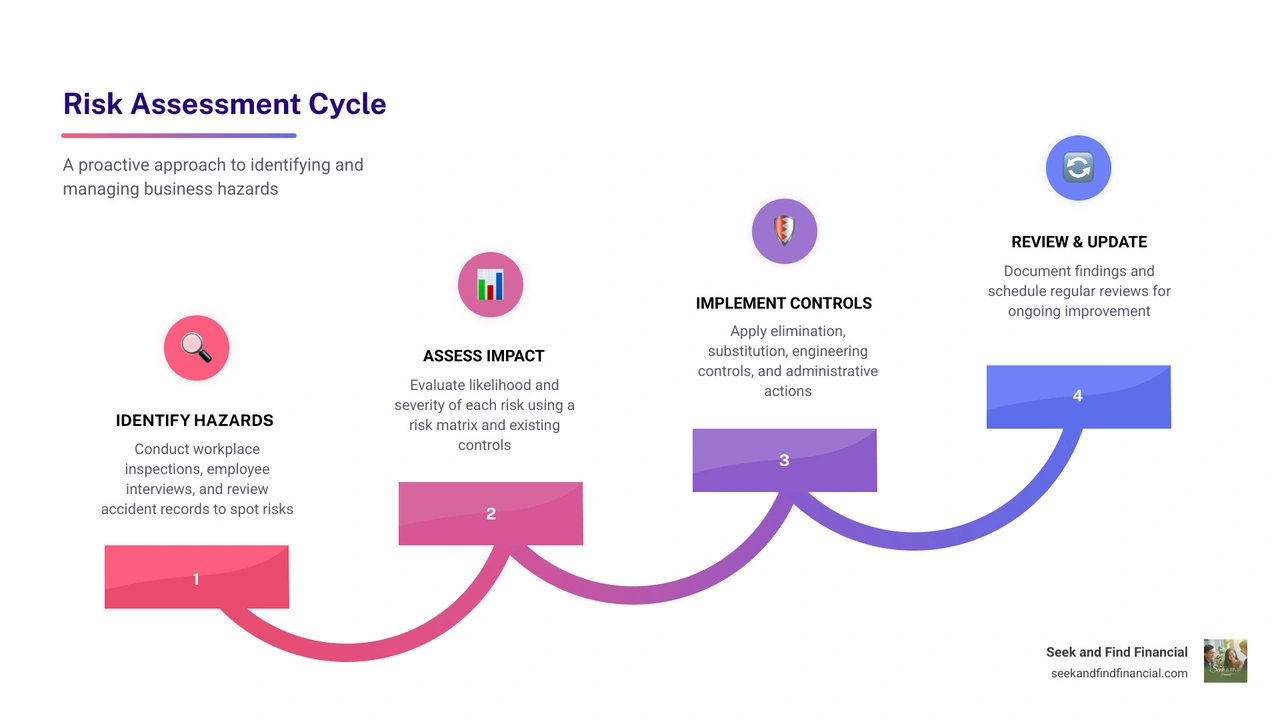
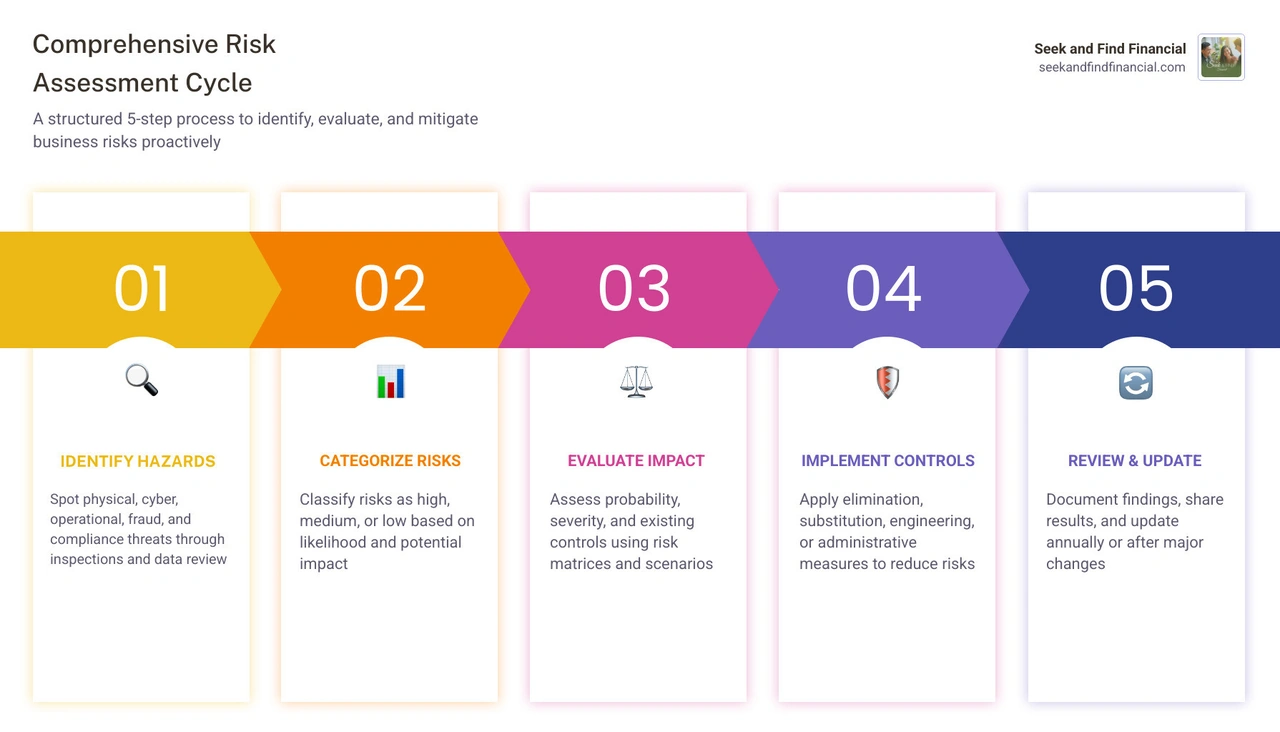
Conducting an assessment does not have to be scary. We break it down into five simple steps. This is a key part of Risk Management for Entrepreneurs.
First, we walk around and look for trouble. We check workplace records and talk to employees. Hazards can be physical, like trip hazards, or health-related, like exposure to chemicals. They can also be human-caused, like a staff member who needs more training.
Once we find a hazard, we ask: who does this hurt? It might be your staff, your customers, or even the people living near your business. We also think about "vulnerable" groups, like people who might have trouble evacuating in an emergency.
Not all risks are equal. We use a risk matrix to see which ones are the most dangerous. We look at the "probability" (how likely it is) and the "severity" (how bad it would be). This helps us focus our money and time on the biggest threats first.
Now we take action. We follow a specific order:
If it is not written down, it did not happen. We document everything for legal reasons and for our own records. We share these results with the team so everyone knows the plan. We also use guides like the Comprehensive Preparedness Guide (CPG) 201, 3rd Edition to make sure our community-level planning is solid.
A risk plan is not a "one and done" document. We review it every year. We also update it if there is a big change, like moving to a new office in Valparaiso or buying new technology.

In 2026, tech risks are everywhere. We look for system failures and data breaches. We also look at how AI might be used against your business. We check your disaster recovery plan to see how fast you can get back online if your systems go down.
Fraud often happens when one person has too much power over the money. We look for "segregation of duties." This means making sure no single person can both approve a payment and send the money. We also watch for changes in your processes that might create new holes for fraud.
A risk matrix is a simple table. It helps us see where to spend our resources.

We use historical data and expert judgment to fill out our matrix. We ask: has this happened before? Could it happen again? If a risk is "high impact" but "low likelihood," we still need a plan, but it might not be our first priority.
There are four main ways to handle a risk:
Many companies fall into the trap of "paper compliance." They fill out the forms but do not actually change anything. This leads to a false sense of security.
An effective assessment needs active participation. It needs the "tone from the top." If the owner does not care about safety, the staff won't either. We want to build a safety culture where everyone feels responsible for spotting hazards.
Modern tools can help us stay safe. We use automated scanning to find tech bugs and predictive analytics to guess where the next problem might be. This makes our data more accurate and our responses faster.
If you have a feeling you are missing something, you probably are. If you have recently changed your policies or had a "near miss" incident, it is time for a full review. Every business in Northwest Indiana or Chicago should have one to stay compliant with local laws.
Everyone should have a voice. Senior leaders set the goals, but front-line staff usually know where the real hazards are. External advisors, like us at Seek & Find Financial, can provide a fresh set of eyes.
We recommend an annual schedule. However, you should also update it after any major incident, a new product launch, or if the government changes the rules for your industry.
At Seek & Find Financial, we believe that a comprehensive risk assessment is the foundation of a good wealth strategy. You work too hard to let an unmanaged risk take away what you have built. Whether you are in Valparaiso, Merrillville, or Chicago, we can help you create a personalized, technology-driven plan that protects your business and your future.
Learn more about our structured planning services
Investing involves risk, including possible loss of principal. No investment strategy can ensure financial success or guarantee against losses. Past performance may not be used to predict future results. Provided content is for overview and informational purposes only, reflect the opinions of the author, and is not intended and should not be relied upon as individualized tax, legal, fiduciary, or investment advice.
This information is being provided only as a general source of information. These views may change as market or other conditions change. This information is not intended and should not be used to provide financial advice and does not address or account for an individual’s circumstances. Past performance does not guarantee future results and no forecast should be considered a guarantee. Please seek the guidance of a financial professional regarding your particular financial concerns.
Investment advisory services offered by duly registered individuals through Seek & find Financial LLC a Registered Investment Adviser. Licensed Insurance Professional