

Strategic Exit Planning: Don't Just Leave, Exit in Style
Plan your exit strategy for founders early: boost value, avoid pitfalls, and exit in style with proven steps for acquisitions, IPOs & more.
An exit strategy for founders is a plan for the future. It shows how you and your team will turn your company shares into cash. Here is a look at your main choices:
One day, a buyer might email you. Or a competitor gets bought. You might just feel tired. Exits feel far away until they are right in front of you.
Most founders only think about an exit when they have to. That is the most expensive way to do it. Research shows that planning early leads to better results. You should start three to five years before you want to sell.
The stakes are high. For many founders, the business is their wealth. Selling it is a big life choice. I am Daniel Delaney. I lead Seek & Find Financial. I have seen how a good plan makes a huge difference. We will walk through every part of that plan. We will look at how to pick your path and protect what you built.
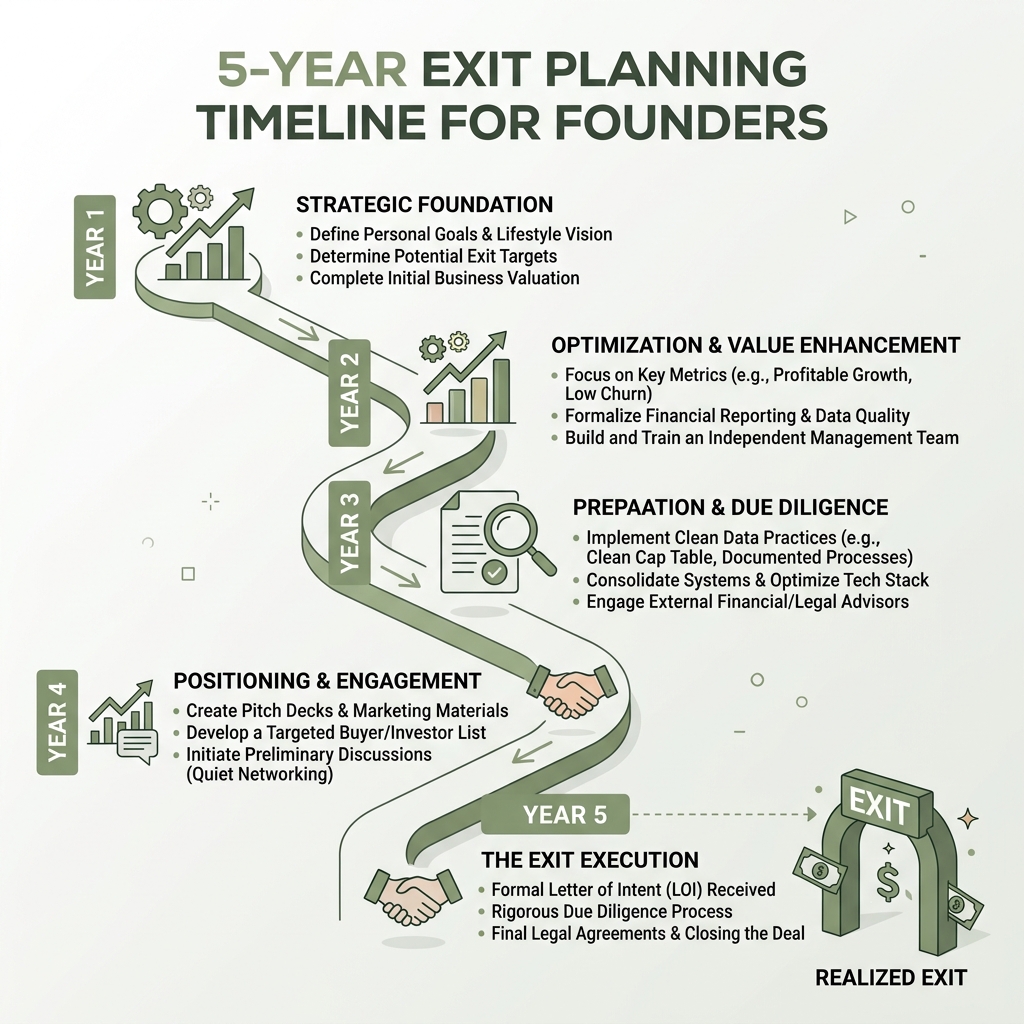

We talk to many business owners who think an exit is far away. They focus on today's sales. But a good plan is about having choices. If you do not have a plan, you might have to sell when the market is down. That is when you lose your power.
You must make sure the business can run without you. If it needs you for everything, it is worth less. Some buyers will pay half as much if you are the only one who knows how to run things. Planning now helps you teach others. This makes your company a better asset.
As Tom Stimson explains in his article on exit planning, you should check your goals early. Talk to your partners. If you wait until you are tired, you lose your best cards.
Thinking about your exit helps you make better choices today. It tells you which customers to pick. It tells you which products to build.
Markets move fast. What is popular now might not be in two years. If you are ready, you can sell when the market is high. If you are not ready, you will miss the chance while you fix your books.
Early planning also lowers risk. We look at your personal money and your business together. We want to make sure your family is safe even if the business has a bad year.
There is no single path for everyone. Most founders want a big sale. But the reality is often more simple.
According to data from the NVCA, acquisitions are much more common than IPOs. Most founders get their money through a sale to another company.
How do you choose? It depends on what you want. Do you want the most money? Or do you want to save jobs?
Some buyers are other companies in your field. They might pay more because your business helps theirs. Other buyers are investment firms. They care most about your cash flow.
For tech firms, price is often based on yearly sales. We help you look at these numbers. We find the path that fits your needs.
A buyer will look closely at your business. They want to see that everything is in good shape.
First, they check who owns the company. If the list of owners is messy, it can scare buyers away. You want a clear list of who owns what.
Your cash is also important. If you are almost out of money, you have no power. But if you have plenty of cash, you can say no to a bad deal. We help our clients keep a close eye on their spending.
The quality of your sales matters too. Buyers love sales that happen every month. They want to know customers will stay. If most of your money comes from just one client, that is a risk. It can lower your sale price.
Secondary sales are good for founders who want to stay for a long time. It can take ten years to sell a whole company. That is a long time to wait for cash.
A secondary sale lets you sell some shares now. Pitchbook-NVCA reports show that secondaries are playing a bigger role as startups stay private longer.
This gives you money to buy a home or pay off debt. It also helps keep employees happy. If they can sell some shares, they might stay longer to help you reach the final goal.
Selling a business is like selling a house. You need to clean it up first.
First, get your money records in order. Your books should be clean and easy to read. A buyer will want proof that your profit is real.
Second, build systems. Write down how everything works. From hiring to sales, it should all be in a guide. This shows the business can run without you.
Third, think about taxes. This is where many founders lose money. You might be able to save millions in taxes if you plan ahead. You have to start this years before you sell.
We help founders with these complex tax and wealth steps. You can learn more about how we help entrepreneurs grow their wealth here. We use tools to show you how your money is doing at any time.
The biggest mistake is waiting too long. Founders often wait until they are too tired. By then, the business might be doing worse. You will not have the energy to fight for a good price.
Another mistake is only looking at the price. A high price with bad rules can be worse than a lower price with good rules. For example, you might get a deal called an earn-out. This means you only get paid if you hit hard goals later. If you do not like the buyer, those years will feel very long.
Do not forget your feelings. Selling your business is hard. Many founders feel lost after a sale. We help you plan for what comes next. You might want a new business. Or you might want to spend time with family. Having a plan for your time is just as important as a plan for your money.
Lastly, do not try to do it alone. You are an expert at your business. But you might only sell a company once. Buyers have teams of experts. You need your own team too. This includes a financial planner, a tax expert, and a lawyer. They help make the deal fair for you.
You should start three to five years before you want to leave. This gives you time to clean up your books. It helps you build a team that can lead without you. It also helps you save on taxes.
IPOs are for very large companies. You usually need at least 100 million dollars in yearly sales. You also need very strong rules and steady growth. Most companies find that selling to another company is faster and easier.
A strategic buyer is another company. They want your business to help their own goals. They often pay more. A financial buyer is an investment firm. They want to buy your business, make it better, and sell it for a profit later.
An exit strategy for founders is not just an ending. It is the goal of all your hard work. By planning early, you leave on your own terms. You keep your future safe.
At Seek & Find Financial, we know your business is a big part of you. We are here to give you clear and practical help. We help you move from being a founder to being financially free. We can help you build a plan that covers taxes and your life after the sale.
Ready to start planning? Let us build a strategy that lets you exit well. Visit us at https://seekandfindfinancial.com/ to learn how we can help you reach your goals.
Investing involves risk, including possible loss of principal. No investment strategy can ensure financial success or guarantee against losses. Past performance may not be used to predict future results. Provided content is for overview and informational purposes only, reflect the opinions of the author, and is not intended and should not be relied upon as individualized tax, legal, fiduciary, or investment advice.
This information is being provided only as a general source of information. These views may change as market or other conditions change. This information is not intended and should not be used to provide financial advice and does not address or account for an individual’s circumstances. Past performance does not guarantee future results and no forecast should be considered a guarantee. Please seek the guidance of a financial professional regarding your particular financial concerns.
Investment advisory services offered by duly registered individuals through Seek & find Financial LLC a Registered Investment Adviser. Licensed Insurance Professional