

The Soloist: How an Independent Personal Financial Advisor Keeps Your Future in Harmony
Discover how an independent personal financial advisor delivers fiduciary advice, transparent fees, and tailored strategies to secure your financial future.
An independent personal financial advisor is a professional who works for you, not for a bank, brokerage firm, or insurance company.
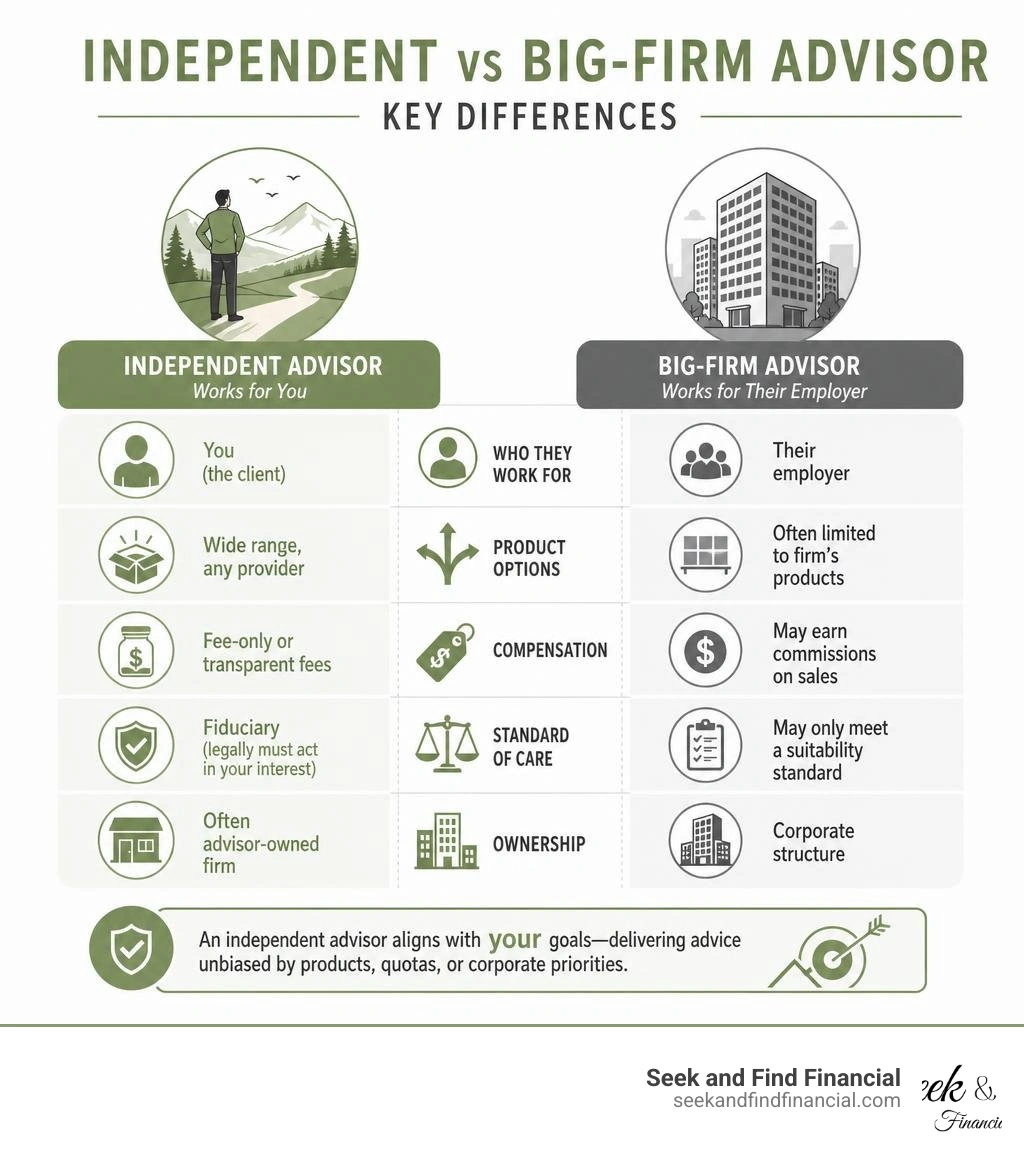
Here is a quick breakdown of what that means:
| Feature | Independent Advisor | Big-Firm Advisor |
|---|---|---|
| Who they work for | You (the client) | Their employer |
| Product options | Wide range, any provider | Often limited to firm's products |
| Compensation | Fee-only or transparent fees | May earn commissions on sales |
| Standard of care | Fiduciary (legally must act in your interest) | May only meet a suitability standard |
| Ownership | Often advisor-owned firm | Corporate structure |
If you earn $400K+ and have a complex financial life, this distinction matters a lot. A generic plan from a big firm is built around their product shelf. An independent advisor builds around your life.
The financial advisory industry holds about 326,000 jobs as of 2024, and the field is growing fast, with a projected 10% increase through 2034. But not all advisors are structured the same way, and the structure behind your advisor shapes every recommendation they make.
I'm Daniel Delaney, Founder of Seek & Find Financial. I spent years inside established financial institutions, including serving clients where investment products were offered through a major brokerage network, and I launched my own independent personal financial advisor practice in 2021 specifically to provide advice without those structural conflicts. That experience on both sides of this divide shapes everything in this guide.
Investing involves risk, including possible loss of principal. No investment strategy can ensure financial success or guarantee against losses. Past performance may not be used to predict future results. Provided content is for overview and informational purposes only, reflect the opinions of the author, and is not intended and should not be relied upon as individualized tax, legal, fiduciary, or investment advice.
This information is being provided only as a general source of information. These views may change as market or other conditions change. This information is not intended and should not be used to provide financial advice and does not address or account for an individual's circumstances. Past performance does not guarantee future results and no forecast should be considered a guarantee. Please seek the guidance of a financial professional regarding your particular financial concerns.
Investment advisory services offered by duly registered individuals through Seek & Find Financial LLC a Registered Investment Adviser. Licensed Insurance Professional
Easy independent personal financial advisor glossary:

An independent personal financial advisor operates outside the walls of major Wall Street brokerage houses and insurance conglomerates. Traditional advisors at large firms are often registered representatives of a parent broker-dealer. This means their primary legal duty is to their employer. They are often expected to distribute proprietary financial products. These products can include specific mutual funds, annuities, or structured notes.
In contrast, an independent advisor works for an independent Registered Investment Advisor (RIA) firm. They do not have a parent company telling them what products to sell. They use an open-architecture platform. This setup allows them to select investment options from the entire market. They can choose low-fee exchange-traded funds (ETFs), individual stocks, or specialized private assets. Their advice is not tied to a corporate sales quota.
To understand the day-to-day role of these professionals, you can read our Financial Advisor What They Do Guide.
In the local landscape of Northwest Indiana and Chicago, you will find various financial firms. While some firms operate under larger national networks, a truly independent advisor has complete freedom over their business decisions and investment strategies. This structural freedom means they can focus entirely on your personal goals.
The standard of care is the legal rule that guides how an advisor treats you. Many people assume all financial professionals must act in their best interest. Unfortunately, that is not how the financial world works.
Non-independent advisors often operate under the suitability standard. This standard only requires that a recommendation is suitable for you at the time of the transaction. It allows them to recommend a higher-cost product that pays them a larger commission, as long as it fits your basic profile.
Independent advisors who run RIAs are registered with the SEC or state regulators. They are bound by the fiduciary standard. This is a strict legal obligation. It requires them to put your interests ahead of their own at all times. They must disclose all conflicts of interest. They must also keep costs reasonable and transparent.
Working with a fiduciary provides peace of mind. It removes the guesswork from financial advice. You do not have to wonder if your advisor recommends an investment because it is good for you or because it pays them a hidden bonus.
This standard is particularly important for high earners in our communities, from Portage and Hebron to Merrillville and Crown Point. When you are managing significant assets, even small conflicts of interest can cost you thousands of dollars over time.
Choosing a Certified Financial Advisor who is also a committed fiduciary ensures your planning is built on trust. This standard protects your wealth from hidden sales charges and aligned corporate interests.
How you pay your advisor affects the advice you receive. Traditional brokerage models rely heavily on commissions. Independent models prefer transparent, fee-based or fee-only structures.
| Fee Model | How It Works | Potential Conflicts |
|---|---|---|
| Fee-Only | You pay a flat fee, hourly rate, or percentage of assets. The advisor receives no commissions. | Very low conflict. Advisor only succeeds when you succeed. |
| Fee-Based | You pay a fee, but the advisor can also earn commissions from selling insurance or investment products. | Moderate conflict. Advisor might favor products that pay commissions. |
| Commission-Only | You pay no upfront fees. The advisor is paid entirely by the companies whose products they sell. | High conflict. Strong incentive to sell products to earn a living. |
Research shows that typical wealth management fees range from 0.25% to 1.00% of assets under management (AUM) annually. However, the true cost depends on the complexity of your situation.
Independent advisors use several modern fee structures to match your needs:
If you are looking for Personalized Financial Planning, a transparent fee structure ensures you only pay for the value you receive. It keeps your advisor focused on growing your wealth, not selling you products.
An independent advisor does much more than manage a stock portfolio. They look at your entire financial life as an interconnected system.

For high-income professionals and business owners, investment management is only one piece of the puzzle. True wealth management requires a coordinated strategy that covers several areas:
If you live in Lake or Porter County, our Merrillville Financial Advisor Guide 2026 offers specific insights into local wealth planning.
Major life events require rapid, smart decisions. If you are selling a business, changing careers, or navigating a divorce, your financial plan must adapt quickly.
Our practice specializes in helping business owners and executives manage these high-stakes moments. For entrepreneurs, business wealth and personal wealth are often tied together. We help you separate those risks and build a stable personal balance sheet.
If you are launching a new venture, our guide for a Financial Advisor for Startups is a great resource. If you are a corporate leader managing complex benefits, our Financial Advisor Executives Guide can help you optimize your compensation.
You should not take an advisor's word for it. You can verify their status using public resources:
When you meet with a prospective advisor, treat it like a job interview. Here are key questions to ask:
For a complete checklist, read our Financial Advisor Consultation Guide 2026.
Because independent advisors are not tied to a parent company's product list, they can recommend a broader range of investment options. They typically build portfolios using low-fee ETFs, institutional mutual funds, and individual securities.
They also use independent third-party custodians to hold your money. This setup adds an extra layer of security. It ensures your advisor never has direct custody of your funds.
Choosing an independent personal financial advisor is about taking control of your financial future. It ensures your planning is built on transparency, personalized strategy, and a legal commitment to your best interests.
At Seek & Find Financial, we combine this independent structure with modern technology. We partner with Altruist, a leading modern custodian built specifically for independent advisors. This technology helps us keep investment costs low, open accounts quickly, and give you clear, real-time tracking of your wealth. We do not offer generic advice. We build custom plans for business owners, executives, and families across Northwest Indiana and Chicago who want real-life financial growth.
If you are ready to build a clear, structured roadmap for your wealth, explore what we do at Seek & Find Financial.
Investing involves risk, including possible loss of principal. No investment strategy can ensure financial success or guarantee against losses. Past performance may not be used to predict future results. Provided content is for overview and informational purposes only, reflect the opinions of the author, and is not intended and should not be relied upon as individualized tax, legal, fiduciary, or investment advice.
This information is being provided only as a general source of information. These views may change as market or other conditions change. This information is not intended and should not be used to provide financial advice and does not address or account for an individual’s circumstances. Past performance does not guarantee future results and no forecast should be considered a guarantee. Please seek the guidance of a financial professional regarding your particular financial concerns.
Investment advisory services offered by duly registered individuals through Seek & find Financial LLC a Registered Investment Adviser. Licensed Insurance Professional