
How to Build a Portfolio That Actually Fits Your Life
Discover personalized investment strategies that fit your life. Ditch 60/40 portfolios, manage taxes, and maximize returns with custom plans.

Personalized investment strategies are portfolios built around your specific goals, risk tolerance, income, timeline, and life situation — not a generic template applied to everyone.
Here is a quick breakdown of what makes a strategy truly personalized:
Most investors are handed a standard plan. A common one is the 60/40 portfolio — 60% stocks, 40% bonds — regardless of who you are or what you need.
For a high-earning business owner with complex income, concentrated assets, and real tax exposure? That generic plan often falls short.
The gap between a generic strategy and a tailored one is not just philosophical. Research shows the average equity fund investor earned 4.88% annually over a 10-year period, while the S&P 500 returned 8.5% — largely due to misaligned strategies and reactive behavior.
A plan built around your actual life closes that gap.
I'm Daniel Delaney, founder of Seek & Find Financial and a financial advisor with experience at established firms including Riverstone Financial Advisors and Brightway Wealth Management, where I built a deep foundation in portfolio management and personalized investment strategies. In this guide, I'll walk you through exactly how to build a portfolio that fits your life — not someone else's.
Investing involves risk, including possible loss of principal. No investment strategy can ensure financial success or guarantee against losses. Past performance may not be used to predict future results. Provided content is for overview and informational purposes only, reflect the opinions of the author, and is not intended and should not be relied upon as individualized tax, legal, fiduciary, or investment advice.
This information is being provided only as a general source of information. These views may change as market or other conditions change. This information is not intended and should not be used to provide financial advice and does not address or account for an individual's circumstances. Past performance does not guarantee future results and no forecast should be considered a guarantee. Please seek the guidance of a financial professional regarding your particular financial concerns.
Investment advisory services offered by duly registered individuals through Seek & Find Financial LLC a Registered Investment Adviser. Licensed Insurance Professional.
Think of a personalized investment strategy as a custom-tailored suit. You could buy a suit off the rack, and it might stay on your shoulders. But a bespoke suit is measured to your exact frame. It moves with you. It looks better because it was made for you.
In the financial world, the benefits of personalized investment come from looking at your whole picture. We don't just look at how much money you have. We look at your income needs, your net worth, and how much "cash on hand" or liquidity you need for your business or family.
A personalized plan answers questions like:
Instead of a one-size-fits-all model, we select assets that align with your specific life vision. This might include a mix of traditional stocks and bonds, but it could also include specialized holdings that reflect your unique situation.

In the past, true personalization was only for the ultra-wealthy. Today, technology has changed the game. At Seek & Find Financial, we use the Altruist platform to give our clients a level of detail that wasn't possible before.
Technology allows for "direct indexing." This means instead of just buying one big fund, we can own the individual stocks for you. This gives us the power to monitor your accounts daily. If a stock drops, we can see it instantly and decide if there is a tax benefit to selling it. This data-driven approach brings transparency to your wealth. You can see exactly what you own and why you own it.
Every strategy has two sides. The biggest "pro" of a personalized strategy is efficiency. Your money is working specifically toward your goals, not a generic benchmark. It also helps with "behavioral discipline." When you know your portfolio was built for your life, you are less likely to panic when the news cycle gets scary.
However, there are risks to watch out for. Some people try to get too personal by trying to "beat the market" or time their trades perfectly. Research shows that 85% of active managers fail to outperform the S&P 500 index. If a personalized strategy turns into a guessing game about which stock will go up tomorrow, it can lead to market timing traps that actually hurt your returns. The goal is a strategy that fits your life, not one that tries to predict the future.
For decades, the "60/40" portfolio was the gold standard. You put 60% of your money in stocks for growth and 40% in bonds for safety. It was simple. But today, many experts argue that why the 60/40 portfolio may no longer cut it is due to a changing world.
Here is why the generic approach struggles:
| Feature | Generic 60/40 Plan | Personalized Allocation |
|---|---|---|
| Goal Alignment | General Wealth | Specific (e.g., Business Exit) |
| Risk Handling | Fixed | Based on Personal Comfort |
| Tax Efficiency | Low/Standard | High (Tax-Loss Harvesting) |
| Inflation Protection | Moderate | High (Inflation-Adjusted Assets) |
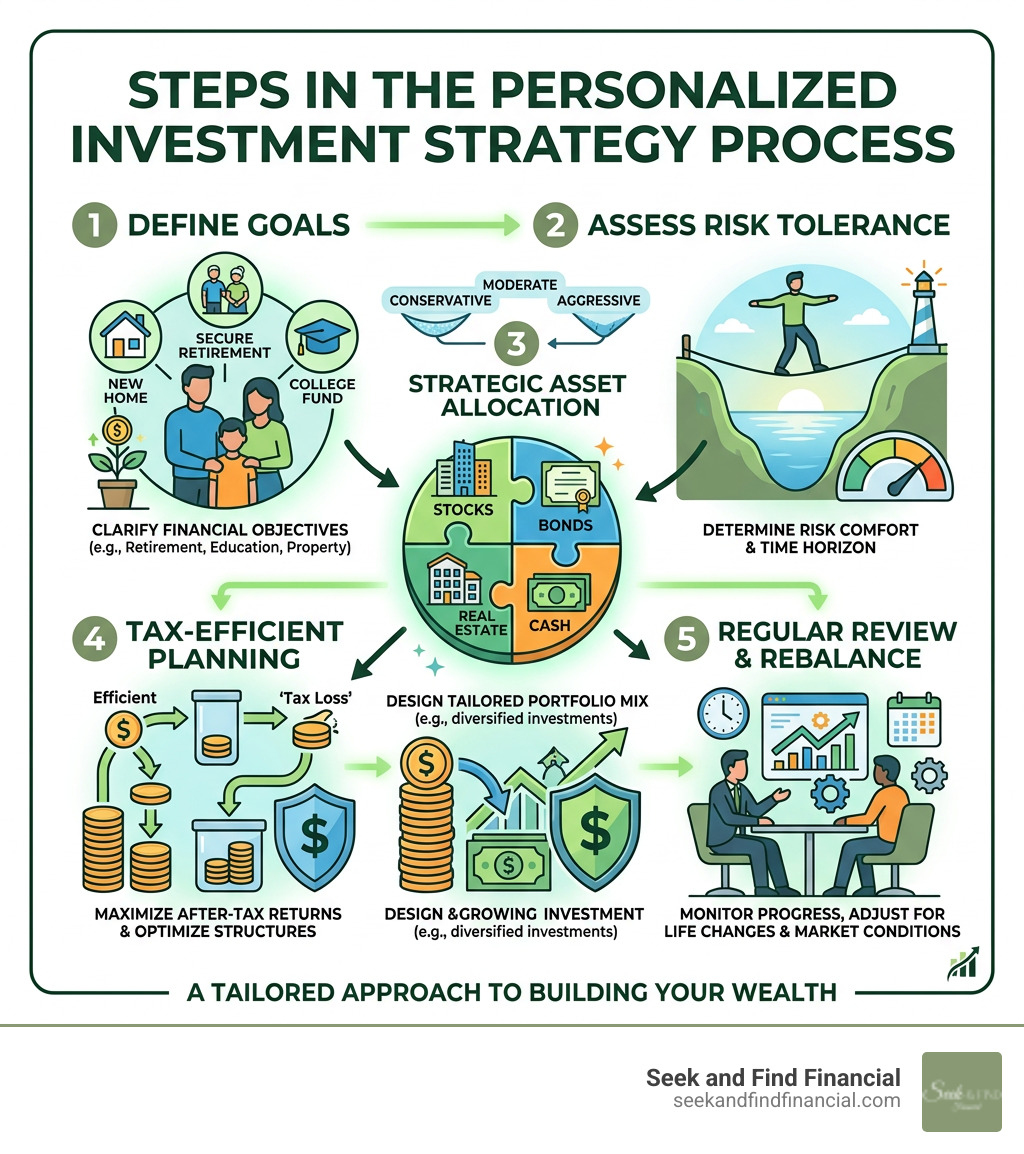
Building personalized investment strategies starts with a deep dive into who you are. We look at several core factors:
It is also important to know your assets are safe. We ensure our clients understand SIPC protection details, which protects the securities and cash in your brokerage account if a firm fails.
Your needs change as you move through life.
A plan is not a "set it and forget it" document. Life happens. You might get married, change careers, or decide to move from the city to the suburbs. Market cycles also change. Sometimes tech stocks are up; sometimes they are down.
We perform regular rebalancing. This means if one part of your portfolio grows too big, we sell a little and move it back to your target mix. Annual reviews ensure that if your life changes, your money changes with it.
It isn't just about what you make; it’s about what you keep. Taxes can be a silent killer for investment returns. Research shows that proper tax management improves returns by up to 1.0% every single year. Over twenty or thirty years, that 1% adds up to a massive amount of money.
We use several strategies to help:
Even with a good plan, it is easy to trip up. Common mistakes include:
A fiduciary advisor is legally required to put your interests first. This is a big deal. It means the advice you get is conflict-free. We aren't trying to sell you a specific product; we are trying to build a strategy that works.
Working with an advisor provides emotional discipline. When the markets in Chicago or across the country get volatile, having an expert to talk to can keep you from making a mistake you'll regret. Firms that prioritize this kind of trust often show up on lists like IBD’s most trusted companies.
We recommend a deep-dive review at least once a year. However, if you have a big life change—like selling a business, receiving an inheritance, or having a child—you should reach out to your advisor immediately to adjust your plan.
Growth investing focuses on companies that are expected to grow at a faster rate than the rest of the market. They are exciting but can be risky. Value investing is like bargain hunting. You look for solid companies that the market has undervalued. A good personalized strategy often uses a mix of both.
Inflation is the "hidden tax." If inflation is 4% and your portfolio only grows 3%, you are actually losing money in terms of what you can buy. Personalized investment strategies account for this by including assets that historically keep up with or beat inflation, like certain types of stocks or real estate.
Building a portfolio that fits your life isn't about finding a "magic" stock. It is about structured planning and long-term stability. It is about knowing that every dollar you have has a job to do, whether that is funding a retirement in Chesterton or a new home in Portage.
At Seek & Find Financial, we believe in giving you clear financial direction. We use modern tools and personalized thinking to help business owners and families grow their wealth without the stress of generic, "off-the-rack" advice. If you are ready to move past one-size-fits-all investing, we invite you to learn more about what we do.
Investing involves risk, including possible loss of principal. No investment strategy can ensure financial success or guarantee against losses. Past performance may not be used to predict future results. Provided content is for overview and informational purposes only, reflect the opinions of the author, and is not intended and should not be relied upon as individualized tax, legal, fiduciary, or investment advice.
This information is being provided only as a general source of information. These views may change as market or other conditions change. This information is not intended and should not be used to provide financial advice and does not address or account for an individual’s circumstances. Past performance does not guarantee future results and no forecast should be considered a guarantee. Please seek the guidance of a financial professional regarding your particular financial concerns.
Investment advisory services offered by duly registered individuals through Seek & find Financial LLC a Registered Investment Adviser. Licensed Insurance Professional