

Personalized Investment Strategies That Actually Work
Discover a tax efficient investment strategy: asset location, tax-loss harvesting, HSAs, and more to maximize returns and minimize taxes.
A tax efficient investment strategy is a structured approach to growing wealth by legally reducing, deferring, and managing the taxes your portfolio generates each year. Here is a quick summary of how to do it:
Most investors focus on picking the right stocks or funds. That makes sense. But there is a quieter force working against your returns every single year: taxes.
Of all the costs an investor faces, taxes have the potential to take the biggest bite out of total returns. Ordinary income from bonds and cash can be taxed as high as 37%. Short-term capital gains are not far behind. Meanwhile, money lost to unnecessary taxes stops compounding permanently.
For a high-earning business owner or entrepreneur, this gap is even wider. Your income is already taxed heavily. Your investments should not be adding to that burden without a plan.
The good news? You do not need exotic products or complicated schemes. You need a repeatable system built around how the tax code actually works.
I'm Daniel Delaney, founder of Seek & Find Financial, and my background in investment planning and portfolio management at established financial advisory firms gave me a front-row seat to how a well-structured tax efficient investment strategy can meaningfully change long-term outcomes. I have spent my career helping individuals and families keep more of what they earn, and this guide lays out exactly how to do that.
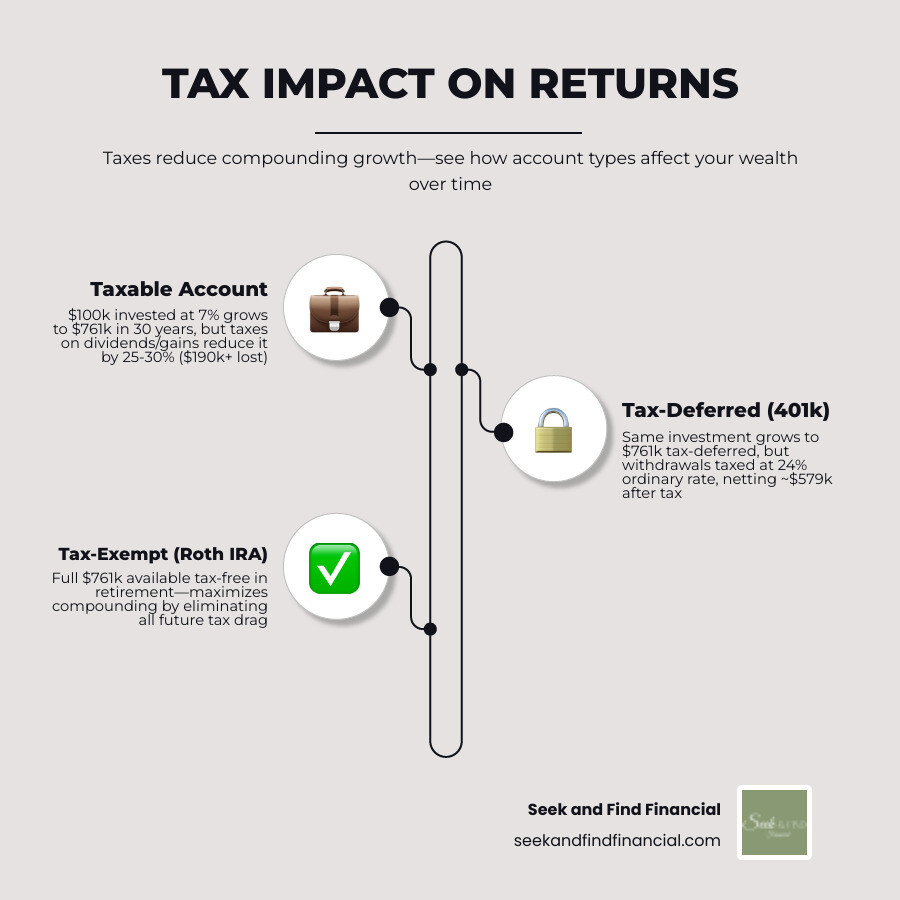
To build a tax efficient investment strategy, we first have to look at where your money lives. Not all accounts are treated the same by the IRS. If you put the wrong investment in the wrong account, you might pay much more in taxes than you need to.
We generally group accounts into three main buckets. Each has its own set of rules for when you pay taxes.
For 2025, the IRS has set new limits for these accounts. The 401(k) contribution limit is $23,500. If you are age 50 or older, you can add a catch up contribution of $7,500. For those aged 60 to 63, a special catch up limit of $11,250 applies. Traditional and Roth IRA limits are $7,000, with a $1,000 catch up for those 50 and older.
Understanding these buckets is the first step in our personalized planning services. By knowing how each account works, we can start to decide which investments belong in which bucket.
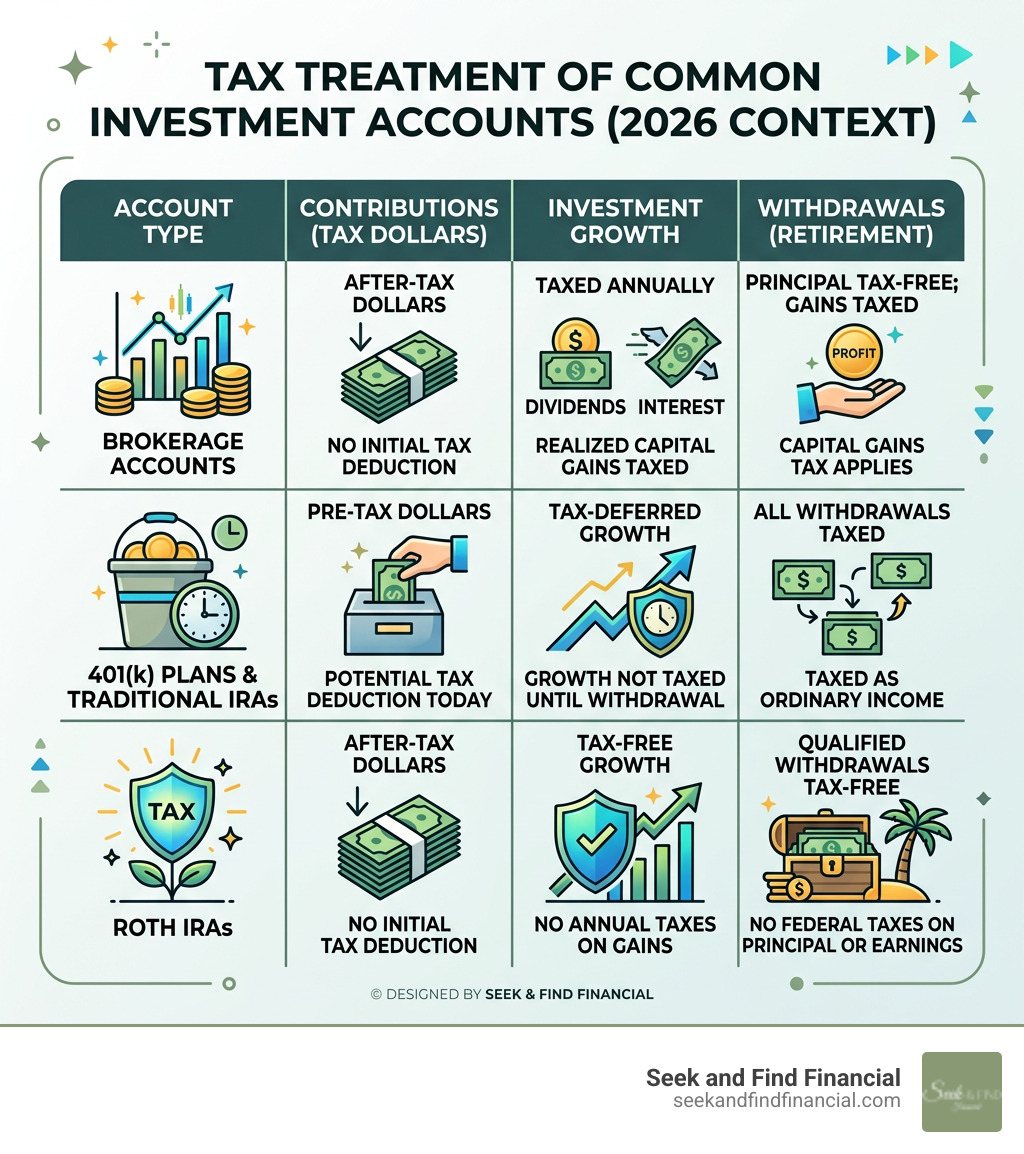
Once you have your accounts set up, the next step is a concept called asset location. This is different from asset allocation. Asset allocation is about what you own (like stocks versus bonds). Asset location is about where those investments live.
Think of your accounts like different colored buckets. You want to put your most "tax-heavy" investments in buckets that shield them from the IRS.
Asset location is a powerful tool because it can boost your returns without adding any extra risk. Research shows that proper asset location can add between 0.14% and 0.41% to your annual returns. Over 20 or 30 years, that adds up to a lot of real wealth.
If you have tax-inefficient investments like Real Estate Investment Trusts (REITs) or high turnover mutual funds in a taxable account, you are losing money to "tax drag" every year. Moving those to a retirement account stops that leak. We use advanced technology to look at your whole portfolio as one system to make sure every asset is in the right spot.
When you sell an investment for more than you paid, you have a capital gain. The IRS looks at how long you held that investment to decide your tax rate. This is a big part of a tax efficient investment strategy.
The IRS Topic on Capital Gains and Losses explains that you can also use your losses to your advantage. This is called tax-loss harvesting. If you have an investment that has dropped in value, you can sell it to "realize" the loss. You can use that loss to cancel out your gains. If your losses are more than your gains, you can use up to $3,000 to lower your regular taxable income each year.
Tax-loss harvesting is great, but you have to follow the rules. The most important one is the wash-sale rule. The IRS does not want you to sell a stock just to get a tax break and then buy it right back.
If you sell a security at a loss, you cannot buy a "substantially identical" security within 30 days before or after the sale. If you do, the IRS will disallow your loss for that year. Instead, the loss gets added to the cost basis of the new shares you bought.
To avoid this, we often look for "substitute" investments. For example, you might sell an S&P 500 fund to capture a loss and immediately buy a Total Stock Market fund. They move similarly, but they are not "identical" in the eyes of the IRS. This keeps your money in the market while still getting the tax benefit.
For entrepreneurs and business owners earning $400,000 or more, standard advice is not enough. You need advanced tactics to keep your tax bill down.
One great option is Municipal Bonds. These are loans you make to local governments, like those in Indiana or Illinois. The interest you earn is usually free from federal taxes. If you live in the state where the bond was issued, it might be free from state and local taxes, too. For someone in a high tax bracket, a tax-free bond can actually put more money in your pocket than a taxable bond with a higher interest rate.
Another tactic is choosing the right investment vehicles. Exchange-Traded Funds (ETFs) are generally more tax efficient than mutual funds. This is because of how they are built. When people sell a mutual fund, the manager often has to sell stocks inside the fund, which creates taxes for everyone. ETFs use a special "in-kind" process that avoids many of these taxes. You can read more in this SEC Bulletin on how ETFs work.
We also look at specialized accounts that offer massive tax benefits.
A tax efficient investment strategy does not stop when you retire. How you take money out is just as important as how you put it in.
The general "spending order" is to take Required Minimum Distributions (RMDs) first, then money from taxable accounts, and finally from tax-deferred accounts. This allows your tax-advantaged money to grow for as long as possible. Under current rules, RMDs start at age 73.
If you are charitably minded, there are even better ways to give. Instead of giving cash, consider donating appreciated stock from your brokerage account. You get a tax deduction for the full value, and you never have to pay the capital gains tax on the growth.
If you are over age 70.5, you can use a Qualified Charitable Distribution (QCD). This allows you to send money directly from your IRA to a charity. This counts toward your RMD but does not show up as taxable income on your return. This is a great way to lower your tax bill while supporting causes you care about in your local community.
The Roth IRA or Roth 401(k) is usually the best place for high-growth assets. Since these accounts are tax exempt, you will never pay taxes on that growth as long as you follow the withdrawal rules. This makes them perfect for stocks you expect to skyrocket over the next 20 years.
Yes. If your total investment losses for the year are more than your total gains, you can use up to $3,000 of the "extra" loss to reduce your ordinary taxable income. If you have more than $3,000 in losses, you can carry the rest over to future years. This is a key part of managing your long term tax bill.
In most cases, yes. Because of the way ETFs are structured, they tend to trigger fewer capital gains distributions than traditional mutual funds. This means you have more control over when you pay taxes. For a taxable brokerage account, an index ETF is almost always a more tax-efficient choice than an actively managed mutual fund.
Building a tax efficient investment strategy is about more than just filing your return in April. It is a year-round system designed to help you keep more of your hard-earned money. By using the right accounts, placing your assets strategically, and using tools like tax-loss harvesting, you can significantly increase your wealth over time.
At Seek & Find Financial, we believe in personalized, technology-driven planning. We do not use generic advice. We look at your specific situation as a business owner or high earner to build a strategy that actually works for your life. Whether you are in Valparaiso, Crown Point, or Chicago, we are here to help you find clarity in your financial journey.
If you are ready to stop letting taxes eat your returns and want a clear strategy for the future, learn more about our services.
Investing involves risk, including possible loss of principal. No investment strategy can ensure financial success or guarantee against losses. Past performance may not be used to predict future results. Provided content is for overview and informational purposes only, reflect the opinions of the author, and is not intended and should not be relied upon as individualized tax, legal, fiduciary, or investment advice.
This information is being provided only as a general source of information. These views may change as market or other conditions change. This information is not intended and should not be used to provide financial advice and does not address or account for an individual’s circumstances. Past performance does not guarantee future results and no forecast should be considered a guarantee. Please seek the guidance of a financial professional regarding your particular financial concerns.
Investment advisory services offered by duly registered individuals through Seek & find Financial LLC a Registered Investment Adviser. Licensed Insurance Professional