

RSUs and ESPPs: A Survival Guide for the Modern Engineer
Master tech financial planning: Decode RSUs, ESPPs, ISOs, taxes, IPOs & AI strategies for engineers. Build wealth wisely!

tech financial planning is one of the most complex areas of personal finance, and most generic advice gets it wrong.
If you landed here looking for a quick answer, here is what you need to know:
The core challenges of financial planning for tech professionals:
Getting these decisions wrong is not just a missed opportunity. It can mean a six-figure tax bill you were not prepared for.
Tech compensation is built differently. Your total pay includes salary, equity grants, vesting schedules, and sometimes an Employee Stock Purchase Plan (ESPP). Each piece has its own tax rules, timing decisions, and risks. And when your company goes public, the stakes get even higher.
A 22% federal withholding rate on your RSUs may sound reasonable until you realize your marginal tax rate is 32% or higher. That gap adds up fast. One engineer earning $400K with $350K in RSUs vesting in a single year could face a surprise federal tax shortfall of over $45,000 just from under-withholding alone.
The complexity does not stop at taxes either. Market volatility, lock-up periods, insider trading rules, and life goals all pull your decisions in different directions at once. Most standard financial planning frameworks were not built for this.
I'm Daniel Delaney, Founder of Seek & Find Financial, and after years of working within established financial institutions before launching my own independent advisory firm, I have seen how costly it is when tech professionals try to navigate tech financial planning without a structured strategy. This guide will walk you through exactly what you need to know.
Investing involves risk, including possible loss of principal. No investment strategy can ensure financial success or guarantee against losses. Past performance may not be used to predict future results. Provided content is for overview and informational purposes only, reflects the opinions of the author, and is not intended and should not be relied upon as individualized tax, legal, fiduciary, or investment advice.
This information is being provided only as a general source of information. These views may change as market or other conditions change. This information is not intended and should not be used to provide financial advice and does not address or account for an individual's circumstances. Past performance does not guarantee future results and no forecast should be considered a guarantee. Please seek the guidance of a financial professional regarding your particular financial concerns.
Investment advisory services offered by duly registered individuals through Seek & Find Financial LLC a Registered Investment Adviser. Licensed Insurance Professional.
When you join a tech company, your offer letter usually includes a mix of stock options or units. Understanding the difference between these is the first step in tech financial planning. Each type of equity has its own rules for when you own it and how the IRS takes its cut.
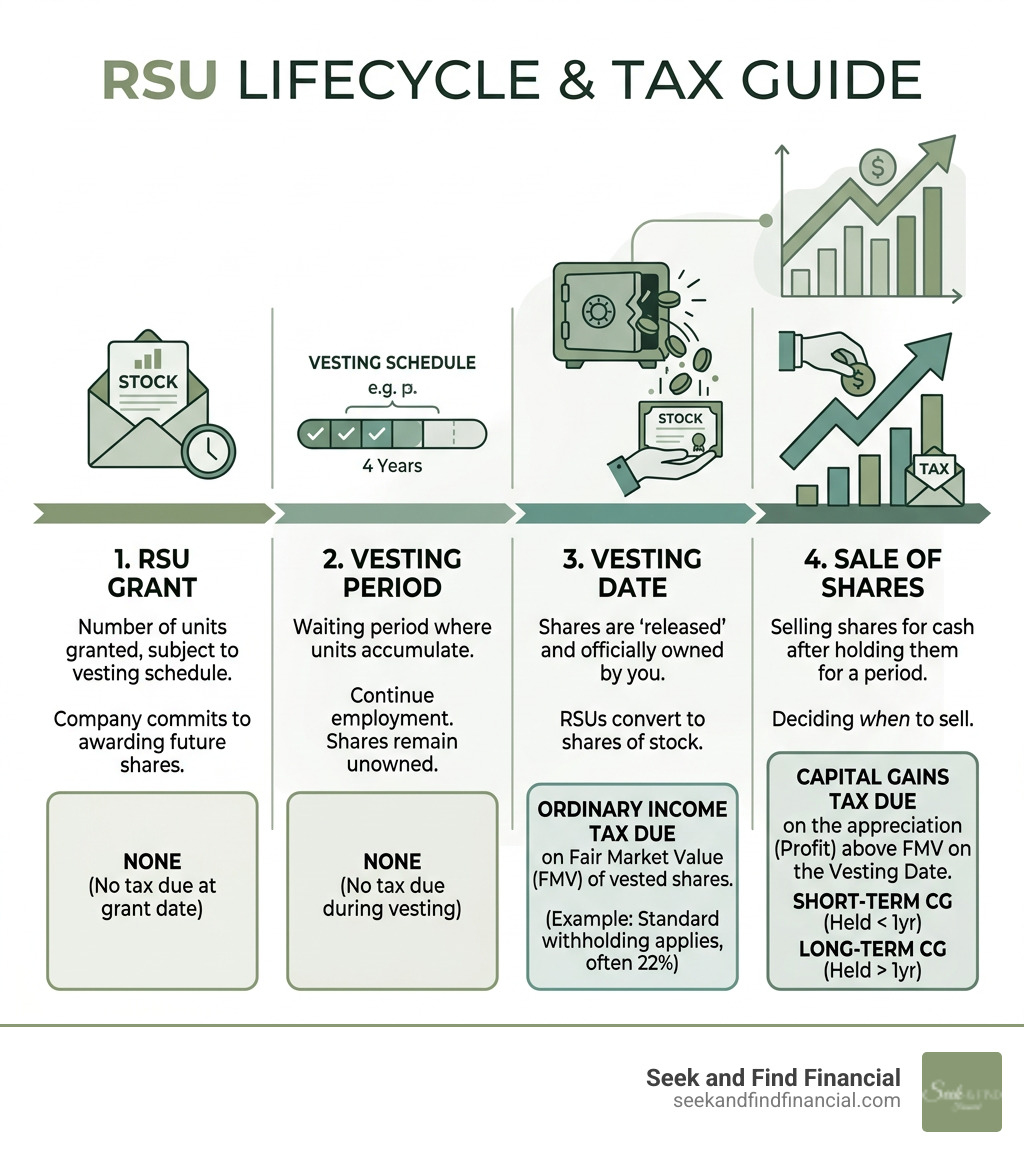
A vesting schedule is the timeline for when you actually earn your shares. Most tech firms use a four-year schedule with a one-year cliff. This means you get nothing if you leave before your first anniversary. After that, shares vest monthly or quarterly.
The grant price is what the stock was worth when you were hired. The Fair Market Value (FMV) is what it is worth today. The difference between these two numbers is where your wealth is built, but it is also where your tax bill starts.
| Feature | RSUs | ISOs | NSOs |
|---|---|---|---|
| Tax at Vesting | Ordinary Income | None | None |
| Tax at Exercise | N/A | Possible AMT | Ordinary Income |
| Tax at Sale | Capital Gains | Capital Gains | Capital Gains |
| Withholding | Required | None | Required |
Restricted Stock Units (RSUs) are the most common form of equity for established tech companies. Think of them as a cash bonus that is paid in company shares. On your vesting dates, the company delivers the shares to your brokerage account.
The moment they vest, they are considered supplemental wages. Your company will usually sell a portion of the shares immediately to cover taxes. This is called a "sell to cover." You receive the net shares, which you can then hold or sell. Because they are taxed as income when they vest, your cost basis for future capital gains is the FMV on the vesting date.
Incentive Stock Options (ISOs) are common in early-stage startups. They give you the right to buy shares at a set price. The "bargain element" is the profit between your low grant price and the current FMV.
ISOs have special tax perks. If you hold the shares for at least two years from the grant date and one year from the exercise date, the entire profit is taxed at lower long-term capital gains rates. However, there is a catch. The bargain element can trigger the Alternative Minimum Tax (AMT) in the year you exercise. This means you might owe taxes on "paper profit" even if you haven't sold any shares yet.
Technology is changing how we manage wealth. In the past, financial plans were static PDF documents that got dusty on a shelf. Today, we use AI and real-time data to make sure your plan stays current with your life.

The demand for these tools is growing. Cerulli Associates projects that $124 trillion will transfer between generations through 2048. This "Great Wealth Transfer" is moving money into the hands of younger, tech-savvy professionals. These individuals expect digital-first solutions that offer transparency and speed.
We use advanced platforms like Altruist to give our clients a clear view of their entire financial life. This includes tracking concentrated stock positions and modeling how a stock price change impacts their long-term goals.
AI helps us move beyond generic advice. Instead of just guessing, we use scenario modeling and Monte Carlo simulations to test thousands of possible market outcomes. This helps us see if your plan can survive a market downturn or a sudden drop in your company's stock price.
According to the Envestnet Affluent Investor Report, younger affluent investors review their net worth regularly. They want to know exactly where they stand. AI allows us to provide this clarity by analyzing behavioral patterns and risk tolerance in real-time. It acts as a bridge, helping us have deeper conversations about what your money is actually for.
Waiting for a quarterly meeting to rebalance your portfolio is a thing of the past. Modern tech financial planning uses automation for tasks like tax-loss harvesting. If a specific investment drops in value, the system can automatically sell it to create a tax benefit and replace it with a similar investment.
This speed is vital when dealing with volatile tech stocks. When your net worth is tied to one ticker symbol, you need instant updates. Automation allows us to manage the boring stuff—like scheduling and data entry—so we can focus on the big decisions that impact your family's future.
Taxes are often the biggest expense for a high-earning engineer. In our experience, the default settings on most payroll systems are not designed for people earning over $400K.
The most common mistake is the 22% federal withholding rate. The IRS requires companies to withhold 22% on supplemental wages like RSUs. But if your total income puts you in the 35% or 37% bracket, you are essentially under-paying your taxes all year long. This leads to a massive bill in April and potential under-payment penalties.
To avoid a surprise tax bill, we recommend doing regular tax projections. If you know you will have a gap, you can increase your withholding on your base salary or make quarterly estimated payments to the IRS.
Year-end strategy is also important. If you have a large vest coming up, you might choose to maximize your 400(k) contributions or look into charitable giving strategies to lower your taxable income. Cash flow planning ensures you have the liquidity to pay the IRS without being forced to sell your stock at a bad time.
The AMT is a "shadow" tax system. It was designed to make sure wealthy people pay at least a minimum amount of tax. For engineers with ISOs, exercising a large number of options can push you into AMT territory.
Before you click "exercise" on your brokerage portal, you must model the impact. You need to know if you have the cash on hand to pay the AMT bill the following year. If the stock price drops after you exercise but before you sell, you could end up owing more in taxes than the stock is actually worth. This is a liquidity event you must plan for months in advance.
An Initial Public Offering (IPO) is an exciting milestone, but it is also a time of high stress. When a company goes public, employees are usually subject to a 180-day lock-up period. During this time, you own the shares, but you are legally barred from selling them.
This period is a psychological rollercoaster. You watch your net worth swing up and down every day on the news, but you can't do anything about it. Price volatility is common right after an IPO as the market tries to find the right value for the company.
We believe that financial planning should be driven by your life goals, not just a stock ticker. Before the lock-up ends, we help our clients define their "why." Are you trying to buy a home in Crown Point or Merrillville? Are you looking for financial independence so you can start your own business?
A values-based plan helps you stay disciplined. Instead of trying to "time the top" of the market, we set specific price targets or dates to sell portions of your stock. This process of diversification reduces your risk. It ensures that even if the company hits a rough patch, your family's core goals are still protected.
For executives or those with access to non-public information, a 10b5-1 plan is a vital tool. This is a pre-scheduled plan to sell stock at set times or prices. Because the plan is created when you do not have "inside information," it provides a legal defense against insider trading claims.
These plans also help with emotional discipline. Once the plan is set, the sales happen automatically. You don't have to wake up every morning and decide whether to sell or hold. It removes the "what if" from the equation and keeps your strategy on track through blackout periods and market swings.
The best way is to be proactive. Do not rely on the default 22% withholding. Work with a professional to run a tax projection mid-year. You can then adjust your W-4 withholding or set aside cash in a high-yield savings account to cover the expected shortfall in April.
Many engineers are not just building their own wealth; they are also set to inherit assets from older generations. This requires a holistic look at estate planning and tax strategy. Managing an inheritance alongside a high-tech salary requires careful coordination to avoid unnecessary tax hits.
Most Employee Stock Purchase Plans offer a 15% discount. This is an immediate gain. For many, the best strategy is to sell the shares as soon as they are purchased. This locks in the 15% profit and allows you to move that money into a diversified portfolio rather than keeping it concentrated in your employer's stock.
tech financial planning is not about finding a "magic" stock pick. It is about building a system that manages taxes, handles volatility, and aligns your wealth with your real-life goals. Whether you are navigating an IPO or managing a steady stream of RSUs, having a structured strategy provides the clarity you need to move forward with confidence.
At Seek & Find Financial, we specialize in helping high-earning professionals in Indiana and Illinois—from Valparaiso to Chicago—make sense of these complex decisions. We use modern technology to build personalized plans that grow with you.
If you are ready to stop guessing and start planning, we invite you to learn more info about our wealth management services. Let's build a strategy that works for your life.
"Investing involves risk, including possible loss of principal. No investment strategy can ensure financial success or guarantee against losses. Past performance may not be used to predict future results. Provided content is for overview and informational purposes only, reflect the opinions of the author, and is not intended and should not be relied upon as individualized tax, legal, fiduciary, or investment advice.
This information is being provided only as a general source of information. These views may change as market or other conditions change. This information is not intended and should not be used to provide financial advice and does not address or account for an individual’s circumstances. Past performance does not guarantee future results and no forecast should be considered a guarantee. Please seek the guidance of a financial professional regarding your particular financial concerns.
Investment advisory services offered by duly registered individuals through Seek & find Financial LLC a Registered Investment Adviser. Licensed Insurance Professional"