

Digital Transformation: Why Your Portfolio Needs a Software Update
Discover the impact of technology on wealth management: AI boosts productivity, hybrid models thrive, and future tech personalizes portfolios. Update yours now!
The impact of technology on wealth management is reshaping how advisors work, how portfolios are built, and how clients experience financial planning. Here is a quick summary of what that means for you:
How technology is changing wealth management:
The shift is not just about new tools. It is about a fundamentally different way of delivering financial advice.
Over 85% of financial institutions have named digital transformation their top strategic priority. Meanwhile, nearly 40% of advisors are expected to retire within a decade. The pressure to adapt is real, and it is happening now.
I'm Daniel Delaney, founder of Seek & Find Financial. My background spans institutional advisory work and independent practice, giving me a hands-on perspective on the impact of technology on wealth management across both large firms and client-first independent models. In this guide, I'll break down exactly what these changes mean for high-earning business owners and families who want their financial strategy to keep pace with a rapidly shifting landscape.
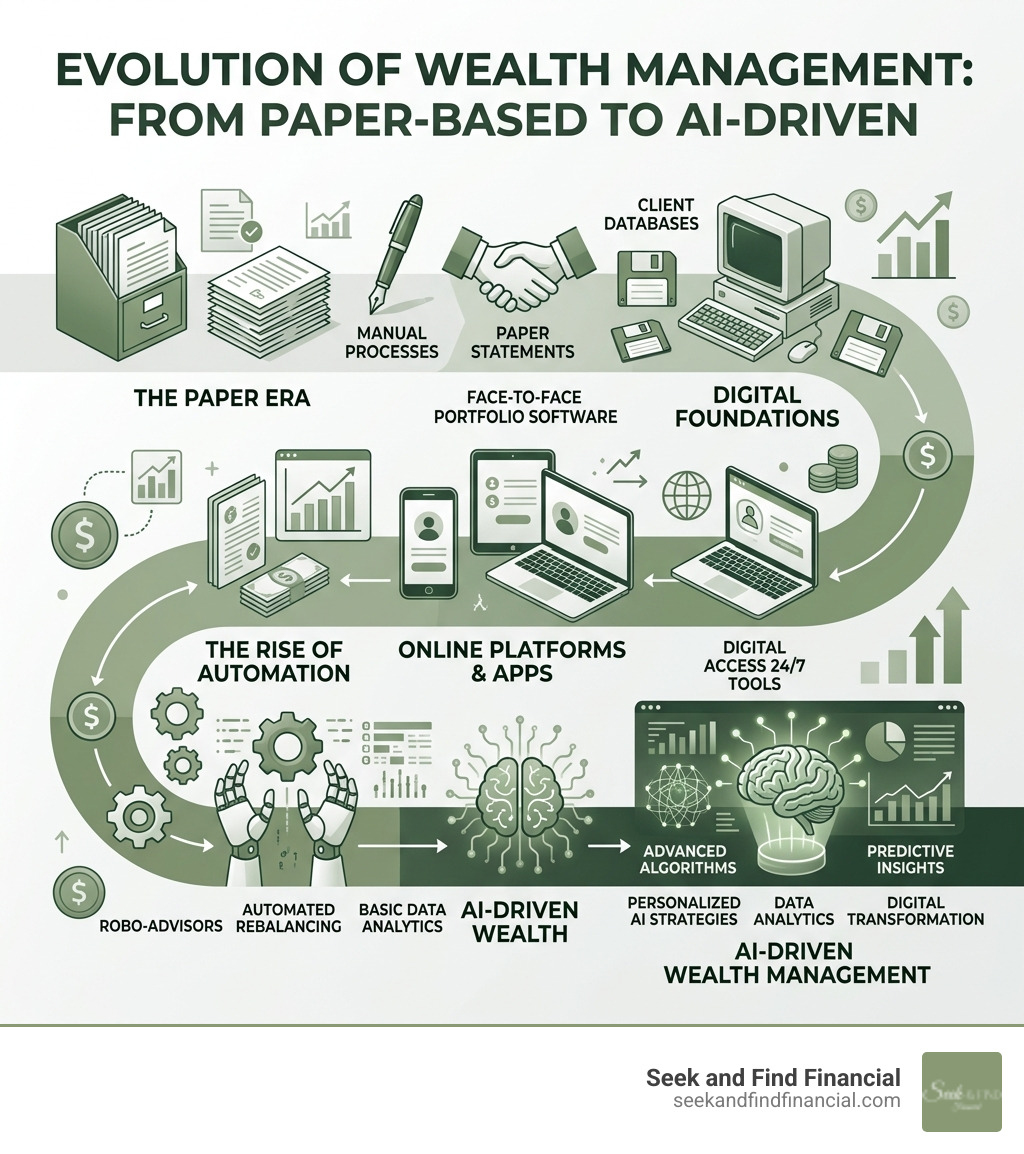
Wealth management used to be a world of paper statements, physical filing cabinets, and annual face-to-face reviews. Today, that world is vanishing. We are seeing a massive shift toward digital-first experiences. This change is driven by a need for speed, accuracy, and better client results.

Modern firms are no longer just investment houses. They are becoming technology hubs. By forming fintech partnerships, firms can access tools that were once only available to the largest banks. This allows independent firms to offer institutional-grade wealth management technology while keeping a personal touch.
According to research on the digital wealth manager of today, this transformation is not just about making things look pretty on a screen. It is about re-architecting the entire back end of the business. When systems talk to each other, advisor productivity goes up. This means we spend less time on paperwork and more time on your strategy.
AI is the engine behind this new productivity. It handles the heavy lifting of data aggregation. Instead of an advisor manually pulling data from three different banks, technology does it in seconds. This creates a "single source of truth" for your net worth.
These partnerships also allow for bespoke investment strategies. In the past, "custom" often meant choosing between three pre-set models. Now, we use software to tailor every detail of a portfolio to your specific tax situation and risk tolerance. Automated workflows ensure that if your portfolio drifts away from its target, it is corrected quickly and accurately.
The back office is where the most significant "quiet" changes happen. Cloud computing has replaced old servers, making data more secure and accessible from anywhere. This is vital for clients in places like Merrillville, Indiana, or Chicago, Illinois, who need to access their plans on the go.
As noted in the Brazilian Journal of Development, digitalization and automation are reshaping how portfolios are managed. Routine tasks like account opening and performance reporting are now seamless. This operational efficiency lowers costs and reduces the chance of human error. It also ensures that your advisor is looking at real-time data, not numbers from last month.
With all this talk about AI, you might wonder if you even need a human advisor. It is a fair question. Robo-advisors can build a basic portfolio for a very low fee. But wealth management is about more than just picking stocks. It is about your life, your family, and your legacy.
The future of financial advice is a hybrid model. This combines the raw processing power of AI with the emotional intelligence of a human. Think of it like a surgeon using a robotic arm. The robot provides precision, but the surgeon provides the judgment. This is the core of strategic wealth management solutions.
Technology is great at math, but it is terrible at context. An algorithm doesn't know that you are worried about your daughter's wedding or that you are considering selling your business in five years. It doesn't understand the nuance of family dynamics or the fear that comes with a market crash.
Research shows that Americans trust advisors more than AI for big decisions. Trust is built on empathy and reliability. While AI can be reliable, it cannot be empathetic. As TechBullion explains, technology cannot replace the "behavioral coaching" that keeps investors from making emotional mistakes during volatility.
Because technology handles the routine tasks, the role of the advisor is evolving. We are moving from being "stock pickers" to being "life coaches" supported by data. We use personalized investment strategies to help you navigate life's big transitions.
Whether you are in Crown Point or Valparaiso, our goal is to use these tools to give you clarity. We look at your whole life, not just your brokerage account. Technology allows us to run "what-if" scenarios instantly. Can you retire early? Can you fund a new business venture? We can show you the impact of those choices in real time, allowing for holistic life management.
The people who own wealth are changing. We are currently seeing the largest intergenerational wealth transfer in history. Gen X and Millennials are set to inherit trillions. At the same time, more women are taking control of household and business wealth. By 2035, women are expected to control over 40% of US wealth.
These new investors have different expectations. They grew up with iPhones and Amazon. They expect their financial experience to be just as smooth. They want customized wealth management that reflects their values and their digital habits. As Lombard Odier points out, UHNWIs (Ultra-High-Net-Worth Individuals) are increasingly using digital tools but still value high-touch human interaction for major decisions.
For entrepreneurs earning $400K+, the stakes are higher. Your wealth is often tied up in your business. You don't need generic advice; you need tax-efficient wealth management.
Technology helps us solve complex problems for business owners. We use advanced software to track business liquidity and plan for exit strategies. We can model the tax impact of selling a company years before it happens. This level of detail ensures that you keep more of what you build. In Northwest Indiana and Chicago, where business ownership is a major driver of wealth, these tools are essential.
The "Portfolio of the Future" looks different than the old 60/40 mix of stocks and bonds. Technology has opened the door to advanced wealth strategies like direct indexing. This allows you to own the individual stocks in an index, which makes it much easier to harvest tax losses and customize your holdings.
We also see technology making alternative assets more accessible. Private equity, real estate, and digital assets are now easier to track and manage within a unified dashboard. This gives you a more robust, diversified portfolio that is built for the long term.
If the last ten years were about mobile apps and robo-advisors, the next ten will be about "Agency." We are moving toward a world of agentic AI. These are AI systems that don't just give advice; they take action.
By 2035, your AI agent might talk to our AI agent to handle routine rebalancing or tax filings. Blockchain technology will likely settle trades instantly, removing the "T+2" waiting period we have today. This will make the private wealth management firm of the future faster and more transparent.
Compliance is one of the most expensive parts of financial services. Technology is changing that through "RegTech." Instead of manual audits, we now have real-time monitoring systems. These tools check every trade and every communication to ensure they meet strict regulations.
According to ScienceDirect, intelligent financial systems are transforming how we manage risk. We can now run thousands of stress tests on a portfolio in seconds. This helps us see how your plan would hold up in a recession or a period of high inflation, giving you peace of mind.
The industry is facing a talent shortage. With nearly 37% of advisors retiring by 2030, firms must use technology to attract new professionals. Young advisors want to work with modern tools, not legacy systems.
By providing digital workstations and automated workflows, firms can help new advisors get up to speed faster. This is crucial for entrepreneur wealth management. It ensures that as older advisors retire, there is a new generation of tech-savvy professionals ready to serve business owners in Hobart, Hebron, and beyond.
Wealth management firms face a big decision: do they build their own technology or buy it from specialists? This is known as the "Build vs. Buy" debate.

Most modern firms, including ours, choose to partner with leading fintech providers like Altruist. This allows us to leverage a massive vendor ecosystem. By using open API integration, we can connect the best tools for planning, taxes, and investing into one seamless experience for you. As Portage Ventures suggests, the "why now" for fintech is driven by the fact that these specialized tools are now better and more affordable than anything a single firm could build on its own.
No. While AI is excellent at processing data and handling routine tasks, it lacks the "Trust Equation." Humans are still needed for empathy, complex life transitions, and behavioral coaching. The most likely future is a hybrid model where AI empowers the human advisor to provide better, faster advice.
The primary risks are data privacy and a lack of transparency. Some AI models are "black boxes," meaning it is hard to see how they reached a conclusion. There is also the risk of algorithmic bias. This is why human oversight is non-negotiable. We must ensure that the technology is acting in your best interest.
Modern platforms are incredibly helpful for high earners. They use automated tax-loss harvesting to offset gains with losses throughout the year, not just in December. They also help with "tax-aware" portfolio construction, ensuring that the most tax-heavy investments are held in the right types of accounts. This is a game-changer for business owners with complex income.
The impact of technology on wealth management is clear. It is making financial planning more precise, more personal, and more proactive. At Seek & Find Financial, we don't view technology as a replacement for our relationship with you. We view it as a tool that allows us to be better stewards of your wealth.
Whether you are a business owner in Valparaiso or a professional in Chicago, you deserve a plan that uses every advantage available. We combine structured planning and long-term strategy with the best tools in the industry to help you grow. Technology gives us the data, but our relationship gives that data meaning.
If you are ready for a financial plan that finally gets a software update, we are here to help. Start your journey with us today and see how personalized, tech-driven planning can change your future.
Investing involves risk, including possible loss of principal. No investment strategy can ensure financial success or guarantee against losses. Past performance may not be used to predict future results. Provided content is for overview and informational purposes only, reflect the opinions of the author, and is not intended and should not be relied upon as individualized tax, legal, fiduciary, or investment advice.
This information is being provided only as a general source of information. These views may change as market or other conditions change. This information is not intended and should not be used to provide financial advice and does not address or account for an individual’s circumstances. Past performance does not guarantee future results and no forecast should be considered a guarantee. Please seek the guidance of a financial professional regarding your particular financial concerns.
Investment advisory services offered by duly registered individuals through Seek & find Financial LLC a Registered Investment Adviser. Licensed Insurance Professional