

Are You Phased Out? Navigating Traditional IRA Deduction Limits
Learn how traditional ira deduction phaseouts affect your 2026 contributions and discover strategies to keep saving for retirement.
Traditional IRA deduction phaseouts are one of the most misunderstood rules in retirement tax planning — and for high earners, the cost of getting it wrong can be significant.
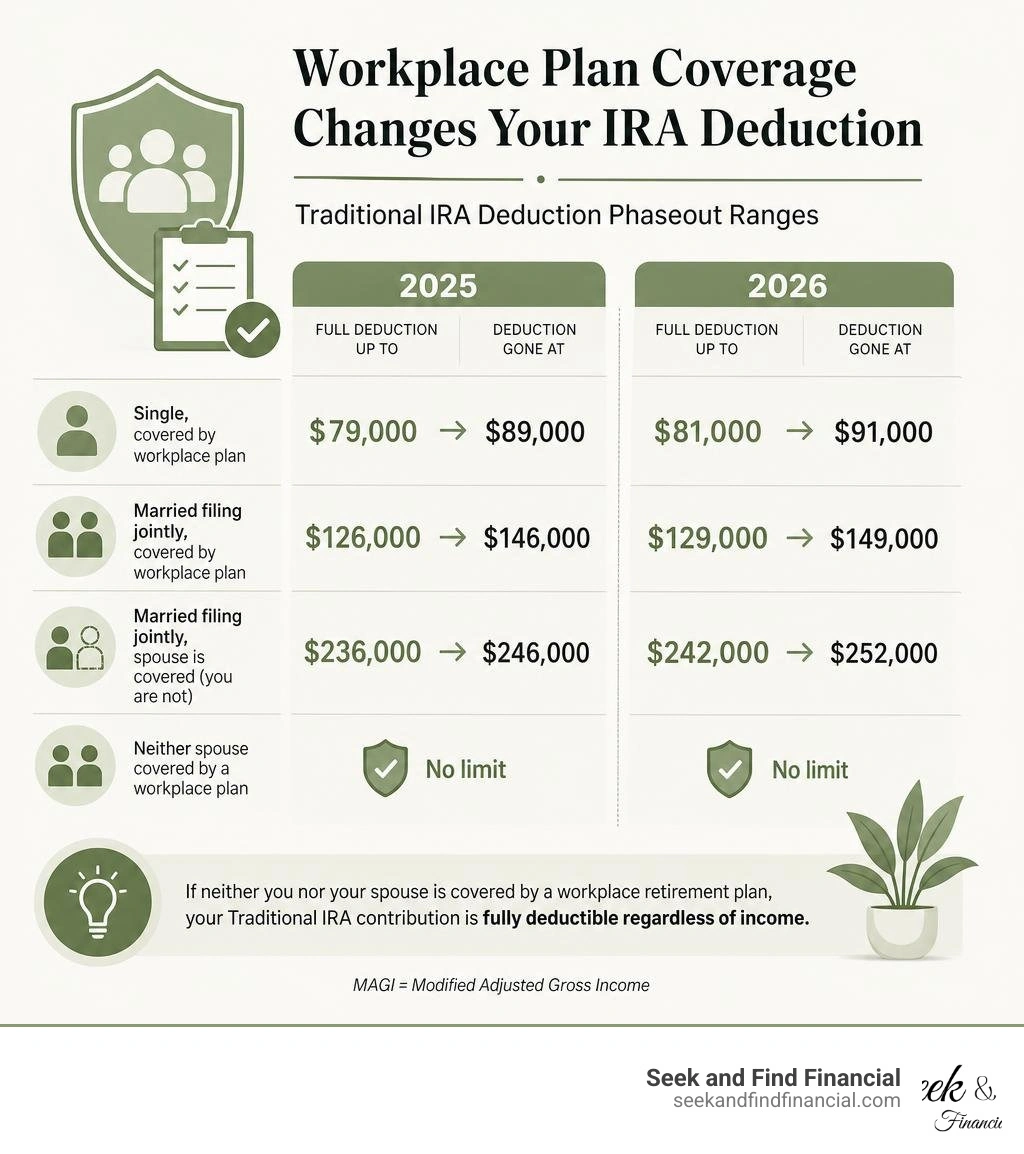
Here is a quick answer based on your situation:
Note: If neither you nor your spouse is covered by a workplace retirement plan, your Traditional IRA contribution is fully deductible regardless of income.
Many people assume they are getting a full tax deduction on their Traditional IRA contribution. They make the contribution, file their taxes, and never realize the deduction quietly disappeared — or shrank — because their income crossed a threshold.
This is especially common for business owners and high earners. You contribute to a Traditional IRA expecting a write-off. But if your income is above certain levels and you or your spouse participates in a workplace retirement plan, the IRS limits how much of that contribution you can actually deduct.
The contribution itself is still allowed. The deduction is what phases out.
Understanding exactly where you stand before you file can save you from overclaiming a deduction — or missing a smarter alternative strategy entirely.
I'm Daniel Delaney, Founder of Seek & Find Financial, and navigating complex planning situations like traditional IRA deduction phaseouts is exactly the kind of work I do with clients who need more than generic advice. In the sections below, I'll walk you through the exact rules, income thresholds, and options available to you.
Investing involves risk, including possible loss of principal. No investment strategy can ensure financial success or guarantee against losses. Past performance may not be used to predict future results. Provided content is for overview and informational purposes only, reflect the opinions of the author, and is not intended and should not be relied upon as individualized tax, legal, fiduciary, or investment advice.
This information is being provided only as a general source of information. These views may change as market or other conditions change. This information is not intended and should not be used to provide financial advice and does not address or account for an individual's circumstances. Past performance does not guarantee future results and no forecast should be considered a guarantee. Please seek the guidance of a financial professional regarding your particular financial concerns.
Investment advisory services offered by duly registered individuals through Seek & Find Financial LLC a Registered Investment Adviser. Licensed Insurance Professional
To understand how deductions work, we must first look at the contribution limits. The IRS sets a hard cap on how much money you can put into an IRA each year. This cap applies across all your personal IRAs combined, whether they are Traditional or Roth.
In 2025, the annual IRA contribution limit was $7,000 for those under age 50. If you were age 50 or older, you could make a catch-up contribution of an extra $1,000, bringing your total limit to $8,000.
For 2026, the IRS adjusted these limits upward to account for inflation. The base contribution limit is now $7,500 for individuals under age 50. If you are age 50 or older, you can add a catch-up contribution of $1,100, which brings your total annual contribution limit to $8,600. You can learn more about these yearly changes in the Traditional IRA Contribution Limits for 2025 - 2026 - Charles Schwab guide.
You must have earned income to contribute to an IRA. Your contribution cannot exceed 100 percent of your earned income for the year. If you only earned $5,000 in 2026, then $5,000 is your personal contribution limit. You can review the official parameters on the Retirement topics - IRA contribution limits | Internal Revenue Service page.
It is also vital to separate the contribution limit from the deduction limit. Anyone with earned income can contribute to a Traditional IRA. However, whether you can write off that contribution on your tax return depends entirely on your income and your access to a workplace retirement plan.
The IRS does not want high earners to double dip on tax-advantaged retirement accounts. If you have access to a retirement plan at work, the IRS starts restricting your ability to deduct your Traditional IRA contributions.
How do you know if you are covered by a workplace plan? The IRS uses the term active participant. You are considered covered if you have access to a plan like a 401k, 403b, SEP IRA, or SIMPLE IRA, and you or your employer put money into it during the year.
The easiest way to check your status is to look at your W-2 form at the end of the year. In Box 13, there is a checkbox labeled "Retirement plan." If that box is checked, you are considered covered. This is true even if you did not personally contribute money to the plan but your employer made a contribution on your behalf.
There is an important exception. A 457b plan does not trigger active participant status. If you only have a 457b plan, you can still claim a full Traditional IRA deduction regardless of your income.
If neither you nor your spouse is covered by a retirement plan at work, the rules are simple. You can deduct your entire Traditional IRA contribution, no matter how much money you make. But if either of you is covered, the traditional ira deduction phaseouts will apply once your income crosses certain levels. You can read the official IRS guidelines on the IRA deduction limits | Internal Revenue Service page.
The IRS adjusts the income thresholds for inflation every year. Your eligibility to deduct your contributions is based on your Modified Adjusted Gross Income, or MAGI, and your tax filing status.
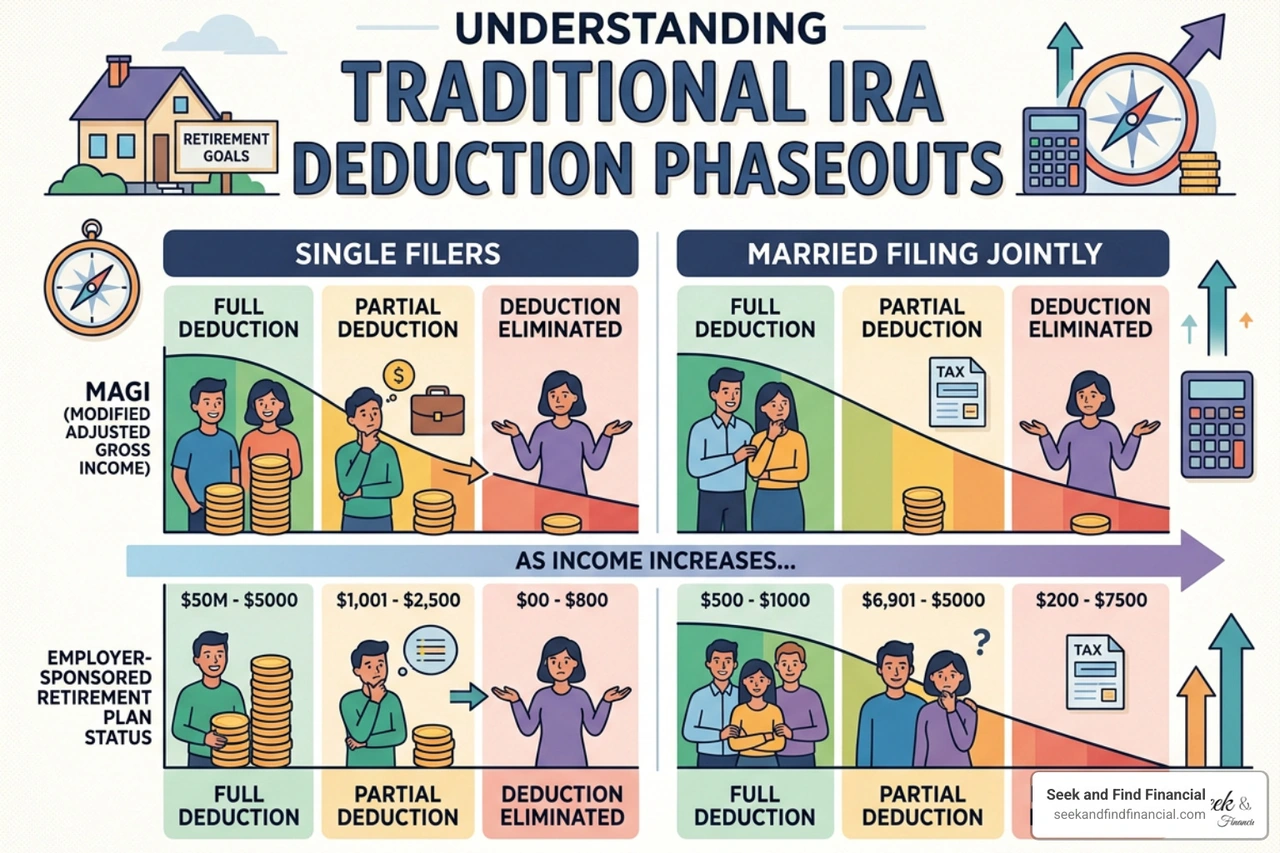
Below is a complete comparison of the phaseout ranges for 2025 and 2026. If your MAGI is below the starting number, you get a full deduction. If your income falls inside the range, you get a partial deduction. If your income is above the top number, you get no deduction at all.
If you file as single or head of household, your deduction limits are lower than those for married couples. In 2025, your deduction began to phase out once your MAGI crossed $79,000. It disappeared entirely once your income reached $89,000.
For 2026, the phaseout range is $81,000 to $91,000. If you earn $80,000, you can deduct your full contribution. If you earn $86,000, you are right in the middle of the range, meaning you will only get a partial deduction. If you earn $92,000, you cannot deduct any of your Traditional IRA contribution.
For professionals living in areas like Chicago or Northwest Indiana, crossing these income levels can happen quickly. If you find yourself in the phaseout range, you must look at other ways to lower your tax bill. You can explore some of these options in our guide on Tax Reduction Strategies.
For married couples filing jointly, the rules depend on who has coverage at work. If you are the spouse making the contribution and you are covered by a workplace plan, the joint phaseout range for 2025 was $126,000 to $146,000. For 2026, this range increases to $129,000 to $149,000.
A special rule applies if you do not have a workplace plan but your spouse does. In this scenario, the IRS gives you a much higher income limit. In 2025, your deduction phased out between $236,000 and $246,000. For 2026, this spousal phaseout range rises to $242,000 to $252,000.
This is a massive planning opportunity for families where one spouse stays at home or works a job without benefits. It allows the non-covered spouse to secure a full tax write-off even at higher household income levels. To see how this fits into a broader wealth plan, read our article on Tax Planning for High Income.
To find out where you fall in the phaseout ranges, you must calculate your Modified Adjusted Gross Income. Many people make the mistake of using their base salary or their Adjusted Gross Income, which is found on Form 1040. Your MAGI is actually your AGI with several specific deductions added back.

To find your MAGI for IRA purposes, start with your AGI and add back the following items:
For most taxpayers, MAGI and AGI are very close, but these add-backs can push you over the line if you are near the bottom of a phaseout range. It is critical to calculate this carefully before making your contribution. You can read the official instructions and find worksheets in the 2025 Publication 590-A and the general Contributions to Individual Retirement Arrangements (IRAs) document.
If you want to run the numbers yourself, you can use interactive tools like the Traditional IRA Deduction Calculator 2026 — Tax47 or the Traditional IRA Calculator | Hebron Savings Bank .
If your income is too high to deduct your Traditional IRA contributions, you still have excellent financial planning options. You do not have to give up on saving for retirement outside of your workplace plan.
First, you can still make a nondeductible contribution to a Traditional IRA. Your money will still grow tax-deferred, meaning you do not pay taxes on dividends or capital gains year after year.
However, if you make a nondeductible contribution, you must file Form 8606 with your tax return. This form tracks your basis, which is the money you already paid taxes on. If you do not file Form 8606, the IRS may tax you again when you withdraw the money in retirement.
Second, you can use the Backdoor Roth IRA strategy. This is a highly popular strategy for high earners. You make a nondeductible contribution to a Traditional IRA, and then you immediately convert those funds into a Roth IRA. Because you did not take a tax deduction on the contribution, the conversion is generally tax-free, provided you do not have other pre-tax IRA assets.
If you have other pre-tax IRAs, the IRS pro-rata rule applies. This rule looks at all your IRAs as one big bucket. If you have a mix of pre-tax and after-tax money, any conversion you make will be taxed proportionally. For a deeper dive into how to execute this without making costly mistakes, check out our Roth IRA for High Earners Guide and our Tax Efficient Investment Strategies Guide.
Yes. There are no income limits on your ability to make a contribution to a Traditional IRA. The income limits only dictate whether you can deduct that contribution on your tax return. If you are phased out, you can still put up to $7,500 (or $8,600 if you are 50 or older in 2026) into a Traditional IRA as a nondeductible contribution. Your money will grow tax-deferred until you make withdrawals in retirement.
If you file a joint tax return and you are not covered by a workplace retirement plan, but your spouse is, you can still make a fully deductible Traditional IRA contribution as long as your joint MAGI is under $242,000 in 2026. The deduction phases out completely once your joint MAGI reaches $252,000. This spousal IRA rule allows non-working or non-covered partners to build their own retirement nest egg with a full tax benefit.
If you contribute more than the annual limit, or if you contribute more than your earned income, you have made an excess contribution. The IRS imposes a six percent excise tax penalty every year on the excess amount until it is corrected. To avoid this penalty, you must withdraw the excess contribution plus any earnings it generated before the tax filing deadline (usually April 15 of the following year).
Navigating traditional ira deduction phaseouts is a critical part of building a smart, long-term wealth strategy. If you are a high-income earner or business owner in Chicago or Northwest Indiana, including Valparaiso, Chesterton, Portage, Hebron, Merrillville, Crown Point, or Hobart, generic tax advice is rarely enough.
At Seek & Find Financial, we specialize in helping families and business owners earning $400K+ build personalized, technology-driven financial plans. We use modern platforms like Altruist to help you track your wealth and implement advanced strategies like the Backdoor Roth IRA. If you want to learn more about how we can help you optimize your retirement planning, read our guide on Traditional IRA for High Income Earners.
Investing involves risk, including possible loss of principal. No investment strategy can ensure financial success or guarantee against losses. Past performance may not be used to predict future results. Provided content is for overview and informational purposes only, reflect the opinions of the author, and is not intended and should not be relied upon as individualized tax, legal, fiduciary, or investment advice.
This information is being provided only as a general source of information. These views may change as market or other conditions change. This information is not intended and should not be used to provide financial advice and does not address or account for an individual’s circumstances. Past performance does not guarantee future results and no forecast should be considered a guarantee. Please seek the guidance of a financial professional regarding your particular financial concerns.
Investment advisory services offered by duly registered individuals through Seek & find Financial LLC a Registered Investment Adviser. Licensed Insurance Professional