

Breaking the Piggy Bank: Traditional IRA Early Withdrawal Penalties Explained
Learn how traditional IRA early withdrawal penalties work and discover strategies to avoid the 10% tax.
Traditional IRA early withdrawal penalties can take a serious bite out of your retirement savings — often more than people expect.
Here is the short answer:
If you are a high earner, the cost gets even steeper. A $50,000 early withdrawal could trigger $5,000 in penalties plus thousands more in income taxes — all money that is no longer working for your future.
The IRS designed these penalties on purpose. As IRS Topic No. 557 puts it, the goal is "to discourage the use of IRA distributions for purposes other than retirement." For business owners and high-income earners, breaking that rule early is one of the most expensive financial mistakes you can make.
I'm Daniel Delaney, Founder of Seek & Find Financial, and having spent years advising clients through major financial institutions before building an independent practice, I have seen how traditional IRA early withdrawal penalties can quietly derail even the most disciplined retirement strategies. Understanding these rules before you act is the first step to protecting what you have built.

Investing involves risk, including possible loss of principal. No investment strategy can ensure financial success or guarantee against losses. Past performance may not be used to predict future results. Provided content is for overview and informational purposes only, reflect the opinions of the author, and is not intended and should not be relied upon as individualized tax, legal, fiduciary, or investment advice.
This information is being provided only as a general source of information. These views may change as market or other conditions change. This information is not intended and should not be used to provide financial advice and does not address or account for an individual's circumstances. Past performance does not guarantee future results and no forecast should be considered a guarantee. Please seek the guidance of a financial professional regarding your particular financial concerns.
Investment advisory services offered by duly registered individuals through Seek & Find Financial LLC a Registered Investment Adviser. Licensed Insurance Professional
Know your traditional ira early withdrawal penalties terms:
An Individual Retirement Arrangement (IRA) is an excellent tool for tax-deferred retirement growth. However, accessing your funds too early or failing to take required distributions can trigger costly IRS penalties. The IRS wants you to keep this money saved for your older years. Because of this, they set a clear age line. That line is age 59½.
If you take money out of your traditional IRA before you reach age 59½, you are making an early withdrawal. This action usually triggers a 10% federal penalty tax. This penalty is not the only cost. You must also include the withdrawn amount in your gross income for the year.
For high-income entrepreneurs and business owners, this creates a major tax problem. Traditional IRA contributions are often made to lower your current taxable income. You can read more about how this works in our Traditional IRA Deduction Guide 2026. When you withdraw that money early, you add those funds right back onto your tax bill.
If you are already in a high federal tax bracket, adding a large early withdrawal can push you into an even higher bracket. This means you do not just pay the 10% penalty. You also pay your top marginal income tax rate on every dollar you take out. According to Topic no. 557, Additional tax on early distributions from traditional and Roth IRAs | Internal Revenue Service, the 10% additional tax applies specifically to the part of the distribution that you have to include in your gross income. If you have no basis in the IRA, the entire withdrawal is penalized and taxed.
Taking an early withdrawal from your traditional IRA triggers a double hit to your wallet. First, you face the federal penalty. Second, you face ordinary income taxes. For some people, state and local income taxes also apply.
This double hit can feel like a form of double taxation. It quickly shrinks the actual cash you receive. Let us look at how this works in real life. Suppose you take an early withdrawal of $100,000 to cover a business cash flow need.
The rules are even stricter for certain other retirement plans. If you have a SIMPLE IRA, the early withdrawal penalty is much higher during your first two years of participation. Instead of the standard 10% penalty, you face a steep 25% penalty tax. This two-year clock starts on the first day your employer makes a contribution to your account.
When you take a distribution, your IRA custodian will send you Form 1099-R. This form shows the total amount you withdrew in Box 1. It also shows the taxable amount in Box 2a.
Most importantly, look at Box 7. This box contains a code that tells the IRS what kind of distribution you took. Code 1 means you took an early distribution with no known exception.
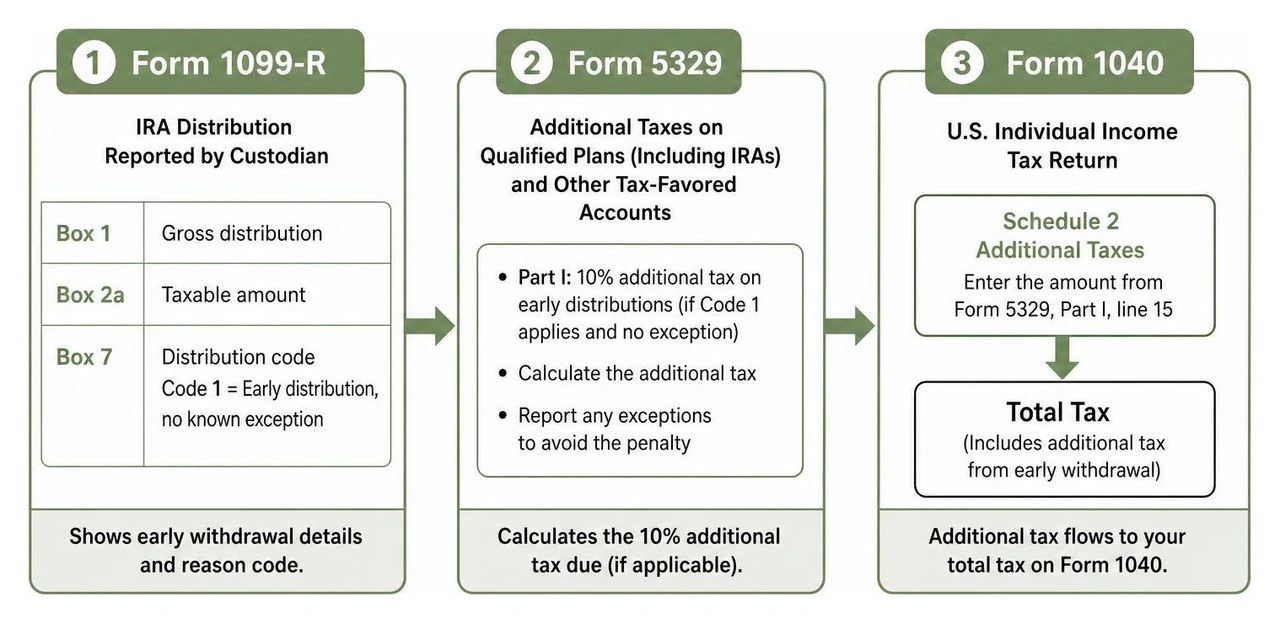
If Box 7 shows Code 1, you must report the 10% additional tax. You do this using IRS Form 5329, Additional Taxes on Qualified Plans (Including IRAs) and Other Tax-Favored Accounts. You then carry this tax over to Schedule 2 of your Form 1040. If your custodian did not identify the correct exception code on your Form 1099-R, but you actually qualify for one, you must file Form 5329 to claim your exemption and avoid the penalty.
To help compare these rules, here is a simple breakdown:
| IRA Type | Standard Early Penalty (Before 59½) | Penalty in First 2 Years of Plan | Tax Treatment |
|---|---|---|---|
| Traditional IRA | 10% | 10% | Ordinary Income Tax |
| SIMPLE IRA | 10% | 25% | Ordinary Income Tax |
| SEP IRA | 10% | 10% | Ordinary Income Tax |
If you want to understand how your contributions affect your taxes before you even think about withdrawals, review our guide on Traditional IRA Deduction Phaseouts.
Fortunately, the IRS recognizes that life does not always go according to plan. There are specific, legally backed exceptions to the 10% early withdrawal penalty.
According to the official Retirement topics - Exceptions to tax on early distributions | Internal Revenue Service, these exceptions let you access your funds penalty-free under certain conditions. However, you will still owe regular income tax on the money you withdraw. There is no exception to the 10% additional tax specifically for general financial hardships. You must meet the exact legal definitions of the exceptions listed below.
These standard exceptions have been in place for many years. They help taxpayers cover major life milestones and unexpected emergencies:
The SECURE Act 2.0 introduced several new exceptions. These rules are fully active for the 2026 tax year:
If you need cash but want to avoid traditional ira early withdrawal penalties, you have a few strategic options. These methods require careful planning and precise timing.
The IRS does not allow you to take a loan from your traditional IRA. However, you can use the 60-day rollover rule as a short-term liquidity tool. Under this rule, you can withdraw funds from your IRA and use them for any purpose. As long as you deposit the exact same amount into another eligible retirement plan or IRA within 60 days, the transaction is treated as a tax-free rollover.
There are two major risks with this strategy:
If you retire early, you can access your traditional IRA funds penalty-free using Substantially Equal Periodic Payments (SEPP) under IRC Section 72(t). This strategy requires you to take a series of annual distributions based on your life expectancy.
You must calculate these payments using one of three IRS-approved methods: the amortization method, the annuitization method, or the required minimum distribution method. Once you start a SEPP plan, you must commit to it. You must continue these payments for at least five years or until you reach age 59½, whichever period is longer. If you modify or stop the payments early, the IRS will retroactively apply the 10% penalty to all the distributions you have already received.
If you are going through a divorce, a court order might require you to split your retirement assets. Simply withdrawing cash from your IRA to pay a former spouse will trigger the 10% early withdrawal penalty and income taxes for you.
To avoid this, you must structure the transaction as a direct trustee-to-trustee transfer or an account name change under IRC Section 408(d)(6). The funds must move directly from your IRA to your former spouse's IRA. This keeps the transaction tax-free and penalty-free for both parties.
If you are looking for other long-term tax strategies, such as moving funds from a tax-deferred account to a tax-free account, you can read about our Roth Conversion Strategy.
No. You cannot take a loan from a traditional IRA. The IRS does not allow IRA loans under any circumstances. If you pledge your IRA as security for a loan, the IRS treats that portion of your account as a distribution. This triggers taxes and the 10% early withdrawal penalty. If you need short-term cash, your only option within an IRA is the 60-day rollover rule. You must return the funds within 60 days to avoid penalties.
The standard early withdrawal penalty is 10%. However, if you take a distribution from a SIMPLE IRA during your first two years of participation, the penalty increases to 25%. After you pass the two-year mark, the penalty rate drops back to the standard 10%. To learn more about setting up and managing these accounts, check out our IRA for Business Owners Complete Guide.
You cannot keep your money in a traditional IRA forever. The IRS requires you to start taking Required Minimum Distributions (RMDs) once you reach a certain age. Under current law, you must start taking RMDs by April 1 of the year following the year you turn age 73. Your custodian must notify you of your RMD amount or offer to calculate it by January 31 of each year. If you fail to take your full RMD by the deadline, you can face a steep IRS excise tax on the amount not distributed.
Navigating traditional ira early withdrawal penalties requires clear, proactive planning. Tapping into your retirement accounts early can feel like an easy fix for short-term cash needs, but the long-term tax consequences are often severe. For high-earning business owners and entrepreneurs, these penalties can wipe out years of disciplined savings and compound growth.
At Seek & Find Financial, we help business owners in Valparaiso, Chesterton, Portage, Hebron, Merrillville, Crown Point, Hobart, and Chicago build personalized wealth strategies. We focus on tax-optimized planning that keeps your retirement assets safe while ensuring you have the liquidity you need for real-life financial growth.
If you are a high-income earner looking for advanced retirement and tax strategies, read our guide on the Traditional IRA for High-Income Earners.
Investing involves risk, including possible loss of principal. No investment strategy can ensure financial success or guarantee against losses. Past performance may not be used to predict future results. Provided content is for overview and informational purposes only, reflect the opinions of the author, and is not intended and should not be relied upon as individualized tax, legal, fiduciary, or investment advice.
This information is being provided only as a general source of information. These views may change as market or other conditions change. This information is not intended and should not be used to provide financial advice and does not address or account for an individual’s circumstances. Past performance does not guarantee future results and no forecast should be considered a guarantee. Please seek the guidance of a financial professional regarding your particular financial concerns.
Investment advisory services offered by duly registered individuals through Seek & find Financial LLC a Registered Investment Adviser. Licensed Insurance Professional