

Why Active ETFs Aren't the Tax Hogs You Thought They Were
Discover active ETF tax efficiency: Beat mutual fund taxes with in-kind trades, low distributions & superior after-tax returns.
Active ETF tax efficiency is far better than most investors expect. Here's the short version:
% paid capital gains (2023)
Average capital gains distribution
% paid capital gains (last 5 years)
Tax trigger on redemptions
Bottom line: Active ETFs distribute capital gains far less often than mutual funds, and when they do, the amounts are smaller.
If you earn over $400K a year, taxes are not a small detail. They are one of the biggest forces working against your long-term wealth.
You have probably heard that active funds are tax inefficient. The idea goes like this: active managers trade a lot, they generate gains, and you get stuck with the tax bill at year-end. It is a fair concern for active mutual funds. But active ETFs work very differently.
In 2022, the S&P 500 dropped 18.1%. That was a brutal year. Yet more than 42% of active mutual funds still sent their investors a capital gains distribution worth an average of 5% of the fund's value. Investors lost money and owed taxes. That is the kind of surprise that quietly destroys compounding over time.
Active ETFs mostly sidestepped that problem entirely. And it is not luck. It is structure.
I'm Daniel Delaney, Founder of Seek & Find Financial and a financial advisor with experience across both large institutional firms and independent practice, where I've guided high-earning clients on active ETF tax efficiency and strategic portfolio construction. My goal here is to cut through the noise and show you exactly how this works.

To understand why active ETFs are so efficient, we have to look under the hood. Most investors think an ETF is just a mutual fund that trades on an exchange. While they look similar on your brokerage statement, their internal plumbing is worlds apart.
When you sell shares of a mutual fund, the fund manager often has to sell stocks inside the fund to get the cash to pay you. If those stocks have gone up in value, a capital gain is triggered. By law, that gain must be shared with every person who still owns the fund. You could be hit with a tax bill just because your neighbor decided to sell their shares.
Active ETFs use a different process called "in-kind" transactions. This is the secret sauce of Tax efficiency of ETFs | J.P. Morgan Asset Management.
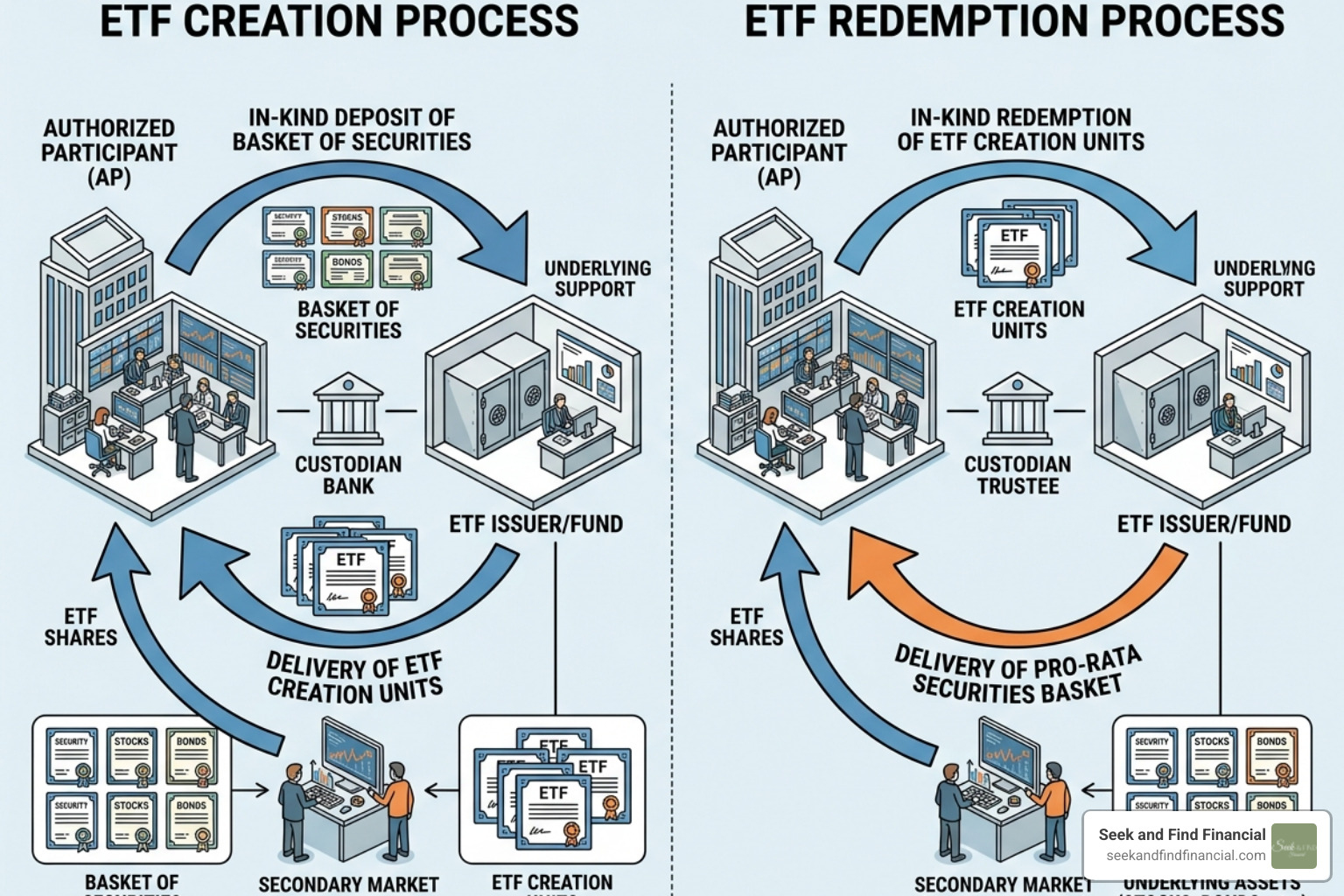
In the ETF world, there are special players called Authorized Participants (APs). When people want to sell their ETF shares, the AP doesn't usually ask the fund manager for cash. Instead, they trade the ETF shares for a "basket" of the actual stocks held by the fund.
This is a "security swap" rather than a sale. Because no cash changes hands and no securities are sold in the open market by the fund itself, no taxable event is triggered for the remaining shareholders.
This process allows the fund to wash away potential tax hits. When the manager needs to send stocks out to an AP, they strategically pick the "low-basis" lots. These are the shares that have gained the most value. By sending those shares out the door through an in-kind swap, the fund gets rid of the looming tax bill without ever "realizing" the gain. This raises the overall cost basis of the remaining portfolio, making the fund even more tax-efficient for the future.
You might worry that an active manager who trades frequently will still trigger taxes. In a mutual fund, high turnover almost always leads to high taxes. In an active ETF, the manager has more tools to manage this.
Active managers can use the daily creation and redemption process to rebalance the portfolio. If they want to reduce a position that has grown too large, they can wait for a redemption and "push out" those specific shares to an AP.
They can also engage in Advanced Tax Strategies like tax-loss harvesting within the fund. If some stocks are down, the manager can sell them to realize a loss, which can then be used to offset any gains that were unavoidable. This flexibility means that even a fund with 50% annual turnover can still result in zero capital gains distributions for the end investor.
The theory sounds great, but the data from 2023 and 2024 proves that this isn't just marketing hype. The gap between these two vehicles is massive, especially for those interested in Tax Strategy For Business Owners.
According to recent data, in 2023, only about 4% of the 1,235 active ETFs in the U.S. paid out any capital gains. Compare that to the 6,710 mutual funds, where 34% sent out a tax bill. The average payout for those few ETFs that did distribute was only 1.9% of the fund's value, while mutual fund payouts averaged 3.6%.

This data from Are Active ETFs Truly More Tax-Efficient? | Morningstar shows that even when the strategy is identical, the ETF structure wins on taxes almost every time. Over the last five years, only 16% of active ETFs have distributed gains, while more than half of active equity mutual funds have.
For a business owner or high-income professional, this 2% to 3% difference in annual tax drag is huge. If you have $1 million in a taxable account, a 3% distribution means $30,000 in taxable income you didn't ask for. At the highest tax brackets, that is roughly $7,000 out of your pocket.
For our clients in places like Valparaiso or Crown Point, we focus on "after-tax alpha." Alpha is the extra return a manager generates above the market. But if a manager gives you 2% alpha and the tax bill takes away 3%, you are actually worse off than if you had just bought a boring index fund.
Active ETFs change the math. They allow you to pursue outperformance while keeping the tax benefits of an ETF. This makes them ideal for taxable brokerage accounts.
When we look at High Net Worth Tax Planning, we use a concept called asset location. This means putting the right investments in the right accounts.
Using active ETFs in a taxable account allows for Tax Efficient Wealth Management that focuses on long-term compounding. You only pay the big capital gains tax when you decide to sell your shares, not when the fund manager decides to sell theirs.
Yes, they can, but it is rare. There are a few scenarios where this happens. If a fund manager needs to sell a large position for cash—perhaps because the market is moving too fast for the in-kind process to keep up—a gain might be triggered.
Also, certain asset classes are harder to manage "in-kind." For example, some international markets or specific types of bonds (like certain mortgage-backed securities) don't allow for easy security swaps. In these cases, the manager has to sell for cash, which can lead to distributions. However, even in these cases, the distributions tend to be smaller than their mutual fund counterparts.
For entrepreneurs in the Chicago area or Northwest Indiana, active ETFs are often a superior choice for surplus business cash or personal taxable accounts. Business owners often have fluctuating income. The last thing you need is a "tax surprise" from your investments during a year when your business already has a high tax bill.
Because active ETFs give you more control over when you realize gains, they fit perfectly into Tax Reduction Strategies. You can hold these funds for decades, letting the value grow without the drag of annual distributions, and then choose to sell in a year when your business income is lower or you have offsetting losses.
It is true that active ETFs usually cost more than passive ones. You might pay 0.40% to 0.75% for an active ETF, compared to 0.03% for a total market index. However, the tax savings often outweigh the higher fee.
If an active ETF saves you 1.5% in annual tax drag compared to a mutual fund, that "tax alpha" more than pays for the management fee. When evaluating these funds, we always look at the net-of-tax return. A slightly higher fee is often worth it if the manager can deliver better performance without the tax headache.
The investment world is changing. The old rule that "active management belongs in an IRA" is being rewritten. Thanks to the structural advantages of the ETF, you can now seek out-of-the-box returns without giving a massive chunk of your growth to the IRS every December.
At Seek & Find Financial, we don't believe in generic advice. We know that for families earning $400K+, every percentage point of tax efficiency matters. Whether you are in Merrillville, Hobart, or Chicago, your wealth deserves a strategy that is as hard-working as you are.
Building wealth isn't just about what you earn; it's about what you keep. By incorporating active etf tax efficiency into a structured, long-term plan, you can take back control of your tax bill and focus on what really matters: your family's future and your long-term goals.
More info about our wealth management services
Investing involves risk, including possible loss of principal. No investment strategy can ensure financial success or guarantee against losses. Past performance may not be used to predict future results. Provided content is for overview and informational purposes only, reflect the opinions of the author, and is not intended and should not be relied upon as individualized tax, legal, fiduciary, or investment advice.
This information is being provided only as a general source of information. These views may change as market or other conditions change. This information is not intended and should not be used to provide financial advice and does not address or account for an individual’s circumstances. Past performance does not guarantee future results and no forecast should be considered a guarantee. Please seek the guidance of a financial professional regarding your particular financial concerns.
Investment advisory services offered by duly registered individuals through Seek & find Financial LLC a Registered Investment Adviser. Licensed Insurance Professional