

High Net Worth Tax Planning 101
Master high net worth tax planning: Beat the 2026 cliff, max retirement, trusts, & real estate strategies for HNWIs.

High net worth tax planning is a way to use legal steps to pay less in taxes. This includes taxes on your income and your investments. It also includes taxes on what you leave to your family. The goal is to keep more of your money for yourself and your loved ones.
Here are the core strategies at a glance:
| Strategy | What It Does |
|---|---|
| Maximize retirement accounts | Reduce taxable income now; grow tax-deferred |
| Tax-loss harvesting | Offset capital gains with investment losses |
| Roth IRA conversion | Pay taxes now for tax-free growth later |
| Charitable giving (DAF, QCD) | Deduct donations; avoid capital gains |
| Irrevocable trusts (IDGT, GRAT, SLAT) | Remove assets from taxable estate |
| 1031 exchange | Defer capital gains on real estate sales |
| Municipal bonds | Earn tax-exempt interest income |
| QSBS exclusion | Exclude up to $15M in startup gains |
If you earn over $400,000 a year, you are likely in a high tax bracket. This means for every extra dollar you earn, you keep less than 63 cents. Without a plan, you lose a lot of money over time.
Right now, the stakes are high. Big tax law changes are coming in 2026. These changes create new chances to save money. But you must act before the window closes.
Most high earners do not have a tax problem. They have a tax planning gap.
I am Daniel Delaney. I am the founder of Seek & Find Financial. I spent years working at big banks. I learned how to manage money and taxes together. Now I use that experience to help business owners and families. In this guide, I will show you the strategies that matter most right now.
When you make a lot of money, the IRS takes a big part of it. In places like Valparaiso or Chicago, taxes can be very complex. We think a good plan should help you keep more of your hard-earned money. This starts with knowing the IRS tax inflation adjustments for 2024.
One great tool is municipal bonds. These are loans you make to local governments. The interest you earn is usually free from federal tax. If you live in the same state, it might be free from state taxes too. This is very helpful for people in high tax brackets.
We also look at where you keep your investments. This means putting the right assets in the right accounts. For example, we might put stocks in one account and bonds in another. This helps lower your yearly tax bill.
Another concern is the Net Investment Income Tax. This is an extra tax on investment income for high earners. We can help lower this cost by managing when you take gains.

Retirement accounts are not just for the future. They help with high net worth tax planning today. For 2025, the IRS 2025 contribution limits for 401(k) plans have gone up to $23,500.
If you are 50 or older, you can add more money. There is even a new catch-up for those aged 60 to 63. This lets you save up to $34,750 in your 401(k) for 2025. For business owners, the total limit can be as high as $70,000.
We also use the Backdoor Roth IRA. High earners often make too much to use a Roth IRA directly. But you can put money in a traditional IRA and then move it. This lets your money grow tax-free forever.
Do not forget the Health Savings Account. We call this a triple tax win.
Investing is not just about picking winners. It is also about how you handle the losers. Tax-loss harvesting is a way to turn a market dip into a tax win.
When an investment drops in value, we can sell it. You can use this loss to cancel out your gains. If your losses are more than your gains, you can use up to $3,000 to lower your regular income tax. Any extra loss can be used in future years.
You must be careful of the wash-sale rule. This rule says you cannot buy the same stock within 30 days before or after the sale. If you do, the IRS will not let you take the loss. We help you find similar but different investments to stay on track.
We also use efficient investments. Using ETFs and index funds is often better than active funds. Active funds often create surprise tax bills. ETFs are built to avoid these extra costs.
Wealth is not just for your life today. It is also about what you leave for your children. Good planning helps you give money to the next generation with fewer taxes.
The annual gift limit is a simple tool. In 2025, you can give $19,000 to as many people as you want. You do not have to pay a gift tax on this money. A married couple can give $38,000 to each person. This is a smart way to shrink your taxable estate over time.
For larger estates, we use special trusts. A Spousal Lifetime Access Trust lets one spouse put money in a trust for the other. This takes the money out of your estate. But your family can still use it.
A Grantor Retained Annuity Trust is another choice. You put assets into a trust for a set time. You get a payment back each year. If the assets grow fast, the extra growth goes to your heirs tax-free.
An Intentionally Defective Grantor Trust is a powerful tool. You still pay the income taxes on what the trust earns. This is good because it lets the trust grow without being cut by taxes. Paying the tax is like giving an extra tax-free gift to your heirs.
These trusts let you keep control while giving up ownership. You can manage the assets, but they are not part of your taxable estate. This freezes the value of your estate for tax purposes.
We also focus on the step-up in basis. When you pass away, your heirs get a new cost basis for your assets. If you bought a stock for $10 and it is worth $100 when you die, your heirs can sell it for $100 and pay zero tax. We help you decide which assets to keep for this big tax break later.
Giving back is important to many of our clients. We help you do it in a way that helps your taxes too. A Donor-Advised Fund is like a personal savings account for charity. You put money in today and get a tax break right away. You can then choose which charities get the money later.
We often use a bunching strategy. Instead of giving $10,000 every year, you might give $50,000 in one year to your fund. This helps you get a bigger tax break.
If you are over 70.5, you can use a Qualified Charitable Distribution. This lets you send up to $108,000 per year from your IRA to a charity. This counts toward your required withdrawal but does not count as taxable income.
Giving stocks that have gone up in value is also better than giving cash. You get a tax break for the full value. You also avoid the taxes you would have paid if you sold the stock.
Real estate has some of the best tax breaks. For our clients in Crown Point or Merrillville, we often use a 1031 exchange. This lets you sell a property and buy a new one without paying taxes right away. You can wait to pay those taxes later.
Cost segregation is another great tool. It lets you find parts of a building that wear out fast. This includes things like carpets or lights. You can take a big tax deduction for these items early on. This creates a large tax break in the first years you own a building.
For business owners, the Qualified Small Business Stock rule is a big deal. You might be able to avoid taxes on up to $15 million when you sell your business. This only works for some businesses. You must also hold the stock for five years.
The way your business is set up changes your taxes. Many clients use LLCs or S-corps. These let you take a special deduction. You can deduct up to 20% of your business income from your taxes.
However, C-corps are popular again. They have a flat tax rate of 21%. This can be lower than the top individual rate. We help you run the numbers to see which setup fits your goals.
Succession planning is also part of high net worth tax planning. We want to make sure the tax bill does not hurt what you built. At Seek & Find Financial, we use Altruist technology to show you all your wealth in one place. This helps us make better decisions together.
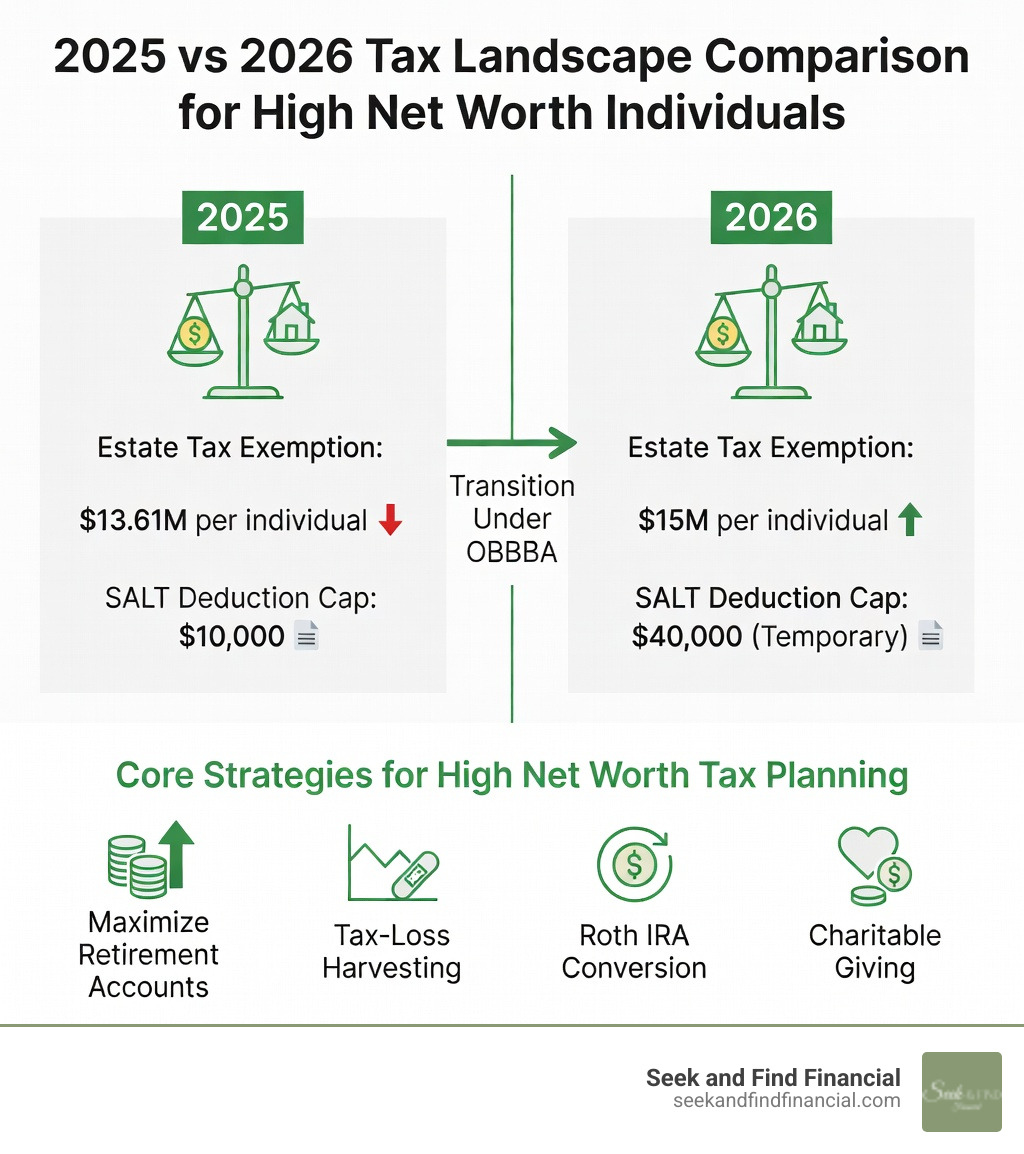
We are entering a very important time for taxes. A new law called the OBBBA has changed things. For 2025, the limit for state and local tax deductions is now $40,000. This is good news for people in high-tax areas like Chicago.
The biggest change comes in 2026. Current tax rules were going to end. But the new law makes the high estate tax limits permanent. The limit is now $15 million for one person. It is $30 million for a couple. This makes it easier to plan for the long term.
| Tax Feature | 2025 Rules | 2026 and Beyond (OBBBA) |
|---|---|---|
| Estate Tax Exemption | ~$13.99 Million | $15 Million (Indexed for Inflation) |
| SALT Deduction Cap | $40,000 | Inflation Adjusted |
| Top Income Tax Rate | 37% | TBD (Likely remains high) |
| QSBS Exclusion | Up to $10M | Up to $15M or 10x Basis |
As the year ends, we look at a few key moves. We check your investments to see if we can lower your taxes. We make sure you put as much as you can into your retirement accounts. We also look at the gifts you gave this year.
Advanced plans do have some risks. You must keep very good records. If you do not follow the rules, the IRS might audit you. This is why we act like a CFO for our clients. We work with your tax person and your lawyer. We make sure everything is done the right way.
We also look at special options like Opportunity Zones. If you have a big gain, you can put it into a special area to lower your taxes. Some people also use Private Placement Life Insurance. This lets you invest in many things without paying taxes on the growth.
In 2025, the highest tax rate is 37 percent. This is for people who make a lot of money. You might also have to pay an extra tax on your investment income.
The wash-sale rule stops you from selling a stock for a tax loss and buying it right back. You must wait at least 30 days to buy the same stock again. If you do not wait, you cannot use the loss to lower your taxes.
A Roth conversion lets you move money to a Roth IRA. You pay taxes on the money now. Then it grows tax-free forever. This is good if you think tax rates will go up later. It also means you do not have to take money out when you get older.
At Seek & Find Financial, we know that tax planning is not a one-time job. It is something you must do all the time. Your life changes and the tax laws change too. Our goal is to help you see your path clearly. We want to help you grow your wealth for a long time.
We do not give generic advice. We focus on your real goals. We use modern tools to help you get there. If you want a plan made just for you, we are here to help.
Investing involves risk, including possible loss of principal. No investment strategy can ensure financial success or guarantee against losses. Past performance may not be used to predict future results. Provided content is for overview and informational purposes only, reflect the opinions of the author, and is not intended and should not be relied upon as individualized tax, legal, fiduciary, or investment advice.
This information is being provided only as a general source of information. These views may change as market or other conditions change. This information is not intended and should not be used to provide financial advice and does not address or account for an individual’s circumstances. Past performance does guarantee future results and no forecast should be considered a guarantee. Please seek the guidance of a financial professional regarding your particular financial concerns.
Investment advisory services offered by duly registered individuals through Seek & find Financial LLC a Registered Investment Adviser. Licensed Insurance Professional