

Mastering Your Money: Financial Strategies for Business Owners and Founders
Master business owner financial planning. Align finances, manage cash flow, optimize taxes, and plan your exit for lasting wealth.
Business owner financial planning is the strategic process of aligning your company's financial operations with your personal wealth goals to build sustainable success and prepare for a profitable exit. For most business owners, their company represents 60-80% of their total net worth, making integrated financial planning essential rather than optional.
Quick answer for business owners:
Many people dream of owning a business, but properly managing one takes more than hard work. Your financial decisions in your 30s and 40s are critical, as life transitions equal money transitions. Yet business owners face unique challenges: inconsistent income, wealth concentration in a single asset, personal liability exposure, and the burden of managing both business operations and personal wealth simultaneously.
The good news? Strategic financial planning can transform these challenges into opportunities. By implementing the right systems for cash flow management, tax optimization, risk mitigation, and exit planning, you can build a business that supports your ideal life—not one you're desperate to retire from.
This guide walks you through the essential components of comprehensive financial planning custom specifically for business owners earning $400K+ annually. You'll learn how to align your business and personal goals, protect your assets, minimize taxes, and ultimately create the financial freedom you've been working toward.
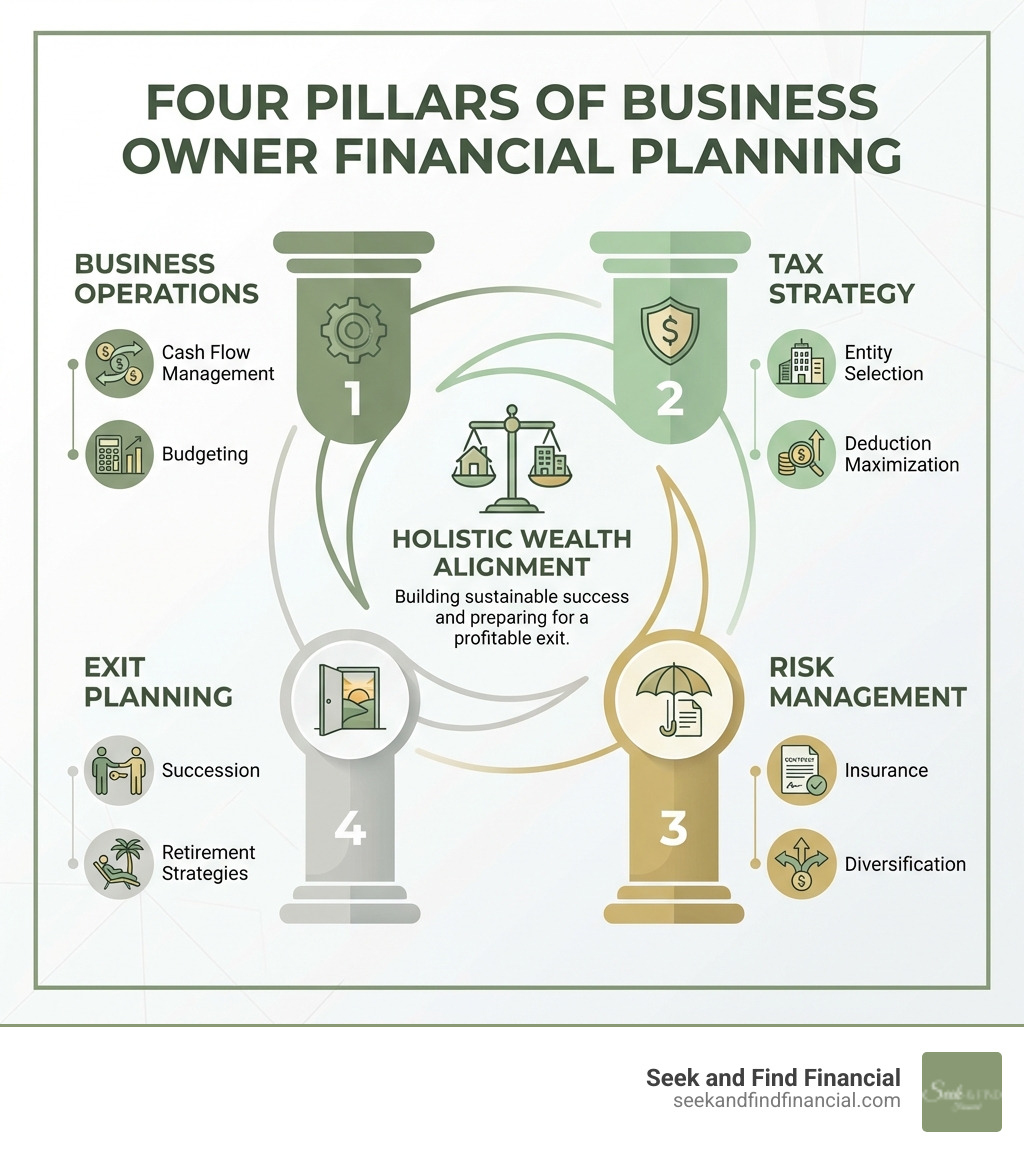
For many of us, our business isn't just a job; it's our passion, our identity, and our primary source of wealth. This unique relationship between our personal and professional lives means that business owner financial planning isn't a one-size-fits-all endeavor. It requires a custom approach that acknowledges this intricate connection.

As business owners, our financial landscape looks significantly different from that of an individual employee. For starters, a substantial portion—often 60-80%—of our personal wealth is tied directly to our company. This wealth concentration means that the health and value of our business directly impact our personal financial security, far more than a traditional employee's salary and benefits would.
We don't typically benefit from employer-sponsored retirement plans, which puts the onus on us to proactively build our own retirement savings. We also face unique personal liability, especially if we're sole proprietors or in certain business structures, where personal assets could be at risk. This means understanding our legal structure and ensuring proper asset protection is paramount.
Another key differentiator is inconsistent income. Fluctuating revenues can make budgeting and personal financial planning a moving target, demanding greater flexibility and strategic cash reserves. However, this direct control over our financial levers also presents unique opportunities. We can make strategic decisions about growth, investments, and tax planning that directly benefit both our business and our personal wealth, ultimately paving the way for unique retirement opportunities and a legacy that reflects our vision.
One of the fundamental rules for small business owners is to maintain a clear distinction between personal and business financial goals. Mixing the two can lead to confusion, complicate decision-making, and obscure the true financial health of your business. It also makes tax time a nightmare!
We strongly advocate for opening dedicated business bank accounts and obtaining business credit cards. This separation isn't just about good bookkeeping; it's about creating financial clarity. It simplifies tax reporting, makes it easier to track income and expenses, and provides an accurate picture of your business's profitability.
Beyond clarity, separating finances is crucial for building business credit in the company's name. As your company grows, strong business credit can be invaluable, making it easier to negotiate with suppliers or qualify for financing. Forming a legal entity, applying for an Employer Identification Number (EIN), and consistently paying bills on time are critical steps in establishing a solid credit history for your business.
Effective business owner financial planning starts with clear, actionable goals. We encourage our clients to set ambitious yet realistic objectives for both their business and their personal lives.
For our businesses, these goals might include increasing revenue by a certain percentage, improving profit margins, enhancing cash flow, or developing a robust succession plan. These are the Key Performance Indicators (KPIs) that tell us if our business is thriving.
Simultaneously, we need to define our personal financial goals: a comfortable retirement, accumulating wealth for future generations, funding children's education, or creating a lasting legacy. The magic happens when we integrate these two sets of goals. For instance, a business valuation provides a clear snapshot of our company’s value, which is essential for making informed decisions regarding potential sales, succession, or gifting of shares—all of which directly impact our personal financial planning and exit strategies.
By regularly reviewing our financial plans—monthly or quarterly—we can monitor progress, adjust strategies based on market dynamics or internal changes, and ensure that our business is serving as a powerful engine for our personal financial aspirations. This alignment of strategy with our core values is what truly defines success.
The day-to-day financial health of our business is the bedrock upon which all long-term plans are built. Without a solid handle on cash flow, budgeting, and tax strategy, even the most ambitious goals can falter.
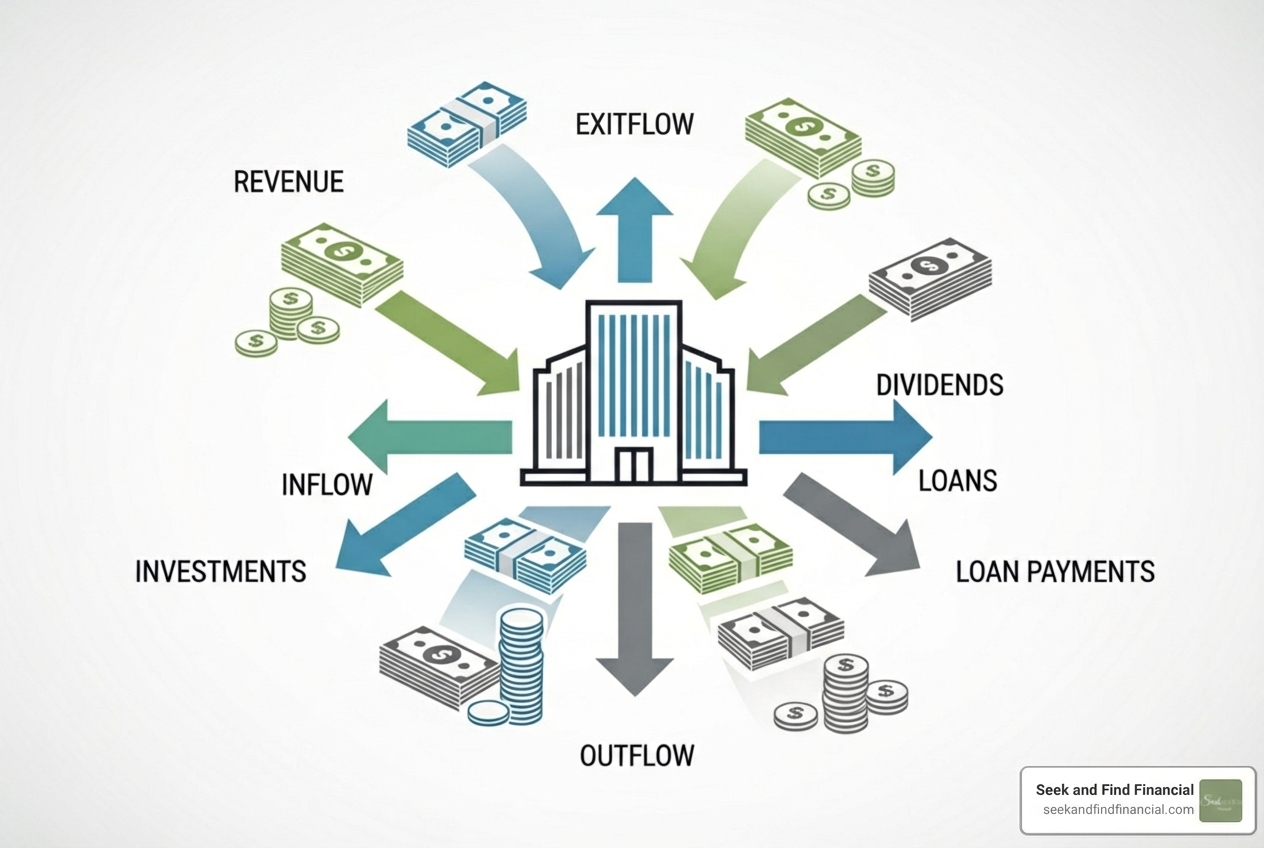
Cash flow is often called the "lifeblood of a business," and for good reason. Proactive cash flow management empowers us to meet our obligations, seize opportunities, and drive sustainable growth.
We recommend consistently tracking inflows and outflows. This isn't just about knowing what's coming in and going out; it's about understanding patterns, anticipating lean periods, and ensuring liquidity. A critical best practice is to establish an emergency fund, aiming to set aside at least 3-6 months of operating expenses. This buffer is crucial for handling unexpected emergencies or weathering economic downturns without resorting to high-interest debt.
Automating invoicing and payments can significantly streamline processes, reduce administrative burden, and improve accuracy. Efficiently managing receivables means timely invoicing and following up on overdue payments, while managing payables involves negotiating favorable terms with suppliers. By doing so, we can cover operational costs, avoid unnecessary debt, and maintain a healthy financial position.
Budgeting and forecasting are our financial roadmaps. They allow us to allocate resources strategically and plan for the future. We advise our clients to set clear objectives for their budgets, aligning them with both short-term operational needs and long-term growth ambitions.
Using historical data is key to creating realistic and accurate budgets. By analyzing past financial performance, we can anticipate future trends and make informed decisions. It's also important to understand our cost structure, differentiating between fixed costs (like rent) and variable costs (like raw materials). This helps us understand our break-even point and how changes in sales volume impact profitability.
Strategic planning allows us to allocate resources toward expansion opportunities, such as product development or market penetration. Furthermore, successful business owner financial planning includes scenario planning. Anticipating financial pitfalls, such as economic downturns, helps us protect our businesses from unexpected shocks. While challenges like inconsistent income, a lack of expertise, or emotional decision-making can make budgeting difficult, regular financial reviews and professional guidance can help us stay on track.
For business owners, tax planning isn't just an annual chore; it's a continuous, strategic imperative. Proactive tax planning can help minimize tax liabilities, maximize savings, and protect profitability for long-term success.
One of the first considerations is our business entity structure. The type of business entity—whether an LLC, S-Corp, C-Corp, or sole proprietorship—impacts which income, employment tax, and information returns we need to file. Legal and tax considerations help us select the best structure to optimize our tax position.
We must also understand what constitutes an "ordinary and necessary" business expense, as these are deductible. To deduct a business expense, it must be both ordinary (common and accepted in your trade or business) and necessary (helpful and appropriate for your trade or business). This includes everything from office supplies and insurance premiums to travel costs and professional fees.
Understanding estimated taxes and the Safe Harbor rules is crucial to avoid penalties. Safe Harbor dictates that we generally need to pay either 100% of the prior year’s tax (or 110% for some higher-earning taxpayers) or 90% of the current year’s tax within the calendar year. Maximizing deductions and credits, such as those available through solo retirement plans or employer-sponsored retirement plans, can significantly reduce our taxable income. By staying informed about tax obligations at the local, state, and federal levels, we can keep detailed records and ensure compliance, especially important for businesses operating in Valparaiso, Indiana, and across Indiana.
Growth is exciting, but it also introduces new complexities. As our businesses expand, we need robust strategies to protect our hard-earned assets and ensure our long-term vision can be realized.
For many business owners, their company is not just an income stream; it's their most significant asset, often comprising 60-80% of their net worth. This makes a business valuation a cornerstone of effective business owner financial planning.
A business valuation provides a clear snapshot of our company’s value, which is essential for making informed decisions regarding potential sales, succession, or gifting of shares. It's not just for when we're ready to sell; it's a vital tool for ongoing strategic planning. Understanding our business's true worth helps us secure financing, attract investors, and plan for future growth.
For those contemplating an exit, a valuation is indispensable. It informs our exit strategy, whether that involves a full sale, a gradual ownership transfer, or bringing in new partners. For example, a business owner might use a valuation to understand their company's worth, enabling informed decisions for their exit strategy and securing their financial future. It provides the financial clarity needed to make the best decisions for ourselves and our families.
Risk Management is essential for protecting a business from unforeseen challenges. Mitigating potential risks through insurance and contingency planning facilitates stability and flexibility during disruptions.
We help our clients identify and mitigate a range of financial and operational risks, including:
To counter these, robust insurance coverage is non-negotiable. This includes liability insurance (which covers third parties claiming injury or damage), property insurance (for physical damage or destruction of assets), and business interruption insurance (to replace lost cash flow if operations cease). We encourage you to learn more about business insurance from the U.S. Small Business Administration to understand the full spectrum of options.
Diversifying revenue streams is another powerful risk mitigation strategy, preventing over-reliance on a single product, service, or client. Additionally, having contingency plans in place for various scenarios ensures that we can pivot quickly and minimize the impact of unforeseen events.
A truly comprehensive financial plan for a business owner integrates several critical components, working in synergy to create a resilient and prosperous future. These components include:
Each of these elements plays a vital role, and neglecting any one can create vulnerabilities that undermine our overall financial health.
While daily operations are crucial, effective business owner financial planning always keeps the long-term vision in sight. This includes planning for our eventual retirement and ensuring the smooth transition of our business, preserving its legacy.
As small business owners, we often don't have the luxury of employer-sponsored retirement plans. This means we must be proactive and independent in planning for our retirement. The good news is there are excellent options available that offer significant tax advantages:
These plans allow for tax-deferred growth, meaning our investments can compound over time without annual taxation, significantly boosting our retirement nest egg. If we establish an employer-sponsored retirement plan, our business may also be eligible for an immediate federal income tax deduction for funding the plan.
Comparing SEP IRAs and Solo 401(k)s
When choosing between a SEP IRA and a Solo 401(k), consider these key differences:
SEP IRA
Solo 401(k)