

The Business Owner Tax Survival Kit
Master Business owner tax strategies for 2026 with clear guidance on deductions, compliance, and minimizing your tax burden.
Business owner tax obligations are among the most complex financial challenges you will face as an entrepreneur. And if you are earning $400K or more, the stakes are even higher.
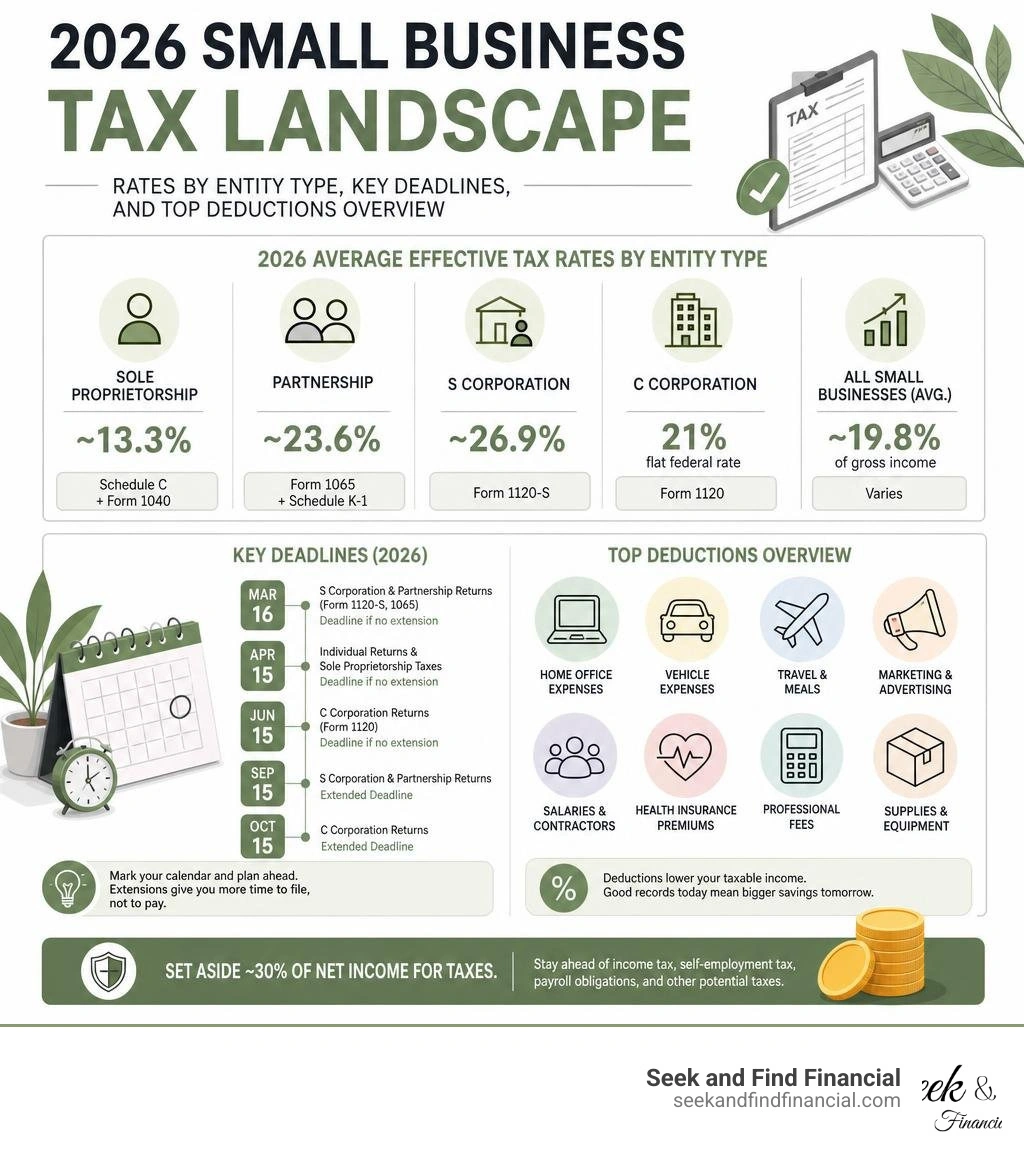
Here is a quick overview of what most business owners owe in 2026:
Most small businesses are pass-through entities, meaning profits flow to your personal return and get taxed at your individual rate. That means your business income and your personal income tax bill are often the same problem.
On top of income tax, self-employment tax, payroll obligations, and potential excise taxes can push your total burden well above what most owners expect. Experts recommend setting aside roughly 30% of net income just to stay ahead of it.
This guide breaks down every layer of that tax burden and shows you how to reduce it legally and strategically.
I'm Daniel Delaney, Founder of Seek & Find Financial, and after years working within established financial institutions before launching my own independent advisory firm, I've seen how much money business owners leave on the table through poor business owner tax planning. My goal here is to give you a clear, practical framework so you can keep more of what you earn.
Investing involves risk, including possible loss of principal. No investment strategy can ensure financial success or guarantee against losses. Past performance may not be used to predict future results. Provided content is for overview and informational purposes only, reflect the opinions of the author, and is not intended and should not be relied upon as individualized tax, legal, fiduciary, or investment advice.
This information is being provided only as a general source of information. These views may change as market or other conditions change. This information is not intended and should not be used to provide financial advice and does not address or account for an individual's circumstances. Past performance does not guarantee future results and no forecast should be considered a guarantee. Please seek the guidance of a financial professional regarding your particular financial concerns.
Investment advisory services offered by duly registered individuals through Seek & Find Financial LLC a Registered Investment Adviser. Licensed Insurance Professional
Easy Business owner tax glossary:

Taxes can feel like a heavy weight. For many business owners, the tax system is confusing. You have to pay different types of taxes at different times.
First, let us look at the main types of taxes you must manage:
The average small business pays about 19.8% of its annual gross income in taxes. This is a big portion of your hard-earned money. If you do not plan ahead, you might face a large bill at the end of the year.
To stay compliant and avoid surprises, you can use resources like the Self-employed individuals tax center | Internal Revenue Service. It is also wise to learn some basic Tax Tips for Small Business to keep your records in order.
The way you structure your business changes how you file and what you pay. Here is a simple breakdown of the options:
If you are self-employed, you must pay self-employment tax. This tax funds Social Security and Medicare. The standard rate is 15.3%. This consists of 12.4% for Social Security and 2.9% for Medicare.
In 2026, the maximum wage limit for the Social Security portion of the tax is $184,500. This means you do not pay the 12.4% Social Security tax on any self-employment earnings above this amount. However, there is no wage limit for the Medicare portion. You will pay the 2.9% Medicare tax on all of your net earnings.
You calculate this tax using Schedule SE. You file this form with your annual tax return if your net self-employment earnings are $400 or more.
One of the best ways to lower your business owner tax bill is to claim deductions. The IRS allows you to deduct expenses that are ordinary and necessary for your trade or business. Ordinary means the expense is common in your industry. Necessary means the expense is helpful and appropriate for your business.
Let us look at some common deductions:
To make sure you follow the rules, read the official Publication 334 (2025), Tax Guide for Small Business | Internal Revenue Service. Setting up a smart Tax Strategy for Business Owners can help you find deductions you might have missed.
Sometimes a business has a bad year and loses money. If your business deductions are more than your business income, you may have a Net Operating Loss (NOL).
An NOL can help you save money on taxes in future years. You can carry your NOL forward indefinitely to offset future taxable income. However, you cannot carry it back to past years.
There is also a limit. You can only use an NOL to offset up to 80% of your taxable income in any single future year. This is still a great way to get a tax break and recover after a difficult business year.
To avoid penalties, you must file your forms and pay your taxes on time. The IRS uses a pay-as-you-go system. This means you must pay your taxes as you earn income throughout the year.
If you expect to owe $1,000 or more in federal taxes, you must make quarterly estimated tax payments. You use Form 1040-ES to calculate and pay these taxes. The deadlines for these payments are:
If you do not pay enough tax during the year, you may face an underpayment penalty.
You must also file the correct annual tax forms based on your business type:
If you have employees, you have extra forms to file. You must file Form 941 every quarter to report payroll taxes. You must also file Form 940 annually for federal unemployment taxes. At the end of the year, you must send W-2 forms to your employees and 1099-NEC forms to any independent contractors you paid $600 or more.
Good recordkeeping is the key to compliance. Keep separate bank accounts for your business and personal life. Store all receipts, invoices, and mileage logs safely. This will save you time and stress if the IRS ever reviews your return.
Selling your business is a major life transition. It is the reward for years of hard work. However, a sale can trigger a large tax bill if you do not plan ahead. Our primary goal during an exit is to protect your wealth from high capital gains taxes.
First, you must understand the difference between an asset sale and a stock sale.
In an asset sale, the buyer purchases individual assets of the business, like equipment, inventory, and customer lists. This is often good for the buyer because they can depreciate the assets. But it can be bad for you, the seller, because some of the gain may be taxed at higher ordinary income rates.
In a stock sale, the buyer purchases the ownership shares of your corporation. This is usually better for you because the entire gain is taxed at lower long-term capital gains rates.
If your business is a C corporation, you might qualify for the Qualified Small Business Stock (QSBS) exclusion under Section 1202. If you meet the requirements and hold the stock for more than five years, you may be able to exclude up to 100% of your capital gains up to $10 million or 10 times your tax basis. This is a powerful tool to eliminate taxes on a business sale. To learn more about these methods, check out our guide on Advanced Tax Strategy for Entrepreneurs.
There are other strategies you can use to lower your tax burden when you sell:
To protect your wealth, you need to start planning long before you sign the sale agreement. Read our article on Business Owner Tax Planning to learn how to prepare your business for a tax-efficient transition.
The average small business pays about 19.8% of its annual gross income in taxes. However, this rate varies by business structure. Sole proprietorships pay an average of 13.3%. Partnerships pay about 23.6%. Small S corporations pay an average of 26.9%.
Quarterly estimated tax payments are due on April 15, June 15, September 15, and January 15. If these dates fall on a weekend or a holiday, the deadline moves to the next business day. If you pay late or do not pay enough, you may face an underpayment penalty.
You can use the simplified method or the actual expense method. The simplified method gives you a flat deduction of $5 per square foot of your home office, up to a maximum of 300 square feet. The actual expense method requires you to calculate the actual costs of running your home and deduct a percentage based on the size of your office. The space must be used regularly and exclusively for your business.
Managing your business owner tax obligations requires a structured financial plan. By choosing the right entity, maximizing your deductions, and planning for your eventual business sale, you can protect your wealth and achieve long-term growth.
At Seek & Find Financial, we specialize in personalized, technology-driven planning for entrepreneurs and business owners earning $400K or more. We help clients across Valparaiso, Chesterton, Portage, Hebron, Merrillville, Crown Point, Hobart, and Chicago build strategies that fit their real lives.
Learn more about our wealth management and tax planning services to see how we can help you coordinate your business and personal financial goals.
Investing involves risk, including possible loss of principal. No investment strategy can ensure financial success or guarantee against losses. Past performance may not be used to predict future results. Provided content is for overview and informational purposes only, reflect the opinions of the author, and is not intended and should not be relied upon as individualized tax, legal, fiduciary, or investment advice.
This information is being provided only as a general source of information. These views may change as market or other conditions change. This information is not intended and should not be used to provide financial advice and does not address or account for an individual’s circumstances. Past performance does not guarantee future results and no forecast should be considered a guarantee. Please seek the guidance of a financial professional regarding your particular financial concerns.
Investment advisory services offered by duly registered individuals through Seek & find Financial LLC a Registered Investment Adviser. Licensed Insurance Professional