

Why a Cash Balance Plan Might Be Your Business's Best Kept Secret
Discover how a cash balance plan helps high earners maximize tax-deferred retirement savings and stack with 401(k)s for powerful wealth building.
A cash balance plan is a type of IRS-qualified defined benefit retirement plan that lets business owners make very large, tax-deductible contributions to retirement — often far more than a 401(k) alone allows.
Here's what you need to know at a glance:
If you're a business owner earning $400,000 or more annually, you've likely hit the ceiling on what a 401(k) can do for you. The contribution limits are fixed. The tax savings are limited. And year after year, a significant portion of your income goes to taxes instead of building your future.
That's where a cash balance plan changes the equation.
While 401(k) plans have dominated the conversation around small business retirement planning, cash balance plans have grown nearly 15-fold — from 1,477 plans in 2001 to over 22,657 in 2020. They now represent nearly half of all defined benefit plans in the country and hold over $1.2 trillion in assets. Yet many high earners have never considered one.
The reason is simple: most generic financial advice isn't built for your situation. A business generating serious income needs serious retirement strategy — not a one-size-fits-all solution.
I'm Daniel Delaney, founder of Seek & Find Financial, and throughout my career in financial services I've worked with business owners who were leaving significant tax savings on the table simply because no one had walked them through how a cash balance plan could work alongside their existing retirement accounts. In this guide, I'll break down exactly how these plans work, who benefits most, and how to evaluate whether one fits your financial picture.
Investing involves risk, including possible loss of principal. No investment strategy can ensure financial success or guarantee against losses. Past performance may not be used to predict future results. Provided content is for overview and informational purposes only, reflect the opinions of the author, and is not intended and should not be relied upon as individualized tax, legal, fiduciary, or investment advice.
This information is being provided only as a general source of information. These views may change as market or other conditions change. This information is not intended and should not be used to provide financial advice and does not address or account for an individual's circumstances. Past performance does not guarantee future results and no forecast should be considered a guarantee. Please seek the guidance of a financial professional regarding your particular financial concerns.
Investment advisory services offered by duly registered individuals through Seek & Find Financial LLC a Registered Investment Adviser. Licensed Insurance Professional
Cash balance plan basics:
To understand a cash balance plan, it helps to look at how it blends two different retirement worlds. In the financial industry, we call it a hybrid plan. It sits right between a traditional defined benefit pension and a defined contribution plan like a 401(k).
If you want to explore the basics of different systems, you can read our guide on Retirement Plans.
In a traditional pension, the employer promises to pay a set monthly benefit when you retire. This benefit is usually based on a complex formula linked to your years of service and your salary. In a 401(k) plan, you have your own account, and the final balance depends entirely on how your investments perform.
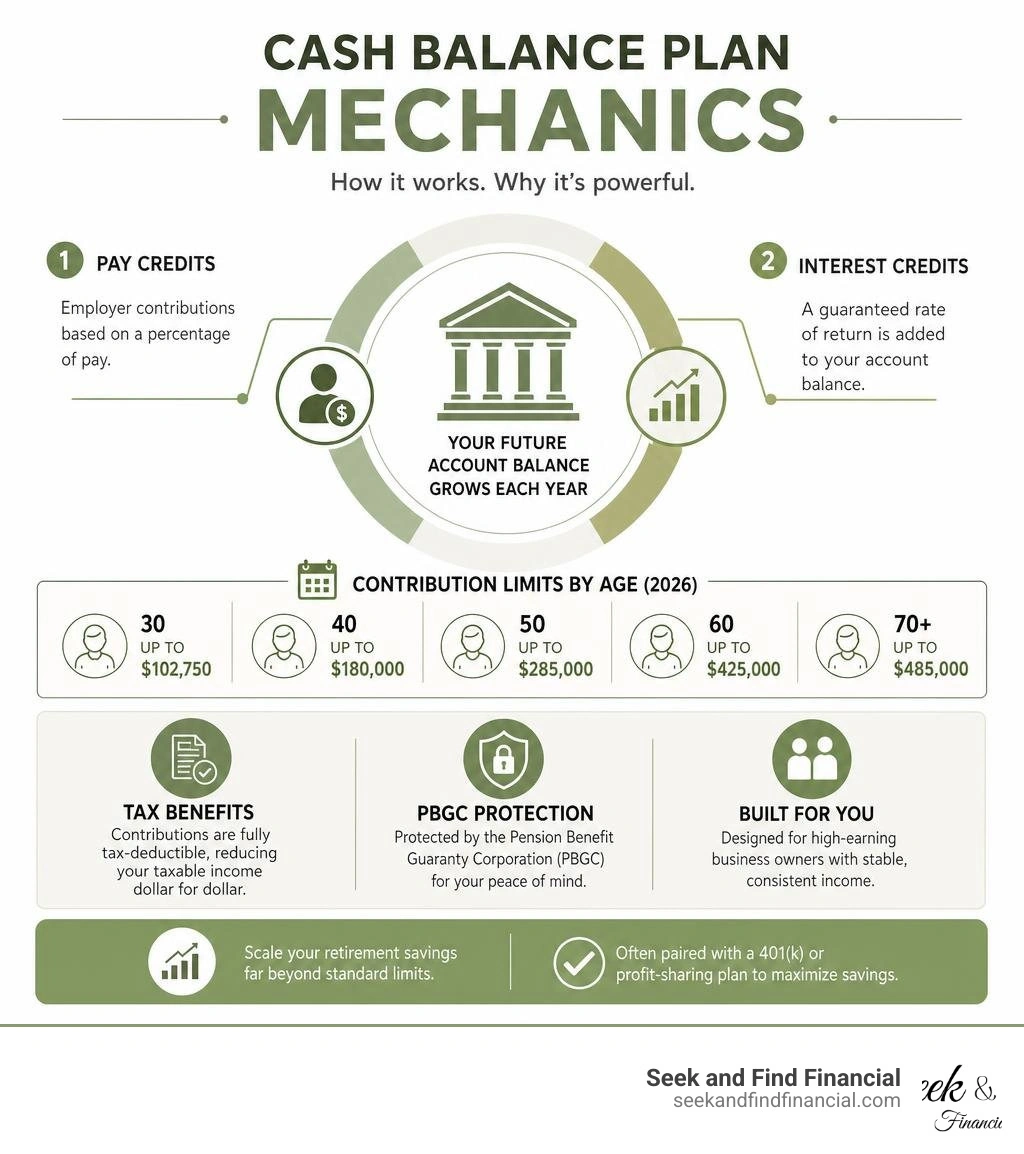
A cash balance plan is technically a defined benefit plan. However, it looks and feels like a 401(k) to the employee. Each participant has a hypothetical account. This account grows every year through two specific credits:
You can learn more about these mechanics in this Cash Balance Plan 101 overview.
The term "hypothetical account" is used because the assets are actually pooled together in a single trust. The employer manages the investments for the entire group. Individual participants do not choose their own investments.
When an employee retires or leaves the company, they can see exactly what their benefit is worth because it is expressed as a single account balance. This is very different from a traditional pension, which only shows a future monthly payment.
When it is time to take a distribution, the plan must offer the participant a choice. They can receive their balance as a lifetime annuity. This is a series of regular monthly payments designed to last for the rest of their life.
Alternatively, most participants choose to take a lump sum distribution. This lump sum can be rolled over directly into an Individual Retirement Account (IRA) or another qualified plan. By doing a rollover, the participant avoids immediate taxes and allows the money to continue growing tax-deferred.
The rules for these distributions are highly regulated to protect workers. For more detailed information on how these payout options function, you can read the Cash Balance Pension Plans Questions & Answers | U.S. Department of Labor page.
Because cash balance plans have higher setup and administrative costs than simple 401(k) plans, they are not the best fit for every business. They are designed for a very specific type of business owner.
We find that the ideal candidates for these plans usually share several traits:
If you are earning over $400,000 annually and want to see how this fits your personal situation, you can read our analysis of Retirement Plans for High Earners.
To help you visualize the differences between these retirement vehicles, we have put together a comparison table. It highlights who bears the investment risk, how contributions are structured, and how the accounts are managed.
| Feature | 401(k) Plan | Cash Balance Plan | Traditional Pension |
|---|---|---|---|
| Plan Type | Defined Contribution | Hybrid (Defined Benefit) | Defined Benefit |
| Account Structure | Actual individual accounts | Hypothetical individual accounts | No individual accounts |
| Who Pays? | Employee and/or Employer | Employer only | Employer only |
| Investment Risk | Borne by the employee | Borne by the employer | Borne by the employer |
| Contribution Limits | Lower ($23,000 in 2026, plus catch-up) | Very high (Up to $400,000+ depending on age) | Determined by actuarial formula |
| Vesting Schedule | Up to 6 years (graded) | Must be 100% vested within 3 years | Up to 7 years (graded) |
| PBGC Insured? | No | Yes (in most cases) | Yes |
As you can see, the cash balance design takes the individual account concept from the 401(k) world but keeps the funding security and high limits of the traditional pension.
For a broader look at small business options, you can read our guide on Retirement Savings Plans for Small Business Owners.
Like any financial tool, a cash balance plan has clear advantages and specific responsibilities. It is important to weigh both sides before deciding to implement one.
The most immediate benefit for a high-earning business owner is tax relief. Contributions made to the plan are fully tax-deductible for the business. If you are in a high tax bracket in Indiana or Illinois, this can save you tens of thousands of dollars in federal and state income taxes each year.
For example, a business owner who contributes $200,000 to a cash balance plan could see their tax bill drop by $70,000 or more, depending on their local tax rates. This is money that would have gone to the government. Instead, it is now building the owner's personal wealth.
To explore more ways to manage your tax liability, read our article on Tax Planning for High Income.
Another benefit is asset protection. Under federal law, assets held within a qualified cash balance plan are generally protected from creditors. If your business faces a lawsuit, the money you have saved for retirement is safe.
Finally, these plans are excellent tools for recruiting and keeping top talent. Offering a guaranteed retirement contribution can make your firm stand out when hiring senior associates or key managers.
The primary drawback is the funding commitment. Unlike a 401(k) profit-sharing plan, where you can choose to make zero contributions during a bad year, a cash balance plan requires consistent funding.
The IRS expects these plans to be permanent. This generally means you should plan to keep the plan open for at least five years. If you experience a sudden drop in revenue, you still must meet the minimum funding requirements calculated by your actuary.
There are also higher administrative costs. Because these plans are defined benefit plans, you must hire an enrolled actuary every year. The actuary calculates the required contributions, performs compliance testing, and signs off on the plan's financial health.
For your staff, a cash balance plan is an incredible benefit. They do not have to contribute any of their own salary to receive it. The employer funds the entire plan.
Employees also enjoy a guaranteed rate of return. They do not have to worry about stock market corrections reducing their retirement nest egg. Their hypothetical account grows steadily year after year.
Lastly, the plan offers portability. If an employee leaves your company after becoming vested, they can take their account balance with them and roll it into an IRA.
One of the most powerful strategies we use for our clients at Seek & Find Financial is plan stacking. You do not have to choose between a 401(k) and a cash balance plan. In fact, about 96% of companies that sponsor a cash balance plan run it alongside a 401(k) plan.
By stacking these plans, you can maximize your tax-deferred savings.
For example, in 2026, a 55-year-old business owner could maximize their 401(k) deferrals and catch-up contributions. Then, they could add a profit-sharing contribution. On top of that, they can layer a cash balance plan contribution.
Depending on their age and income, this stacked strategy can allow them to put away more than $300,000 in a single year, all tax-deferred.
To learn more about how to structure these combined accounts, read our Entrepreneur Retirement Plan guide.
The maximum lifetime lump sum benefit you can build within a cash balance plan is also very high. For 2026, the limit is approximately $3.6 million. This assumes the participant is at least age 62 and has participated in the plan for at least 10 years.
Setting up a cash balance plan requires a team of professionals. You cannot simply open one online through a standard brokerage platform.
First, you need to work with an actuary and a financial advisor to design the plan document. This document defines the pay credit formula and the interest crediting rate. To ensure compliance with IRS guidelines, advisors use resources like the Defined Benefit Listing of Required Modifications and Information Package (LRM) CASH BALANCE SUPPLEMENT.
Second, you must establish a trust account to hold the pooled investments. The trustee is responsible for investing these assets prudently. Because the plan promises a specific interest credit, the investment strategy is typically conservative to moderate. This helps avoid large market losses that would require the employer to make massive, unexpected contributions to make up the difference.
For a step-by-step approach to managing your business finances, check out our Business Owner Financial Planning Guide.
Yes. Combining these two plans is the standard way to optimize retirement savings for high earners. When you stack a cash balance plan with a 401(k) and a cross-tested profit-sharing plan, you can maximize the contributions going to the business owners while keeping the cost of employee benefits reasonable.
To understand how this combination works for business owners, you can read our Retirement Planning Entrepreneurs Guide.
Cash balance plans have strict vesting rules. Under federal law, participants must be 100% vested in their benefits after no more than three years of service.
Unlike 401(k) plans, which allow graded vesting schedules where you vest gradually over six years, cash balance plans do not allow graded vesting. It is a cliff vesting schedule. An employee is either 0% vested or 100% vested once they hit the three-year mark.
The employer bears all the investment risk. If the pooled investments in the trust earn less than the interest crediting rate promised by the plan, the employer must make up the shortfall with additional cash contributions.
Conversely, if the investments perform better than the promised rate, the excess earnings remain in the trust. These excess earnings can be used to reduce the employer's required contributions in future years.
A cash balance plan is one of the most powerful financial secrets available to high-earning business owners in Valparaiso, Crown Point, and the wider Chicago area. It allows you to build a massive retirement nest egg while dramatically lowering your current tax burden.
However, these plans are complex. They require careful design, ongoing actuarial testing, and a disciplined investment strategy.
At Seek & Find Financial, we specialize in helping entrepreneurs and business owners earning $400,000 or more navigate these advanced wealth management strategies. We use modern, technology-driven tools to build personalized plans that fit your real-life goals.
If you are ready to stop writing massive checks to the IRS and start accelerating your personal wealth, we are here to help. Learn more about our wealth management services and see how we can help you build a clear path forward.
Investing involves risk, including possible loss of principal. No investment strategy can ensure financial success or guarantee against losses. Past performance may not be used to predict future results. Provided content is for overview and informational purposes only, reflect the opinions of the author, and is not intended and should not be relied upon as individualized tax, legal, fiduciary, or investment advice.
This information is being provided only as a general source of information. These views may change as market or other conditions change. This information is not intended and should not be used to provide financial advice and does not address or account for an individual’s circumstances. Past performance does not guarantee future results and no forecast should be considered a guarantee. Please seek the guidance of a financial professional regarding your particular financial concerns.
Investment advisory services offered by duly registered individuals through Seek & find Financial LLC a Registered Investment Adviser. Licensed Insurance Professional