

The Ultimate Guide to Retirement Plans for High Earners
Discover retirement plans for high earners: Mega Backdoor Roth, Cash Balance, tax strategies & 25% savings tips for secure wealth.

Retirement plans for high earners look very different from the standard advice most people receive. Here is a quick overview of what you need to know:
Key retirement strategies for high earners:
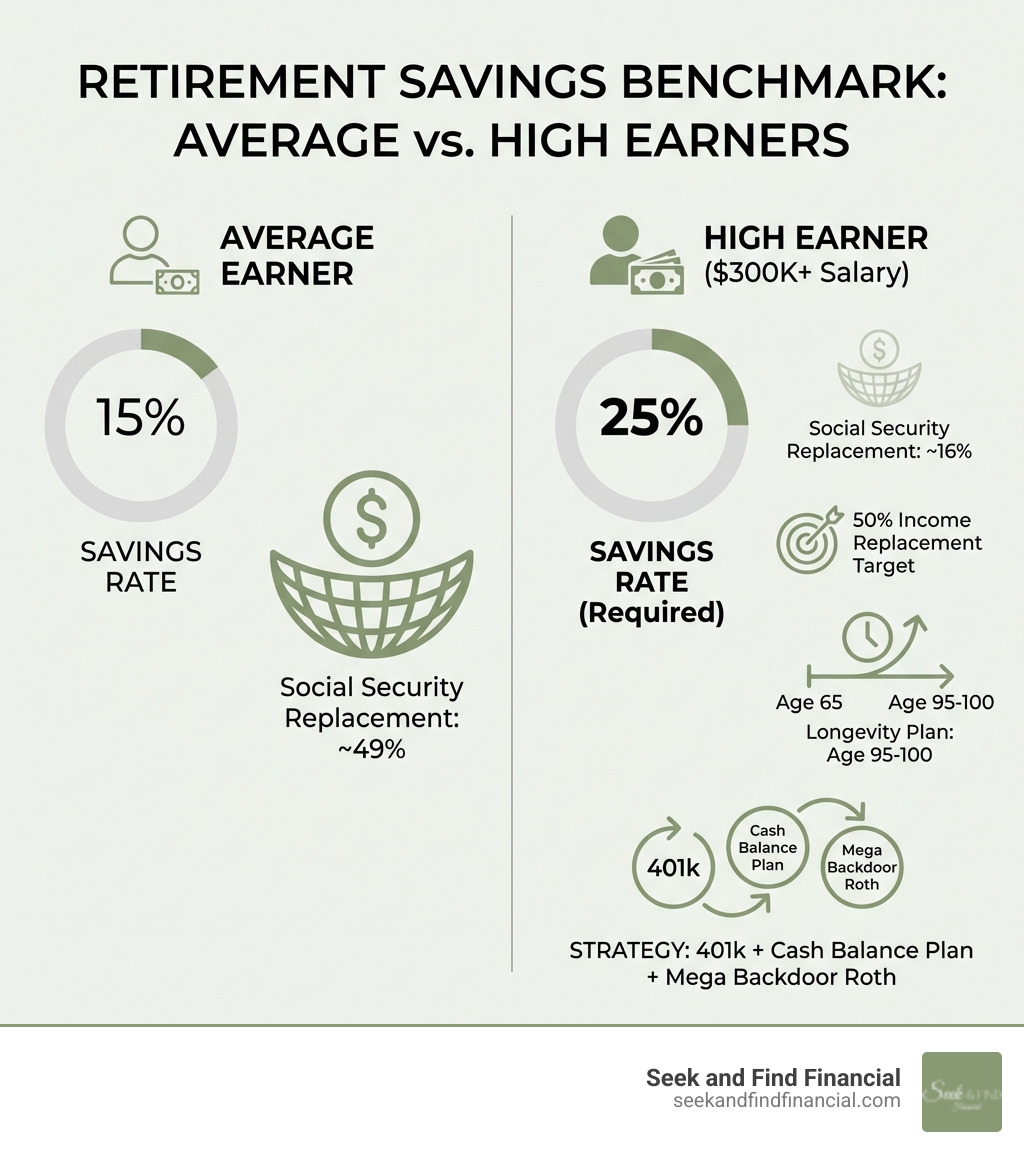
Here is the core problem. Earning a high income does not automatically translate into a secure retirement. In fact, high earners often face a bigger savings gap than average workers. Social Security replaces only about 16% of final salary for someone earning $300,000, and just 8% for someone earning $600,000. Compare that to nearly 49% for someone earning $60,000. The system was not built for you.
Add to that the reality that many high-earning professionals - doctors, attorneys, business owners - spend their 20s in school or building a practice, not saving. By the time peak earnings arrive, the window to build retirement wealth is shorter than most people realize.
Then come the tax challenges. High incomes mean fewer deductions, contribution limits that cap your upside, and a future full of Required Minimum Distributions (RMDs) that can push you into higher brackets at exactly the wrong time.
The standard retirement playbook was not written for someone in your situation. It needs to be rebuilt from the ground up.
I'm Daniel Delaney, Founder of Seek & Find Financial and an advisor with experience working inside established financial institutions before launching an independent practice built around transparency and long-term strategy. I have spent years helping high earners navigate the unique complexities of retirement plans for high earners, and this guide breaks down exactly what works. Let's get into it.
Investing involves risk, including possible loss of principal. No investment strategy can ensure financial success or guarantee against losses. Past performance may not be used to predict future results. Provided content is for overview and informational purposes only, reflect the opinions of the author, and is not intended and should not be relied upon as individualized tax, legal, fiduciary, or investment advice.
This information is being provided only as a general source of information. These views may change as market or other conditions change. This information is not intended and should not be used to provide financial advice and does not address or account for an individual's circumstances. Past performance does not guarantee future results and no forecast should be considered a guarantee. Please seek the guidance of a financial professional regarding your particular financial concerns.
Investment advisory services offered by duly registered individuals through Seek & Find Financial LLC a Registered Investment Adviser. Licensed Insurance Professional.

Most financial advice is built for the "average" worker. If you earn $75,000 a year, saving 15% of your income might get you across the finish line. But for those we work with in places like Valparaiso or Crown Point who earn $400,000 or more, that math simply breaks.
The first hurdle is the Social Security gap. Social Security is a progressive system. It is designed to replace a larger chunk of income for lower earners and a much smaller sliver for higher earners. If you earn $300,000, Social Security might only cover 16% of your final salary. If you earn $600,000, it drops to a staggering 8%. This means the vast majority of your retirement lifestyle must be funded by your personal savings.
Another factor is the late career start. Many high earners, like physicians or attorneys, spend their 20s and early 30s in school or residency. They often enter the workforce with high student debt and zero retirement savings at age 35. This delay is a massive disadvantage. Starting at 35 instead of 25 means you miss out on ten years of compound growth. To catch up, you have to save more aggressively. We recommend a 25% savings rate as a non-negotiable benchmark for high earners.
Interestingly, high earners often need a lower income replacement ratio. While the standard rule says you need 70-80% of your pre-retirement income, research from Vanguard suggests the top 5% of earners often spend less than 50% of their income in retirement. This is because high earners often have lower fixed costs relative to their income once their mortgage is paid off and their children are through college. However, achieving even a 50% replacement ratio requires a massive nest egg when your starting salary is high.
If you only use a standard 401(k), you will likely hit a wall. The IRS limits how much you can put into these plans each year. For a high earner, these limits are often too low to reach that 25% savings goal. This is where advanced retirement plans for high earners come into play.
For business owners and executives, we often look at combining a 401(k) with a Cash Balance Plan. Think of a Cash Balance Plan as a "pension on steroids." It allows for much higher contribution limits that increase as you get older. While a 401(k) might limit you to $23,500 (plus catch-ups), a Cash Balance Plan could allow you to squirrel away an additional $100,000 to $250,000 per year, depending on your age and income.
| Plan Type | 2025 Contribution Limit (Under 50) | 2025 Catch-Up (50-59) | Primary Benefit |
|---|---|---|---|
| 401(k) Employee | $23,500 | $7,500 | Immediate tax deduction |
| Cash Balance Plan | Age-based (up to $250k+) | N/A | Massive tax deferral |
| SEP IRA | 25% of pay (up to $70k) | N/A | Simple for business owners |
These plans are powerful because they provide a double benefit: they build your wealth and provide a massive taxable income reduction today. This is a critical form of compensation timing. You take the deduction now while you are in a high tax bracket and pay the taxes later when you might be in a lower bracket.
However, you must be aware of IRS RMD rules. Once you reach age 73 or 75, the government forces you to start taking money out of these tax-deferred accounts. For high earners with large balances, these forced distributions can create a "tax cliff," pushing you back into the highest tax brackets during retirement.
For those who have maxed out their 401(k) and still want to save more, the Mega Backdoor Roth is a game changer. This strategy allows you to put after-tax dollars into your 401(k) and then convert them into a Roth IRA.
Normally, high earners are phased out of making direct Roth IRA contributions. The Mega Backdoor Roth bypasses these income limits. If your employer's plan allows for after-tax contributions and "in-service withdrawals," you can potentially move tens of thousands of dollars into a Roth account every year.
Starting in 2026, new rules will require high-income employees (those earning over $150,000) to make their catch-up contributions on a Roth basis. This makes understanding Roth strategies even more important. Roth accounts provide tax-free growth, which is the ultimate hedge against future tax rate increases.
For the entrepreneurs we serve in Northwest Indiana and Chicago, Cash Balance Plans are often the crown jewel of their strategy. These are defined benefit plans that act like a personal pension.
Because these plans allow for such high deductions, they are perfect for business owners in their peak earning years who need to "super-fund" their retirement. They also serve as an excellent tool for business succession. When you eventually sell your business, having a large portion of your wealth already tucked away in a protected retirement plan provides a massive layer of security.
Retirement planning for high earners isn't just about how much you save; it's about how much you keep after the IRS takes its cut. We focus heavily on asset location. This means putting tax-heavy assets (like bonds) in tax-deferred accounts and growth assets (like stocks) in taxable or Roth accounts.
Strategic Roth conversions are another tool. By moving money from a traditional IRA to a Roth IRA during lower-income years, you can lock in today's tax rates. This is especially useful if you expect tax rates to rise in the future or if you want to leave a tax-free legacy to your heirs.
We also encourage the use of Health Savings Accounts (HSAs). For a high earner, an HSA is the only "triple tax-advantaged" account:
For those with philanthropic goals, Donor-Advised Funds (DAFs) allow you to take a large tax deduction today by donating appreciated assets, while distributing the money to charities over time. This "bunching" of deductions can be a very effective way to lower your tax bill in a high-income year.
Other advanced strategies include:
High earners tend to live longer. Access to better healthcare and a lower-stress lifestyle means you need to plan for a very long retirement. A female physician entering the workforce today has a 33% chance of living past age 95.
This "longevity risk" means your money needs to last 30 or 40 years. We often look at Qualified Longevity Annuity Contracts (QLACs), which provide a guaranteed income stream that starts later in life (like age 85). This protects you from outliving your assets.
Planning for long-term care expenses is also vital. A year in a high-end assisted living facility can easily exceed $150,000. High earners often choose to "self-fund" this risk, but doing so requires a larger nest egg. We also use growth assets like equities even late into retirement to ensure your purchasing power keeps up with inflation.
High earners need to save more because Social Security replaces a much smaller portion of their income. Additionally, high earners often start saving later due to advanced education, meaning they have less time for their money to grow. To reach a comfortable 50% income replacement ratio by age 65, a 25% savings rate is usually the minimum requirement.
While every situation is unique, a common strategy is to withdraw from taxable brokerage accounts first. This allows your tax-advantaged accounts (like 401ks and IRAs) to continue growing. Next, you typically tap into tax-deferred accounts, and finally, your Roth accounts. This sequence helps minimize your lifetime tax bill and can help you avoid higher Medicare premiums (IRMAA surcharges).
Social Security benefits are capped. Once your income exceeds the "Social Security Wage Base" ($176,100 in 2025), you stop paying Social Security taxes, but you also stop earning additional benefits. This is why the "replacement ratio" drops so significantly for high earners. It acts more like a small safety net rather than a primary income source.
At Seek & Find Financial, we believe that high earners deserve a strategy that is as sophisticated as their career. Whether you are in Valparaiso, Chesterton, or Chicago, the goal of retirement plans for high earners is to create a system that works for you.
We don't believe in generic advice. We use personalized, technology-driven planning to give you a clear financial roadmap. Our focus is on providing you with structured financial planning that offers long-term stability and clear financial direction. If you're ready to see what we do and how we can help you bridge the savings gap, let's start a conversation.
Investing involves risk, including possible loss of principal. No investment strategy can ensure financial success or guarantee against losses. Past performance may not be used to predict future results. Provided content is for overview and informational purposes only, reflect the opinions of the author, and is not intended and should not be relied upon as individualized tax, legal, fiduciary, or investment advice.
This information is being provided only as a general source of information. These views may change as market or other conditions change. This information is not intended and should not be used to provide financial advice and does not address or account for an individual’s circumstances. Past performance does not guarantee future results and no forecast should be considered a guarantee. Please seek the guidance of a financial professional regarding your particular financial concerns.
Investment advisory services offered by duly registered individuals through Seek & find Financial LLC a Registered Investment Adviser. Licensed Insurance Professional