

How to Pick a Chicago Investment Management Firm Without Losing Your Mind
Choose a Chicago investment management firm that fits your goals with fiduciary advice and modern planning.
Choosing the right Chicago investment management firm is one of the most important financial decisions you can make, and it can also be one of the most overwhelming.
Chicago is home to more than 87 investment and asset management companies, according to data from Indeed. From household names to boutique independents, the options range from massive institutions to small, specialized shops.
Here is a quick look at the main types of firms operating in Chicago:
| Firm Type | Focus Area | Notable Trait |
|---|---|---|
| Large Global Institutions | Broad asset management, M&A, global research | Massive scale; standardized models |
| Boutique Value Firms | Long-term value investing, equities | Focused portfolios; active patience |
| Specialized Real Estate Firms | Property portfolios, alternative assets | Niche focus; illiquid investments |
| Independent Wealth Advisors | Personalized planning, tax integration | Fiduciary standard; customized strategies |
That list barely scratches the surface. Clutch.co alone listed 98 investment firms in Chicago as of June 2025.
So how do you know which firm is actually right for you, especially when you are running a business, earning well, and have no time for generic advice?
That is exactly what this guide is here to help you figure out.
I'm Daniel Delaney, founder of Seek & Find Financial, and my career spans years working inside established financial institutions. This experience gave me a clear view of how Chicago investment management firm ecosystems actually work from the inside. That background shapes how I help business owners cut through the noise and find advisors who genuinely fit their goals.
Investing involves risk, including possible loss of principal. No investment strategy can ensure financial success or guarantee against losses. Past performance may not be used to predict future results. Provided content is for overview and informational purposes only, reflect the opinions of the author, and is not intended and should not be relied upon as individualized tax, legal, fiduciary, or investment advice.
This information is being provided only as a general source of information. These views may change as market or other conditions change. This information is not intended and should not be used to provide financial advice and does not address or account for an individual's circumstances. Past performance does not guarantee future results and no forecast should be considered a guarantee. Please seek the guidance of a financial professional regarding your particular financial concerns.
Investment advisory services offered by duly registered individuals through Seek & Find Financial LLC a Registered Investment Adviser. Licensed Insurance Professional
Explore more about Chicago investment management firm:
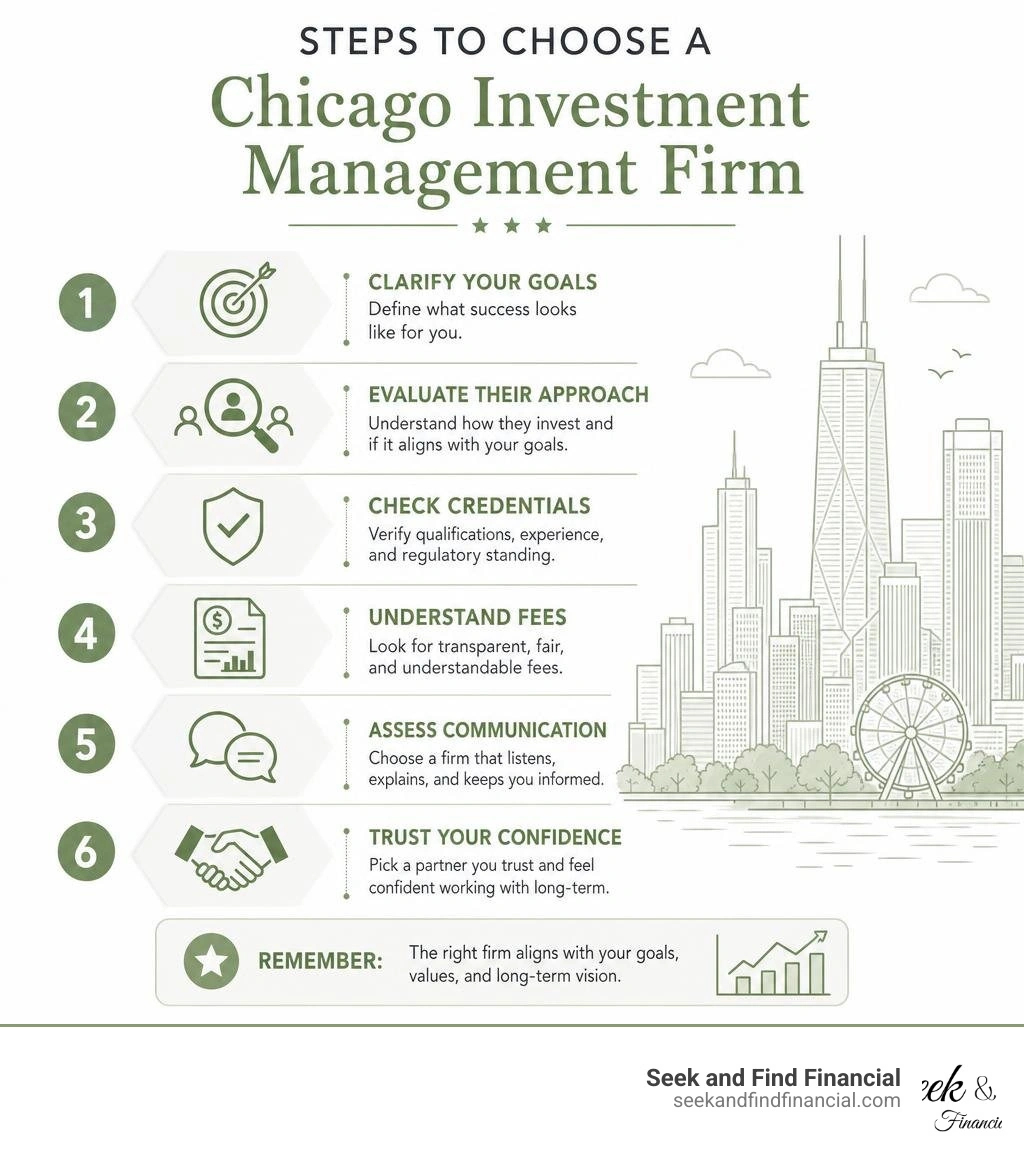
When you start looking for a Chicago investment management firm, it is easy to get distracted by fancy offices and complex charts. However, building real wealth requires focusing on the core foundations of a firm.
First, you must understand the fiduciary duty. A true fiduciary is legally required to put your financial interests ahead of their own. They cannot sell you products just because those products pay them a higher commission. Many large banks and brokerages do not operate under this strict standard at all times. If you want a strategy tailored to your life, you need to work with a firm that commits to this fiduciary standard in writing. You can also review an adviser's registration and background through the SEC's Investment Adviser Public Disclosure database.
Second, pay close attention to fee structures. Traditional firms often charge a fee based on your total assets under management, commonly called an AUM fee. This fee typically ranges from 0.30% to 1.20% depending on the size of your account. Some firms also have minimum annual fees, such as $5,000, or require a minimum asset level of $500,000 to get started. You should always ask for a clear breakdown of all costs, including custodial fees and underlying fund expenses, so there are no surprises.
Third, look at how the firm handles asset allocation. Generic firms often use a cookie-cutter approach. They might put you in a standard model portfolio based solely on your age. A quality firm will build a strategy around your specific business cash flow, your tax situation, and your long-term goals. If you are an entrepreneur earning over $400K, your personal investments must coordinate with your business assets.
For more details on how to build a plan that fits your specific situation, read our guide on customized wealth management. You can also learn about how a private wealth management firm coordinates complex financial needs under one roof.

Every Chicago investment management firm operates with a specific investment philosophy. This philosophy dictates how they buy, sell, and hold assets. Understanding these approaches helps you choose a partner whose beliefs align with yours.
To help you visualize how these philosophies fit together, here is a simple breakdown of the main strategies you will find in the market:

To explore how these ideas apply to your own portfolio, you can read more about our approach to personalized investment strategies.
Some of the most established firms in Chicago rely on value investing. This approach is modeled after classic strategies like those of Warren Buffett. The goal is to find high-quality, undervalued companies and hold them for the long term.
Many value-focused advisors use a philosophy of active patience. This means they believe good outcomes take time, but they never stay static. They focus on looking over the horizon rather than reacting to daily market panic or hype.
Similarly, many traditional wealth managers focus on long-term growth and dividend-paying equities. They avoid complex financial products that are hard to understand. Instead, they focus on businesses with strong balance sheets that can survive different market cycles. This disciplined approach helps protect your money when the market drops while still allowing it to grow over time.
On the other side of the spectrum, some modern firms use advanced technology to manage portfolios. Instead of relying only on human research, they use powerful software to analyze global markets in real time.
These firms use advanced investment technology to run adaptive portfolios. They use algorithms to learn and adapt to market changes faster than traditional systems.
Other modern firms leverage digital tools to make investing more efficient. By using modern platforms like Altruist, advisors can lower transaction costs, trade faster, and give clients real-time tracking of their wealth. This technology-driven approach is highly beneficial for busy professionals who want clear, instant access to their financial picture without waiting for quarterly paper statements.
When you hand your money over to an investment firm, it does not actually sit in their office. Instead, it is held by an independent custodian. Understanding this ecosystem is vital for keeping your assets safe.
An independent custodian is a financial institution that holds your funds and securities for safekeeping. They make sure your money is actually where your advisor says it is. For example, major institutions like Northern Trust or modern platforms like Altruist act as custodians. They handle the administrative side, send you independent statements, and process trades.
This setup provides a vital layer of risk management. Because the advisory firm does not directly hold your cash, they cannot misuse your funds. If you want to learn more about how we protect your wealth from unexpected market events, read about risk management in Chicago.
Using an independent custodian also ensures that your reporting is completely transparent. You can log in directly to the custodian's portal at any time to verify your balances. This structure keeps everyone accountable and gives you peace of mind.
The financial world is shifting rapidly in 2026. High-earning families and business owners can no longer rely on the simple strategies of the past. To stay ahead, you must understand the key trends shaping the investment landscape today.
| Traditional Investing | Modern Wealth Trends (2026) |
|---|---|
| Focuses only on stock and bond performance | Integrates investments with proactive tax strategy |
| Uses generic mutual funds with high hidden fees | Uses low-cost, fractional-share digital platforms |
| Ignores the owner's business cash flow | Coordinates personal wealth with business planning |
| Relies on slow, manual quarterly reporting | Offers real-time digital tracking and updates |
Market volatility and rising interest rates mean that simple buy-and-hold strategies are not always enough. Investors are looking for ways to protect their purchasing power against inflation. This has led many to explore alternative assets or more specialized corporate advisory solutions to navigate complex business transitions.
Additionally, tax strategy has become a primary driver of investment returns. If you are earning over $400K, what you keep is far more important than what you make on paper. Modern firms are focusing heavily on tax-loss harvesting and structured accounts to minimize the IRS's take.
To see how these trends affect your business, read our guide on wealth management for business owners. If you are planning your exit or retirement, you should also check out our insights on Chicago high earner retirement.
You should start by looking for a firm that operates under a strict fiduciary standard. Next, make sure they have experience working with clients in your specific situation. If you are a business owner, you need an advisor who understands corporate tax structures, business valuations, and how to turn business equity into personal wealth. Do not settle for a firm that only offers generic investment models. To find out how to build a truly comprehensive plan, look at our strategic wealth management solutions.
Most firms charge an annual fee based on your assets under management, which usually ranges from 0.30% to 1.20%. Some firms may charge flat fees or hourly rates for specialized financial planning. It is important to ask whether a firm is "fee-only" or "fee-based." Fee-only firms are paid only by you, which reduces conflicts of interest. Fee-based firms may earn commissions from selling specific financial products, which can create a conflict. Always ask for a written disclosure of all potential conflicts of interest.
Directories like Clutch.co rank local firms using several factors, including verified client reviews, the size of the projects they handle, and the specific services they offer. While these directories are helpful for finding a list of firms, you should not rely on rankings alone. A firm that is highly ranked for large institutional pension funds might not be the right fit for an entrepreneur who needs personalized tax planning and hands-on wealth management.
Finding the right Chicago investment management firm does not have to be a stressful process. By focusing on fiduciary duty, clear fee structures, and personalized strategies, you can find a partner who truly supports your financial journey.
At Seek & Find Financial, we do things differently. We specialize in wealth management and tax strategy for entrepreneurs and business owners earning $400K+. We do not believe in generic, cookie-cutter advice. Instead, we use modern, technology-driven planning on the Altruist platform to build real-life financial growth that fits your busy schedule.
We serve clients throughout the region, including Valparaiso, Chesterton, Portage, Hebron, Merrillville, Crown Point, Hobart, and Chicago. If you are ready to take control of your financial future with a clear, structured plan, learn more about Why Choose Us.
Investing involves risk, including possible loss of principal. No investment strategy can ensure financial success or guarantee against losses. Past performance may not be used to predict future results. Provided content is for overview and informational purposes only, reflect the opinions of the author, and is not intended and should not be relied upon as individualized tax, legal, fiduciary, or investment advice.
This information is being provided only as a general source of information. These views may change as market or other conditions change. This information is not intended and should not be used to provide financial advice and does not address or account for an individual’s circumstances. Past performance does not guarantee future results and no forecast should be considered a guarantee. Please seek the guidance of a financial professional regarding your particular financial concerns.
Investment advisory services offered by duly registered individuals through Seek & find Financial LLC a Registered Investment Adviser. Licensed Insurance Professional