

X Practical Ways to Improve Risk Management Chicago
Discover practical risk management Chicago strategies to protect assets, ensure compliance, and strengthen business resilience today.
Risk management in Chicago is one of the most overlooked parts of running a successful business — until something goes wrong.
Whether you run a growing company, lead a nonprofit, or manage a large enterprise, Chicago presents a unique mix of risks. Think local regulations, extreme weather, cyber threats, and complex liability exposures. Ignoring these can put your assets, your people, and your entire operation at risk.
Here is a quick overview of what effective risk management in Chicago involves:
| Area | What It Covers |
|---|---|
| Regulatory compliance | City of Chicago and Cook County rules, workers' comp, liability |
| Cybersecurity | Data protection, breach prevention, threat response |
| Insurance and transfer | Policies, self-insurance, contractual risk transfer |
| Vendor and COI management | Third-party risk, certificate of insurance tracking |
| Consulting and assessments | Local experts, industrial hygiene, security audits |
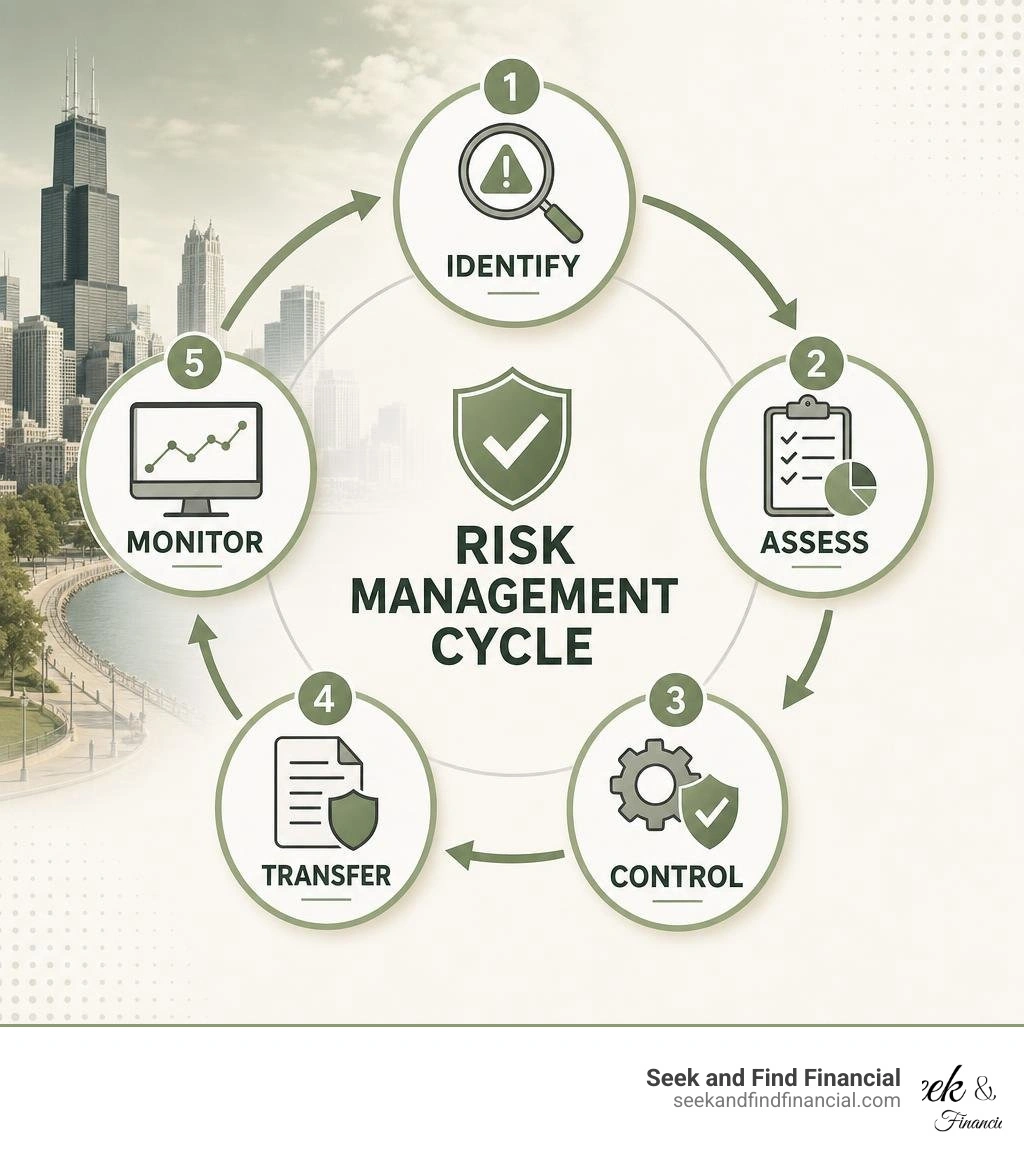
The core idea is simple: identify what could hurt your business, then build a plan to reduce or transfer that risk.
Most risks cannot be fully avoided. But most can be managed — with the right systems, the right partners, and a clear strategy in place.
I'm Daniel Delaney, founder of Seek & Find Financial, and throughout my career advising individuals and business owners — including my years working within established financial institutions — I've seen how poor risk management in Chicago can quietly erode wealth that took years to build. Understanding your exposures is not just an operational concern; it is a core part of any serious financial strategy.
Investing involves risk, including possible loss of principal. No investment strategy can ensure financial success or guarantee against losses. Past performance may not be used to predict future results. Provided content is for overview and informational purposes only, reflect the opinions of the author, and is not intended and should not be relied upon as individualized tax, legal, fiduciary, or investment advice.
This information is being provided only as a general source of information. These views may change as market or other conditions change. This information is not intended and should not be used to provide financial advice and does not address or account for an individual's circumstances. Past performance does not guarantee future results and no forecast should be considered a guarantee. Please seek the guidance of a financial professional regarding your particular financial concerns.
Investment advisory services offered by duly registered individuals through Seek & Find Financial LLC a Registered Investment Adviser. Licensed Insurance Professional.
Every business operating in the Chicagoland area must navigate a complex web of local compliance rules. From municipal codes in the city center to broader Cook County guidelines, staying compliant is your first line of defense. If you ignore these rules, you face heavy fines, legal issues, and damage to your reputation.
For business owners in Chicago and nearby areas like Crown Point or Merrillville, this means keeping a close eye on local employment laws, tax structures, and safety codes. Compliance is not a one time task. It is an ongoing process that requires constant attention.
Public entities set a strong example of how to handle large scale exposures. For example, the Risk Management - City of Chicago department focuses on protecting municipal assets and ensuring that city operations continue without interruption. They manage the city's exposure to accidental losses and establish uniform terms for contracts.
On a broader scale, the Cook County Department of Risk Management handles countywide employee benefits, workers' compensation, and general liability programs. Their work covers everything from civil rights claims and law enforcement liability to medical malpractice and auto liability.
By looking at how these government bodies manage risk, private organizations can learn to structure their own programs. You must ensure your benefits packages, general liability policies, and workers' compensation plans align with both local and federal requirements.
To protect your wealth and your business, you must know exactly what risks you face. A proper risk assessment is not about guessing. It is about taking a structured look at every part of your operation.
We always recommend starting with a Comprehensive Risk Assessment to map out your vulnerabilities. This process helps you see where you are exposed to financial loss, operational failure, or legal trouble. Once you know where the holes are, you can take steps to plug them.
Chicago area businesses face a unique set of physical and operational threats. Extreme weather is a major factor. Lake effect snow, high winds, and severe storms can cause severe property damage and halt business operations. If your physical location is damaged, you need a plan to keep your business running.
Supply chain disruptions are another common threat. Whether you are located in downtown Chicago, Portage, or Chesterton, your business relies on the smooth flow of goods and services.
Even public transportation and safety plans impact local operations. For instance, public transit systems in the region follow structured plans like the PTASP/Safety Management System (SMS) Plan - Valparaiso, IN to keep riders and workers safe. Your business should have a similar, structured continuity plan to handle unexpected disruptions.
In June 2026, cyber threats are more sophisticated than ever. Hackers do not just target giant corporations. They often target mid-sized businesses and growing startups because these companies often have weaker defenses.
A single data breach can cost hundreds of thousands of dollars. It can also destroy the trust you built with your clients. That is why we view cybersecurity as a fundamental part of financial preservation. To protect your digital assets, you need a plan that covers threat hunting, regular security audits, and virtual Chief Information Security Officer (vCISO) services. You can learn more about securing your digital perimeter through specialized services like Cyber Security | RSA Risk Management.
A strong defense requires more than just installing antivirus software. It requires a complete strategy that matches your business model. For business owners, integrating cybersecurity into your broad plan is essential. We discuss these strategies in detail in our guide on Risk Management for Entrepreneurs.
To keep your data safe, consider these active steps:
Insurance is a critical tool for managing risk, but it should not be your only defense. Relying solely on insurance can lead to high premiums and gaps in coverage. Instead, smart business owners use a mix of insurance, self-insurance, and contractual risk transfer.
When we design a wealth strategy for high earning business owners, we look at how insurance fits into the bigger picture. Protecting your business assets directly protects your personal wealth. You can read more about balancing these priorities in our article on Wealth Management Chicago.
When you work with third party vendors, contractors, or suppliers, you inherit their risks. If a vendor makes a mistake that causes a lawsuit or property damage, your business could be held responsible.
To prevent this, you must use contractual risk transfer. This means your contracts should clearly state that the vendor is responsible for their own mistakes.
You also need to collect and track Certificates of Insurance (COIs) to prove your vendors have the right coverage. Managing COIs manually can lead to mistakes. Many businesses use automated tracking tools to ensure no vendor works with expired or insufficient insurance. For a deeper look at how to structure these protective agreements, review the insights on How We Serve to see how professionals analyze exposures and read the fine print.
You do not have to build your risk management program alone. Partnering with local experts can save you time, money, and stress. Chicago is home to highly specialized consulting firms that can help you secure your business.
For physical security and legal protection, you might need forensic accounting, active shooter training, or physical vulnerability assessments. Specialized firms like RSA Risk Management | Risk Management & Investigations bring deep experience, often from federal law enforcement, to help corporate and legal clients protect their assets.
The right consultant depends on your industry and your specific needs. If your business deals with physical products, manufacturing, or commercial real estate, you may face health and safety risks.
In these cases, you need experts in industrial hygiene, occupational safety, and human health risk sciences. Firms like Health & Safety Solution Services in Chicago | RHP Risk Management use advanced exposure simulation laboratories to measure risks from chemicals, noise, and other workplace hazards.
If you run a nonprofit or a service based business, your risks might be more administrative or operational. In that case, working with a specialized consultant like Hoffman-Barnes Risk Management Consulting Company can help you design custom compliance programs and enterprise risk assessments that fit your unique organization.
The City of Chicago Risk Management department is responsible for protecting the city's assets and ensuring its operations can continue after a loss. They focus on minimizing the long term costs of accidental losses and managing the city's insurance policies and self-insurance programs.
Businesses in Chicago must comply with the Illinois Workers' Compensation Act. This requires employers to provide benefits to workers who are injured or become ill on the job. To manage this risk, businesses must administer claims carefully, focus on workplace safety, and maintain proper workers' compensation insurance.
In 2026, Chicago organizations are prioritizing several emerging risks. These include cybersecurity threats, climate and extreme weather risks, supply chain disruptions, and workplace violence. Many businesses are investing in active shooter training and workplace violence prevention to keep their employees safe.
Improving your risk management Chicago program is not a project you finish and forget. It is an ongoing practice that protects everything you have built. By understanding local regulations, assessing your threats, securing your data, and transferring risk through contracts, you build a resilient business.
At Seek & Find Financial, we believe that true wealth management goes beyond picking investments. It is about building a complete, technology-driven financial plan that protects your business, optimizes your taxes, and secures your personal future. Whether you are located in Chicago, Hobart, or Hebron, we are here to help you achieve real-life financial growth.
To learn more about how we can help you align your business success with a long term personal wealth strategy, explore What We Do.
Investing involves risk, including possible loss of principal. No investment strategy can ensure financial success or guarantee against losses. Past performance may not be used to predict future results. Provided content is for overview and informational purposes only, reflect the opinions of the author, and is not intended and should not be relied upon as individualized tax, legal, fiduciary, or investment advice.
This information is being provided only as a general source of information. These views may change as market or other conditions change. This information is not intended and should not be used to provide financial advice and does not address or account for an individual’s circumstances. Past performance does not guarantee future results and no forecast should be considered a guarantee. Please seek the guidance of a financial professional regarding your particular financial concerns.
Investment advisory services offered by duly registered individuals through Seek & find Financial LLC a Registered Investment Adviser. Licensed Insurance Professional