

DST Real Estate Investing: Capital Preservation Meets Tax Planning
Discover how DST real estate investing delivers passive ownership, 1031 tax deferral, and capital preservation for accredited investors.
DST real estate investing is a strategy that lets accredited investors own fractional shares of large, institutional-grade commercial properties — while potentially deferring significant capital gains taxes through a 1031 exchange.
Here is a quick breakdown of what you need to know:
Picture this: you have spent 20 years building a rental portfolio. It has been good to you. But the tenant calls, the maintenance bills, and the sleepless nights before lease renewals? You are done with all of that.
So you decide to sell. Then your CPA delivers the news.
Between federal capital gains taxes, depreciation recapture, state taxes, and the net investment income tax, you could lose 30% or more of your profit to taxes before you see a dollar. For a high-earning business owner or entrepreneur, that is a serious wealth erosion event.
That is exactly the situation where DST real estate investing enters the conversation. It is not a loophole. It is a structured, IRS-recognized strategy that allows investors to defer that tax bill, stay invested in real estate, and step away from active management entirely.
In 2025, DST sponsors raised approximately $8.41 billion in equity — a 49% jump from the prior year. That growth reflects a real and growing demand from investors who want smarter exits from active property ownership.
I'm Daniel Delaney, founder of Seek & Find Financial, and throughout my career in financial services — including work with established advisory firms and exposure to complex investment strategies — I have helped clients think through how DST real estate investing fits within a broader, tax-efficient wealth plan. In this guide, I will walk you through how DSTs work, what the real benefits and risks look like, and how to evaluate whether this strategy makes sense for your situation.
Investing involves risk, including possible loss of principal. No investment strategy can ensure financial success or guarantee against losses. Past performance may not be used to predict future results. Provided content is for overview and informational purposes only, reflect the opinions of the author, and is not intended and should not be relied upon as individualized tax, legal, fiduciary, or investment advice.
This information is being provided only as a general source of information. These views may change as market or other conditions change. This information is not intended and should not be used to provide financial advice and does not address or account for an individual's circumstances. Past performance does not guarantee future results and no forecast should be considered a guarantee. Please seek the guidance of a financial professional regarding your particular financial concerns.
Investment advisory services offered by duly registered individuals through Seek & Find Financial LLC a Registered Investment Adviser. Licensed Insurance Professional
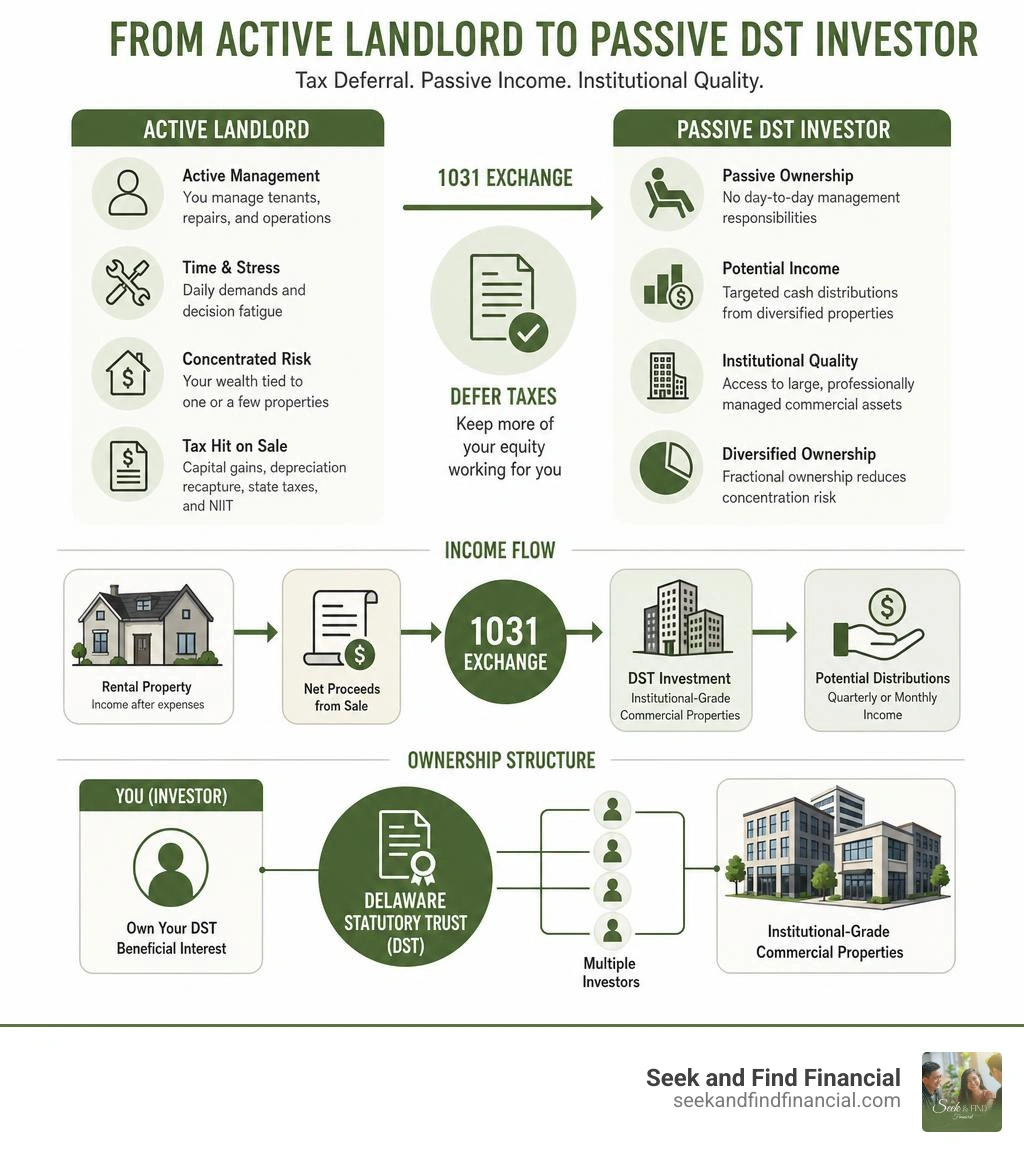
A Delaware Statutory Trust is a distinct legal entity. It is formed under Delaware law. It allows multiple investors to pool their money. Together, they buy fractional shares of high-value real estate.
These properties are often institutional-grade assets. They are large properties like apartment complexes, logistics centers, or medical offices. These assets usually cost between $30 million and $100 million. They are far too expensive for most individual investors to buy on their own.
The legal foundation for this strategy is IRS Revenue Ruling 2004-86. This ruling says that a beneficial interest in a DST is treated as direct ownership of real estate for federal income tax purposes. Because of this, your investment is not treated as a corporate stock or a partnership interest. Instead, the IRS sees it as real property.
The DST is structured as a grantor trust. This means the trust itself does not pay federal income taxes. Instead, all income, deductions, and depreciation pass directly through to the individual investors. This structure is a key part of any Tax Efficient Investment Strategy because it avoids the double taxation found in traditional corporate structures.

To understand how a DST works, you must understand the key players and the legal setup:
To qualify as an accredited investor, you must meet specific financial criteria. You must have a net worth of over $1 million, not counting your primary home. Or you must have an annual income of over $200,000 as an individual ($300,000 for married couples) for the past two years, with the expectation of earning the same this year.
The primary reason investors use DSTs is to defer taxes when selling an investment property. Under Section 1031 of the Internal Revenue Code, you can defer capital gains taxes by exchanging one investment property for another "like-kind" property.
Because a beneficial interest in a DST is treated as direct real estate ownership, it qualifies as like-kind property. This allows you to sell your active rental property and move your money directly into a passive DST. This process is called a Delaware Statutory Trust (DST) 1031 Exchanges transaction.
By using this strategy, you can defer several types of taxes:
When you add these taxes together, they can take a massive bite out of your hard-earned wealth. Deferring them keeps your full investment balance working for you. This is a core pillar of Tax Efficient Wealth Management.
Another major benefit of the DST structure is debt replacement. To fully defer your taxes in a 1031 exchange, you must buy a replacement property of equal or greater value than the one you sold. You must also replace any mortgage debt you had on the old property. If you do not replace the debt, the cash you save is called "boot," and it is fully taxable.
Most DST properties are structured with pre-arranged debt. This debt is non-recourse. This means you are not personally liable for the loan. The lender cannot go after your personal assets if something goes wrong. When you invest in the DST, you receive a proportional share of that debt. This makes it incredibly easy to match your debt and equity requirements without having to qualify for a new bank loan yourself.
The IRS is incredibly strict about 1031 exchange timelines. If you miss a deadline by even one minute, your exchange fails, and your entire tax bill becomes due.
Finding, negotiating, and closing on a commercial property in 45 days is incredibly difficult in today's market. If a deal falls through at the last minute, you run out of time.
DSTs solve this timing problem. Because the DST sponsor has already acquired the property and put the financing in place, these investments are pre-packaged. You can review the documents, select your share, and close the entire transaction in as little as 3 to 5 business days. This speed makes DSTs an excellent safety net or primary target for investors facing tight deadlines. You can find available options by looking at DST Properties for 1031 Exchange | Cornerstone to see how these offerings are structured.
Moving from active landlording to a DST offers several lifestyle and financial benefits. It allows you to protect your wealth while simplifying your daily life. This is why we often include these structures in Bespoke Investment Strategies for clients looking to transition into retirement or focus on their primary businesses.
The most immediate benefit is the complete elimination of active property management. You no longer have to deal with tenants, toilets, or trash. The DST sponsor handles all property maintenance, rent collection, lease negotiations, and monthly reporting. You simply receive your monthly distribution check.
Additionally, you gain access to high-quality assets that would otherwise be out of reach. Instead of owning a single-family rental home in Chicago or Valparaiso, you can own a share of:
These properties often have more stable tenant bases and longer lease terms than residential rentals.
When you own a single rental property, your investment risk is highly concentrated. If your tenant leaves, your cash flow drops to zero. If the local economy hits a rough patch, your property value could fall.
DSTs allow you to spread your investment across multiple properties, asset classes, and geographic regions. For example, if you sell a property in Crown Point or Merrillville, you do not have to put all your exchange proceeds into a single replacement property. You can split your money across three different DSTs:
This diversification helps protect your income stream. If one property faces higher vacancies, the income from the other properties can help balance your portfolio. You can learn more about local options and geographic strategies through 1031 DST Properties Indiana – 1031 Exchange.
While the tax benefits and passive nature of DSTs are highly attractive, these investments are not right for everyone. They carry significant risks that you must carefully weigh before moving forward. At Seek & Find Financial, we believe in looking at both sides of every strategy. This balanced approach is key to our Advanced Wealth Strategies Ultimate Guide.
The biggest disadvantage of a DST is that your capital is completely locked up. There is no public secondary market for DST shares. Once you invest, you cannot easily sell your interest if you need cash for an emergency. You must be prepared to hold the investment for the entire life of the trust, which is typically 5 to 10 years.
Furthermore, you give up all control over the property. You have zero voting rights. You cannot decide when to raise rents, when to paint the building, or when to sell the property. All of these decisions are made by the trustee and the sponsor. If you are an investor who enjoys the hands-on process of improving real estate, this lack of control can be highly frustrating.
Because you have no control, you are entirely dependent on the sponsor's skill and honesty. If the sponsor makes poor management decisions or overpays for a property, your returns will suffer. This is why evaluating the sponsor's historical track record across different economic cycles is the most critical part of your due diligence.
Additionally, to maintain their tax-deferred status under IRS rules, DSTs must operate under very strict limitations. These are commonly known as the "Seven Deadly Sins" of a DST:
These rules create a highly rigid structure. If a major tenant leaves or a property needs unexpected structural upgrades, the trust cannot easily raise new money or change its loan terms to fix the problem.
To help you understand where DSTs fit in the broader real estate landscape, let us compare them to other common real estate investment structures:
| Feature | Delaware Statutory Trust (DST) | Real Estate Investment Trust (REIT) | Tenant-in-Common (TIC) | Direct Ownership |
|---|---|---|---|---|
| 1031 Exchange Eligible | Yes | No (Except 721 UPREIT at exit) | Yes | Yes |
| Management Role | 100% Passive | 100% Passive | Passive to Active | 100% Active |
| Investor Control | None | None | Unanimous consent required | Complete Control |
| Liquidity | Very Low (5-10 year hold) | High (If publicly traded) | Low | Low to Moderate |
| Minimum Investment | $100K - $250K | $1K - $5K | Typically $1M+ | Variable |
| Max Investors | Up to 499 | Unlimited | Up to 35 | Unlimited |
This comparison highlights why different investors choose different paths. While REITs offer excellent liquidity and low minimums, they do not allow you to defer taxes through a 1031 exchange. TICs allow for 1031 exchanges, but they require all investors to agree on major decisions, which can lead to legal gridlock.
For a deeper dive into how these structures impact your tax liability, you can read our Tax Efficient Investment Strategies Guide.
Accredited investors often choose DSTs because they solve the specific problems of high-net-worth wealth transition. If you are earning $400,000+ or have built a multi-million dollar business in Chicago or Northwest Indiana, your time is your most valuable asset.
Spending your weekends managing residential rentals is rarely the best use of your energy. A DST allows you to keep your capital growing in institutional real estate while freeing up your time to focus on your business or your family. You can learn more about how local professionals coordinate these transactions by visiting a Chicago 1031 Exchange Advisory Firm | DST Investments.
For investors executing a 1031 exchange, the typical minimum investment ranges from $100,000 to $250,000. Some sponsors may lower this limit to $25,000 for investors purchasing shares with cash outside of a 1031 exchange. Because you are buying a fractional interest, you can invest precise dollar amounts to match your exact exchange requirements down to the penny. You can browse current minimums and active listings on platforms like DST 1031 Exchange Investments.
The average holding period is 5 to 10 years, with 7 years being the most common target. During this time, your money is fully committed. The sponsor will operate the property, distribute net cash flow monthly, and eventually sell the asset when market conditions are favorable. Once the property is sold, the trust is dissolved, and you receive your share of the proceeds. At that point, you can choose to cash out and pay your deferred taxes, or roll your money into another 1031 exchange to keep deferring those taxes.
DSTs are structured products, and they carry several layers of fees that you must carefully evaluate in the Private Placement Memorandum (PPM):
While these fees can be high, they are often offset by the tax savings and the institutional pricing the sponsor secures on the property. However, you must always verify how these fees impact your projected net returns.
DST real estate investing is a highly structured tool. It is designed for a specific purpose: helping management-fatigued landlords and high-earning business owners preserve their wealth, defer heavy tax bills, and transition into passive income.
But because of the strict IRS rules, the long holding periods, and the complete lack of investor control, it is not a decision to make lightly. Success with this strategy requires deep due diligence, a clear understanding of the fee structures, and a long-term perspective.
At Seek & Find Financial, we do not believe in cookie-cutter financial advice. We work with entrepreneurs and professionals across Valparaiso, Chesterton, Portage, Hebron, Merrillville, Crown Point, Hobart, and Chicago to build highly personalized, technology-driven wealth plans. If you are preparing to sell an investment property and want to see how a DST fits into your overall financial picture, we are here to help you navigate the process.
To explore how tax-efficient planning can protect your hard-earned wealth, discover our insights on High-Net-Worth Tax Planning.
Investing involves risk, including possible loss of principal. No investment strategy can ensure financial success or guarantee against losses. Past performance may not be used to predict future results. Provided content is for overview and informational purposes only, reflect the opinions of the author, and is not intended and should not be relied upon as individualized tax, legal, fiduciary, or investment advice.
This information is being provided only as a general source of information. These views may change as market or other conditions change. This information is not intended and should not be used to provide financial advice and does not address or account for an individual’s circumstances. Past performance does not guarantee future results and no forecast should be considered a guarantee. Please seek the guidance of a financial professional regarding your particular financial concerns.
Investment advisory services offered by duly registered individuals through Seek & find Financial LLC a Registered Investment Adviser. Licensed Insurance Professional