

Exit Planning for Business Owners 101
Master exit planning for business owners: Build value, choose paths, cut taxes & secure retirement in Canada. Start now!

Exit planning for business owners is the process of preparing your business for a future transition — whether that means selling, passing it on, or stepping back — in a way that maximizes value and protects your wealth.
Here is what you need to know at a glance:
| Key Question | Quick Answer |
|---|---|
| What is it? | A strategic plan to transition out of your business on your terms |
| When to start? | 3 to 5 years before your intended exit |
| Main options | Sell to a third party, family, employees, or a hybrid approach |
| Why it matters | Most owners have 80 to 90% of their wealth tied up in their business |
| Biggest risk | Two-thirds of business owners have no documented plan |
Most high-earning business owners spend years building something valuable. But very few have a clear plan for what happens when it's time to leave.
That gap is costly. Research shows only 20 to 30% of private business transitions are successful. Half of business owners are pushed into rushed, unplanned exits due to illness, burnout, or unexpected events. Without a plan, you risk leaving serious money on the table — or losing control of the outcome entirely.
This guide walks you through everything you need to know to exit on your terms.
I'm Daniel Delaney, Founder of Seek & Find Financial, and I've spent my career in financial services — first at established wealth management firms and now independently — helping clients navigate complex financial decisions, including exit planning for business owners. The strategies I've seen work best always start with one thing: a clear, structured plan built well in advance.
Investing involves risk, including possible loss of principal. No investment strategy can ensure financial success or guarantee against losses. Past performance may not be used to predict future results. Provided content is for overview and informational purposes only, reflect the opinions of the author, and is not intended and should not be relied upon as individualized tax, legal, fiduciary, or investment advice.
This information is being provided only as a general source of information. These views may change as market or other conditions change. This information is not intended and should not be used to provide financial advice and does not address or account for an individual's circumstances. Past performance does not guarantee future results and no forecast should be considered a guarantee. Please seek the guidance of a financial professional regarding your particular financial concerns.
Investment advisory services offered by duly registered individuals through Seek & Find Financial LLC a Registered Investment Adviser. Licensed Insurance Professional.
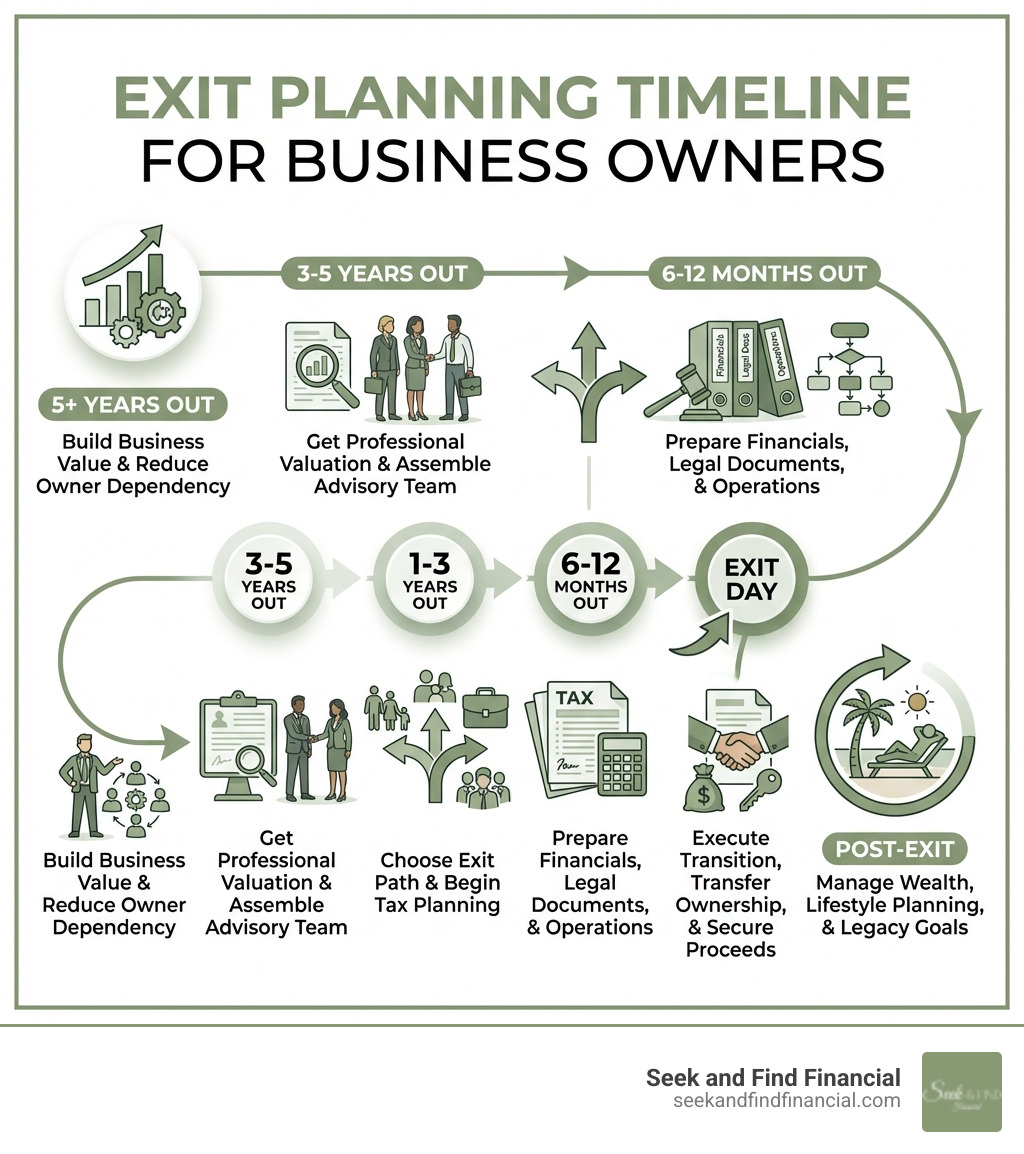
Think of exit planning for business owners as a strategic roadmap. It is not just about the day you hand over the keys. It is about every decision you make leading up to that moment. Many owners in places like Crown Point or Chicago focus so much on daily operations that they forget the big picture. They assume a buyer will just show up when they are ready to retire.
Unfortunately, the data tells a different story. While millions of small business owners plan to exit in the next decade, only a small fraction are actually prepared. This "preparation gap" is a major problem. If you don't have a plan, you are essentially leaving your legacy to chance.
A good exit plan does several things:
Without a documented plan, transitions often become chaotic. This can lead to lower sale prices and stress for your employees and customers. By starting early, you can use a succession planning guide to ensure your business remains a source of pride and wealth for years to come.
There is no one size fits all way to leave a business. The path you choose depends on your goals, your family, and your financial needs. Generally, you have three main routes: internal, external, or a hybrid of both.
Internal sales involve people who already know the business. This could be your children, your business partners, or your management team. External sales involve selling to someone outside the company, like a competitor or a private equity group.
| Feature | Internal Sale | External Sale |
|---|---|---|
| Speed | Often slower, involves grooming | Usually faster once a buyer is found |
| Culture | High chance of staying the same | Higher risk of major changes |
| Price | May be lower (family/employee discount) | Often higher (strategic premium) |
| Training | Owner often stays to mentor | Owner usually exits quickly |
For many owners in Valparaiso or Merrillville, keeping the business in the family is the ultimate goal. A family succession allows you to pass on your legacy. However, it requires careful planning to avoid family drama and ensure the next generation is actually ready to lead.
Another internal option is a management buyout. This is where your top employees buy the company from you. This is great for continuity because they already know the customers and the systems. Sometimes, owners use "seller financing" to help this happen. This means you get paid over time from the company's future profits. It is a win-win that lets you stay involved as a mentor while slowly stepping away.
If you want the highest possible price and a clean break, an external sale might be the way to go. Strategic acquirers are often willing to pay more because your business fits perfectly into their existing operations.
Other external options include:
To understand which route fits your specific situation, you can review different business exit strategies to see how they align with your timeline.
You might think your business is worth a certain amount based on your gut feeling. But a buyer will look at it through a very different lens. To get the best price, you need a professional valuation.
Valuations are often based on "multiples." This usually means a multiple of your EBITDA (Earnings Before Interest, Taxes, Depreciation, and Amortization) or your total revenue. But numbers are only part of the story.
Intangible assets often drive the price higher. These include:
One of the biggest value drivers is "owner replaceability." If the business stops running the moment you go on vacation, it is not worth much to a buyer. They want to buy a machine that works, not a job where they have to be you. To increase your value, you must empower your management team and document your processes.

Building an exit plan is a team sport. You should not try to do this alone. You need an advisory team that includes a financial advisor, a tax professional, and a legal expert.
First, you must define your financial goals. How much money do you actually need to live the life you want after the exit? Once you know that number, you can work backward to see if your business value matches your needs.
Tax strategy is another critical step. The way you structure the sale matters. For example, an asset sale is different from a share sale. In the United States, you might look at strategies like 1031 exchanges for real estate or Opportunity Zones to defer or reduce taxes. You want to keep as much of that hard earned money as possible.
You should also focus on:
For high earners, this is where more info about wealth management services becomes vital. You need to know how the sale proceeds will be invested to support you for the next 30 years.
We often talk about the money, but what about the person? Many business owners struggle with their identity after they sell. If you have been "the boss" for 40 years, who are you on Monday morning when you don't have an office to go to?
Experts like Susan Latremoille emphasize that retirement lifestyle planning is just as important as the financial side. You need to align your personal goals with your business exit. Do you want to travel? Start a charity? Consult?
A successful exit plan isn't just about the bank balance. It is about creating happiness and security. If you don't plan for your "life after business," you might find yourself regretting the sale, even if the price was right.
The best time to start was yesterday. The second best time is now. Ideally, you should start 3 to 5 years before you want to leave. This gives you time to fix any problems in the business and implement tax strategies that take time to set up.
Taxes can take a huge bite out of your sale proceeds. Depending on how your business is structured (C-Corp, S-Corp, LLC), you could face different capital gains rates. Working with a professional to plan your exit can help you find ways to minimize these costs through structured payments or specific tax elections.
The biggest mistake is waiting too long. Many owners wait until they are burnt out or sick to think about selling. When you are in a rush, you lose your leverage. You end up taking a lower price or worse terms because you just want to be done. Another common mistake is having all your personal expenses run through the business, which makes the company look less profitable to a buyer.
At Seek & Find Financial, we believe that exit planning for business owners is the ultimate act of leadership. It protects your family, your employees, and your legacy. By using structured planning and a long term strategy, you can turn your years of hard work into a future of clarity and freedom.
Don't leave your transition to chance. Whether you are in Hobart, Hebron, or Chesterton, the time to build your roadmap is now. You deserve to exit on your own terms with your head held high.
If you are ready to see where you stand, you can start your financial plan today and take the first step toward a successful transition.
Investing involves risk, including possible loss of principal. No investment strategy can ensure financial success or guarantee against losses. Past performance may not be used to predict future results. Provided content is for overview and informational purposes only, reflect the opinions of the author, and is not intended and should not be relied upon as individualized tax, legal, fiduciary, or investment advice.
This information is being provided only as a general source of information. These views may change as market or other conditions change. This information is not intended and should not be used to provide financial advice and does not address or account for an individual’s circumstances. Past performance does not guarantee future results and no forecast should be considered a guarantee. Please seek the guidance of a financial professional regarding your particular financial concerns.
Investment advisory services offered by duly registered individuals through Seek & find Financial LLC a Registered Investment Adviser. Licensed Insurance Professional