

The Definitive Guide to Exit Planning for Entrepreneurs
Master exit planning for entrepreneurs: strategies, valuation, tax tips & steps to maximize value and secure your future.

Exit planning for entrepreneurs is the process of getting your business ready for a change. This could mean selling to a new buyer. It could mean giving it to a family member. It could also mean letting employees take over. You might even choose to close on your own terms.
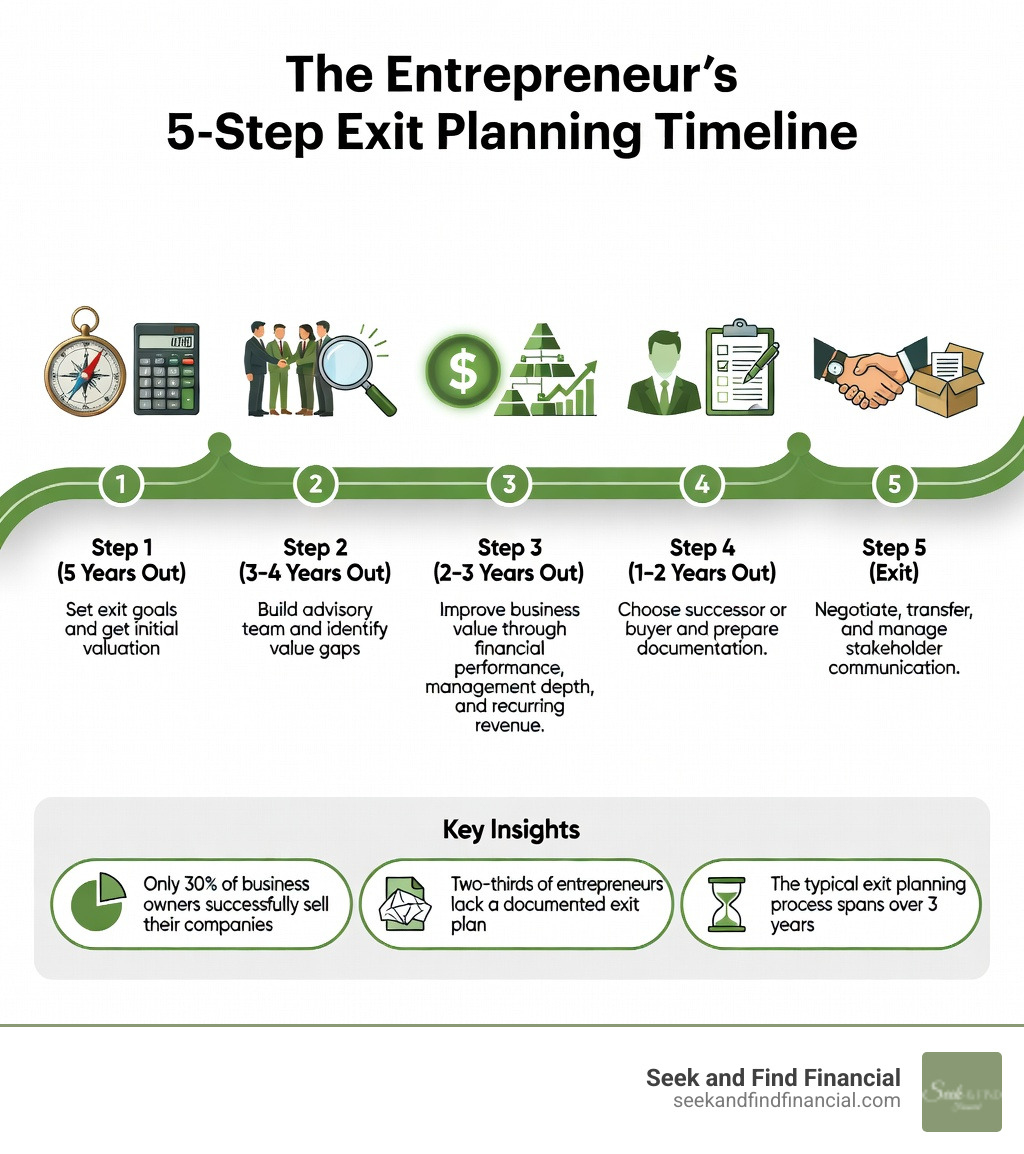
Here is what that process usually looks like:
Many owners spend years building a business. They spend very little time planning how to leave. This is a big mistake. Only 30 percent of owners sell their business. Most do not have a written plan. This is a big risk for owners who earn a lot of money.
A good plan protects what you built. It gives you control over when you leave. It helps you get the most value. It also helps your family and employees.
I am Daniel Delaney. I am the founder of Seek & Find Financial. I have spent my career helping business owners. I have worked at large firms and now run my own practice. I help owners with the hard parts of exit planning for entrepreneurs. My experience helps me give you a clear and practical strategy.
Investing involves risk, including possible loss of principal. No investment strategy can ensure financial success or guarantee against losses. Past performance may not be used to predict future results. Provided content is for overview and informational purposes only, reflect the opinions of the author, and is not intended and should not be relied upon as individualized tax, legal, fiduciary, or investment advice.
This information is being provided only as a general source of information. These views may change as market or other conditions change. This information is not intended and should not be used to provide financial advice and does not address or account for an individual's circumstances. Past performance does not guarantee future results and no forecast should be considered a guarantee. Please seek the guidance of a financial professional regarding your particular financial concerns.
Investment advisory services offered by duly registered individuals through Seek & Find Financial LLC a Registered Investment Adviser. Licensed Insurance Professional.
Building a business is like a long car trip. You would not start driving without a map. Yet many owners do this with their companies. Exit planning for entrepreneurs is important. It turns your business from a job into something you can sell. Without a plan, you are leaving your future to luck.

Only 30 percent of owners sell their companies. This low rate is often because they did not prepare. An exit plan is a safety net. It helps you manage risk. It helps you get the most money for your work. You can use an Official guide to closing or selling your business. This helps protect your employees and customers. It also helps you stay financially independent.
The best time to start is today. You should start 3 to 5 years before you want to leave. Starting early gives you time to raise the sale price. It also makes the change go smoothly.
When you plan early, you can find value gaps. This is the gap between what your business is worth now and what you need for retirement. Expert help is very useful here. It helps you make your company more attractive to buyers.
The biggest problem is often how you feel. It is hard to let go after many years. Many owners feel the business is their identity. They might be too busy to plan for the future.
Another problem is the value gap. Many owners do not know what their business is worth. They guess based on a feeling. They are often sad when they try to sell. You must learn How to handle the emotional roadblocks of exiting. You must be ready for the next chapter.
There is no single plan for everyone. Your plan depends on your goals and your needs.
How do you pick? Ask what matters most. Is it your name on the building? Is it getting cash fast? Is it the future of your workers?
If you care about culture, an ESOP might be best. If you need the most money for retirement, a strategic buyer is usually better. Your goal will guide every choice you make.
Both paths have good and bad points. Selling to an outsider usually pays more cash at once. But it can change the company culture. Selling to people inside the company is smoother for the team. But you often get paid over many years.
| Feature | External Sale | Internal Transfer (Family/MBO) |
|---|---|---|
| Payer | Strategic or Financial Buyer | Family, Managers, or Employees |
| Sale Price | Usually Higher | Often Lower |
| Speed | Can be fast (6 to 12 months) | Usually slow (3 to 5 years) |
| Cultural Impact | High risk of change | High continuity |
| Payment Terms | Mostly cash at closing | Often paid over time |
A good exit needs a team. You should not do this alone. You need a financial advisor and a tax lawyer. You also need a CPA and a business broker.
One big step is separating your personal money from the business. Many owners mix them together. We help you separate them. This helps the business stand on its own. You should write everything down. Make a guide for how the business runs. This lets the business work even if you are not there.
You cannot plan if you do not know your starting point. A professional valuation looks at more than your bank account. It looks at your EBITDA. This stands for earnings before interest, taxes, and other costs. It also looks at market trends and your brand.
Getting a valuation early gives you time to fix things. If the value is too low, you have time to grow. You can use A comprehensive exit plan guide to see how the numbers work.
Sharing your plan is tricky. If you tell people too early, they might get scared and leave. If you tell them too late, they might lose trust.
The key is Maintaining consistency during business changes. You need a clear way to talk to investors and workers. Focus on why the change is good. Show how it brings stability.
You want the best price for your business. To get it, you must make the business ready for a buyer. Focus on what makes the business valuable.
Buyers love money that comes in every month. This is called recurring revenue. If you only sell things one time, it is risky. If you have contracts, your business is worth more. You also need clean books. A pro can check your numbers. This proves your profits are real.
This is a common reason businesses do not sell. If you are the only one who can do the work, you do not have a business. You just have a job that pays well.
We suggest a hub and spoke model. You are the hub. Your team members are the spokes. They should be able to do the work without you. This makes the business more valuable to a buyer.
Buyers will look closely at your money. They will check your inventory and your profit margins.
To get ready, use the US Chamber guide on developing an exit plan. This helps you make your business run better. It shows that your profits come from a good system.
It is not about the sale price. It is about how much money you keep after taxes. Exit planning for entrepreneurs must include a tax plan.
The way you sell matters. It could be an asset sale or a stock sale. This choice has big tax effects. An asset sale might be better for the buyer. But it could trigger higher tax liabilities for you. We look at ways to spread out the tax. We might use trusts to help you save on taxes.
What will you do when the deal is done? Many owners struggle with who they are without their company.
Your money plan needs to account for this. We help you make a budget for life after the business. This includes things the business used to pay for. We think about health insurance and travel. Then we help you invest your money so you have a steady income.
For family businesses, planning helps save on taxes. You can give shares over time. This moves wealth to your family without losing too much to taxes.
In places like Valparaiso or Chicago, local tax laws matter. We know these local rules. We help you keep more of your hard-earned money.
You should start 3 to 5 years before you want to leave. This gives you time to make the business worth more. It also helps you get your personal money ready. But the best time to start is always now.
A full change usually takes more than three years. The actual sale usually takes 6 to 12 months.
You might not be able to sell your business. You might be forced to leave because of health or market changes. This usually means you get less money and pay more in taxes.
Exit planning for entrepreneurs is about more than a sale. It is about your legacy. It is about your family's future. It needs a good plan and a strong team. You must think about the long term while you run the business.
At Seek & Find Financial, we help business owners in Indiana and Illinois. We use technology to give you a clear plan. We make sure your exit matches your real-life goals.
Are you ready to see what your business is worth? Start your personalized financial strategy today.
Investing involves risk, including possible loss of principal. No investment strategy can ensure financial success or guarantee against losses. Past performance may not be used to predict future results. Provided content is for overview and informational purposes only, reflect the opinions of the author, and is not intended and should not be relied upon as individualized tax, legal, fiduciary, or investment advice.
This information is being provided only as a general source of information. These views may change as market or other conditions change. This information is not intended and should not be used to provide financial advice and does not address or account for an individual’s circumstances. Past performance does not guarantee future results and no forecast should be considered a guarantee. Please seek the guidance of a financial professional regarding your particular financial concerns.
Investment advisory services offered by duly registered individuals through Seek & find Financial LLC a Registered Investment Adviser. Licensed Insurance Professional