

The Ultimate Guide to Finding a Fiduciary Retirement Planner
Discover how a fiduciary retirement planner protects your future with unbiased advice and transparent fees.
Working with a fiduciary retirement planner means working with someone who is legally required to put your interests first — not their firm's, not their own. Most people assume every financial advisor already works this way. Most people are wrong.
Here is a quick breakdown of what that actually means:
| Question | Answer |
|---|---|
| What is a fiduciary retirement planner? | An advisor legally obligated to act in your best interest at all times |
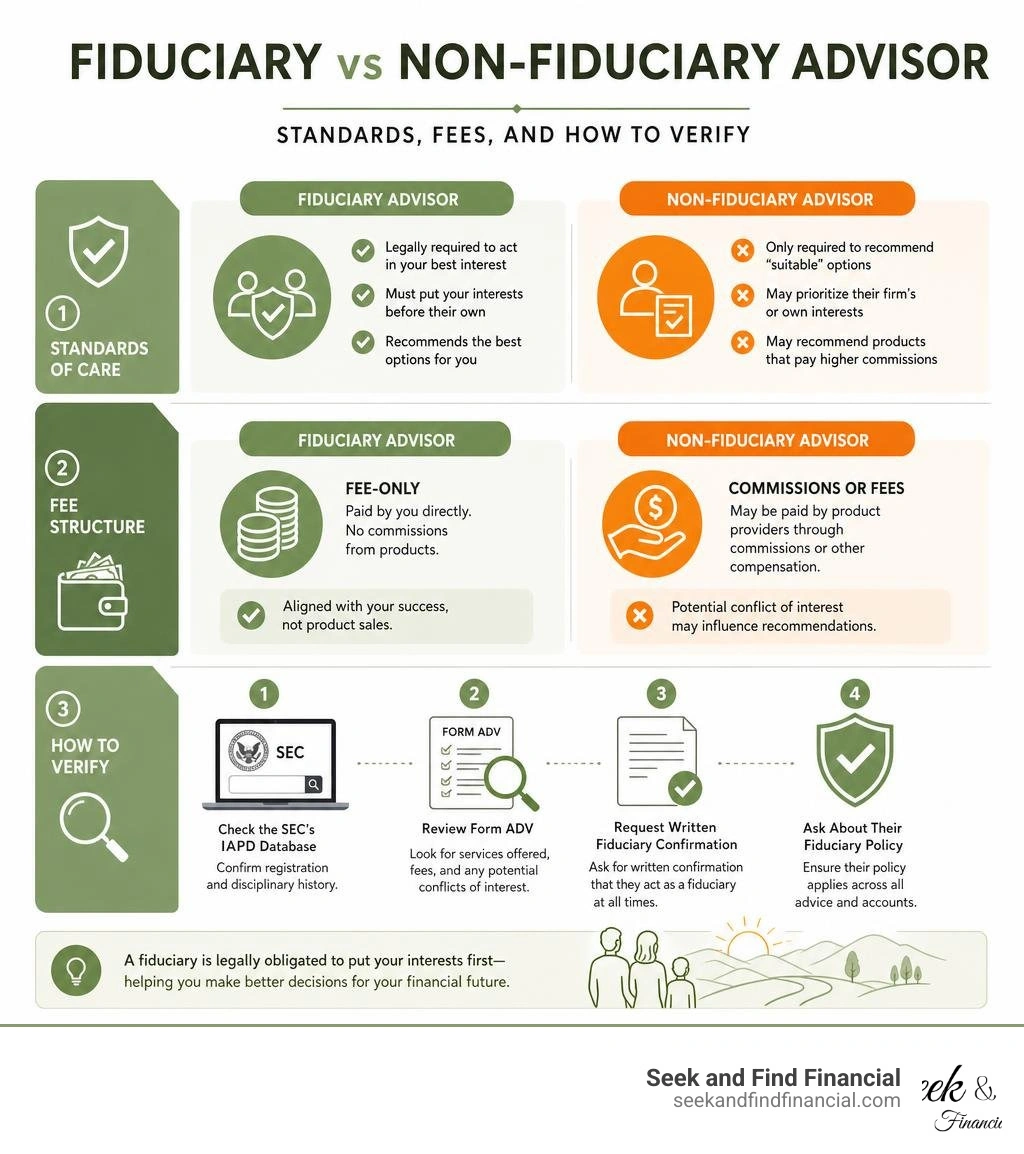
| How is this different from other advisors? | Non-fiduciary advisors only need to recommend "suitable" products, not the best ones |
| How are fiduciary planners typically paid? | Fee-only (by you directly), not through product commissions |
| How do you verify fiduciary status? | Check the SEC's IAPD database, review Form ADV, and ask for written confirmation |
| Who should work with one? | Anyone making major retirement decisions, especially high earners with complex finances |
If you are earning $400K or more, running a business, or approaching a major financial transition, the gap between "suitable" advice and truly independent advice can cost you tens of thousands of dollars over time. A 1% annual fee on a $1.5 million portfolio, for example, equals $15,000 per year — and that compounds into several hundred thousand dollars of lost growth over 20 years.
This guide will walk you through everything you need to know: what fiduciary really means, how to verify an advisor's status, what questions to ask, and how to protect your retirement from conflicts of interest.
I'm Daniel Delaney, founder of Seek & Find Financial, and after years working inside established financial institutions, I built this firm specifically to deliver the kind of transparent, client-first guidance that a true fiduciary retirement planner provides. That experience on both sides of the industry shapes every recommendation in this guide.
Investing involves risk, including possible loss of principal. No investment strategy can ensure financial success or guarantee against losses. Past performance may not be used to predict future results. Provided content is for overview and informational purposes only, reflect the opinions of the author, and is not intended and should not be relied upon as individualized tax, legal, fiduciary, or investment advice.
This information is being provided only as a general source of information. These views may change as market or other conditions change. This information is not intended and should not be used to provide financial advice and does not address or account for an individual's circumstances. Past performance does not guarantee future results and no forecast should be considered a guarantee. Please seek the guidance of a financial professional regarding your particular financial concerns.
Investment advisory services offered by duly registered individuals through Seek & Find Financial LLC a Registered Investment Adviser. Licensed Insurance Professional
Simple fiduciary retirement planner glossary:
A fiduciary retirement planner is a professional who must put your financial needs ahead of their own. This standard is not just a marketing phrase. It is a strict legal requirement.
Many people believe that all financial professionals must act this way. However, many advisors operate under different rules. They might only have to give you advice that is "good enough" rather than what is best for you. For anyone planning a secure retirement, this difference is massive.
The fiduciary standard rests on two main pillars. These are the duty of care and the duty of loyalty.
The duty of care means the advisor must act with great skill and wisdom. They must study your financial life. They must understand your goals, your tax situation, and your tolerance for risk. They cannot give you generic advice.
The duty of loyalty means the advisor must put your interests first. They cannot recommend an investment just because it pays them a big bonus. If a conflict of interest exists, they must tell you about it clearly. They must manage all decisions in your favor.
Conflicts of interest happen often in the financial world. For example, some advisors get paid commissions for selling specific mutual funds or insurance products. This creates a temptation to sell you things you do not need.
A fiduciary planner must avoid these conflicts. If they cannot avoid them, they must disclose them in writing. This transparency keeps your retirement plan clean. It ensures that every dollar in your portfolio is working for your future, not for an advisor's paycheck.
To make the best choice for your money, you must understand how advisors get paid. The way an advisor earns money affects the advice they give you.
| Feature | Fee-Only Fiduciary | Commission-Based / Suitability |
|---|---|---|
| Primary Loyalty | Strictly to the client | Often to the broker-dealer or product company |
| Legal Standard | Fiduciary (Best Interest) | Suitability (Good Enough) |
| How They Are Paid | Flat fees, hourly fees, or AUM fees paid by the client | Commissions from product sales, mutual fund loads |
| Conflicts of Interest | Minimalized and fully disclosed | High, due to product sales incentives |
Many brokers and insurance agents operate under the suitability standard. This standard is regulated by FINRA. It only requires that a product is suitable for you at the time of purchase.
For example, if you need to invest your savings, an advisor under the suitability standard could recommend a fund that charges high annual fees because it pays them a commission. A cheaper, better fund might exist, but they are not legally required to recommend it. These hidden costs can slowly drain your savings. When setting up your Retirement Plans, these extra fees can delay your retirement by years.
A fee-only advisor does not accept commissions. They are paid directly by you. This payment can be a flat annual fee, an hourly rate, or a percentage of assets under management (AUM).
Because they do not sell products for commissions, they can look at all Retirement Investment Options with total honesty. They can help you select low-cost index funds and efficient tax strategies. This keeps more money in your account to grow over time.
You should never take an advisor's word about their fiduciary status. You must verify it yourself. Fortunately, there are simple public tools you can use to check their background.
Look for advisors who hold respected, independent credentials. The most common is the Certified Financial Planner (CFP) designation. CFP professionals are bound by a strict code of ethics to act as fiduciaries when providing financial planning.
You should also look for Registered Investment Advisors (RIAs). These firms are registered with the SEC or state regulators. They are legally bound to the fiduciary standard at all times.
If you are looking for local experts in Indiana, you can search tools like the Indiana FEE-ONLY Financial Advisors - FeeOnlyNetwork.com to find registered professionals who do not accept commissions.
Every Registered Investment Advisor must file a document called Form ADV with the SEC. This document is public. You can search for it on the SEC's Investment Adviser Public Disclosure (IAPD) database.
Form ADV Part 2A is a plain-English brochure. It details the advisor's fees, services, and any past disciplinary problems. You can also use FINRA's BrokerCheck tool to see an advisor's work history. Checking these databases is a crucial step when designing Retirement Plans For High Earners. It ensures your planner has a clean record.
If you want to look at general local listings, you can browse tools like Find Top Financial Advisors in Portage, Indiana - WiserAdvisor.com to see registered options in our Northwest Indiana service areas.
A retirement planner does more than just pick investments. They build a complete system to replace your salary when you stop working.

When you retire, you stop saving money and start spending it. A fiduciary planner helps you calculate a safe withdrawal rate. This is the amount you can take out each year without running out of money.
They also help you optimize your Social Security benefits. They look at your pension options and lifetime income strategies. This structured approach helps ensure you can maintain your lifestyle for decades.
Taxes can be one of your biggest expenses in retirement. A fiduciary planner coordinates your investments with a smart tax strategy.
They will look at your accounts to determine the best withdrawal order. They can help you perform Roth conversions during low-income years. For business owners, they can integrate an Entrepreneur Retirement Plan to maximize tax deductions while you are still working. This careful planning can save you hundreds of thousands of dollars in lifetime taxes.
Before you hire any advisor, you should interview them. Do not be afraid to ask direct questions about their business practices and fees.
Here are the most important questions to ask during an interview:
You can read more about what to expect during this process in our Personalized Retirement Planning Guide.
Watch out for advisors who give vague answers about their fees. If they tell you their services are "free" or paid by the investment company, they are earning commissions.
Another red flag is a strong push toward proprietary products or complex annuities. These products often carry high fees and long lock-up periods. If an advisor cannot explain a strategy in simple language, it is best to walk away. Business owners should be especially careful to avoid these traps when setting up Retirement Savings Plans For Small Business Owners.
Yes, under the CFP Board's rules, a CFP professional must act as a fiduciary when providing financial advice to a client. If they violate this standard, they can lose their certification. However, you should still ask them to confirm their fiduciary status in writing.
Fiduciary planners can charge in a few different ways. Some charge a flat annual fee or an hourly rate. Others charge a fee based on a percentage of the assets they manage for you (AUM). The key is that their fees are transparent and paid directly by you, not by product manufacturers.
Some advisors are "dually registered." This means they can act as a fiduciary when managing your investments, but they can switch to a broker role to sell you an insurance product for a commission. This dual role can create conflicts of interest. It is always safest to work with a pure fee-only advisor who does not accept commissions of any kind.
Planning for retirement can feel overwhelming. There are many moving parts, from tax laws to investment strategies. Working with a fiduciary retirement planner gives you the peace of mind that your advisor is legally bound to act in your best interest.
At Seek & Find Financial, we focus on clear, personalized, and technology-driven planning. We use modern tools like Altruist to keep your costs low and your strategy transparent. We serve clients across our local communities, including Valparaiso, Chesterton, Portage, Hebron, Merrillville, Crown Point, and Hobart in Indiana, as well as Chicago, Illinois.
If you are ready to build a clear, structured plan for your retirement, we invite you to learn more about what we do and how we can support your long-term success.
Investing involves risk, including possible loss of principal. No investment strategy can ensure financial success or guarantee against losses. Past performance may not be used to predict future results. Provided content is for overview and informational purposes only, reflect the opinions of the author, and is not intended and should not be relied upon as individualized tax, legal, fiduciary, or investment advice.
This information is being provided only as a general source of information. These views may change as market or other conditions change. This information is not intended and should not be used to provide financial advice and does not address or account for an individual’s circumstances. Past performance does not guarantee future results and no forecast should be considered a guarantee. Please seek the guidance of a financial professional regarding your particular financial concerns.
Investment advisory services offered by duly registered individuals through Seek & find Financial LLC a Registered Investment Adviser. Licensed Insurance Professional