

The Growth Map Every Entrepreneur Needs
Master financial planning for business growth: Scale smart with strategies, metrics, funding, and resilient roadmaps for entrepreneurs.
Financial planning for business growth is the process of forecasting, budgeting, and managing your financial resources so your business can scale without running out of cash or losing control.
Here is what it covers at a glance:
Growth feels exciting. But without a financial plan behind it, growth can actually hurt your business.
Here is the hard truth: 82% of small businesses fail due to cash flow problems. Many of those businesses were growing. They just were not planning.
Revenue going up does not mean cash is flowing in. Hiring ahead of demand, expanding too fast, or misallocating capital are some of the most common reasons scaling businesses stall or collapse.
A strong financial plan turns your growth ambitions into a structured, repeatable system. It answers three core questions:
Without clear answers to these, you are navigating growth without a map.
I'm Daniel Delaney, founder of Seek & Find Financial, and I've spent my career working inside established financial institutions and now independently helping business owners apply financial planning for business growth at every stage of their journey. This guide breaks down exactly how to build that map, step by step.
Investing involves risk, including possible loss of principal. No investment strategy can ensure financial success or guarantee against losses. Past performance may not be used to predict future results. Provided content is for overview and informational purposes only, reflect the opinions of the author, and is not intended and should not be relied upon as individualized tax, legal, fiduciary, or investment advice.
This information is being provided only as a general source of information. These views may change as market or other conditions change. This information is not intended and should not be used to provide financial advice and does not address or account for an individual's circumstances. Past performance does not guarantee future results and no forecast should be considered a guarantee. Please seek the guidance of a financial professional regarding your particular financial concerns.
Investment advisory services offered by duly registered individuals through Seek & Find Financial LLC a Registered Investment Adviser. Licensed Insurance Professional
Financial planning for business growth terms made easy:
When we talk about Financial Planning for Growth: 5 Levels to Success , we are looking at more than just keeping the books. We are building a strategic framework for your future. For many owners in Northwest Indiana and Chicago, their company represents 60% to 80% of their personal net worth. This means your business growth plan is actually your personal wealth plan.
Sustainable scaling requires you to move from reactive bookkeeping to proactive strategy. You need to know exactly how much you can afford to spend to get a new customer and when that cash will actually hit your bank account. Without this clarity, you might find yourself "growing broke"—having plenty of sales on paper but no cash to pay the bills.
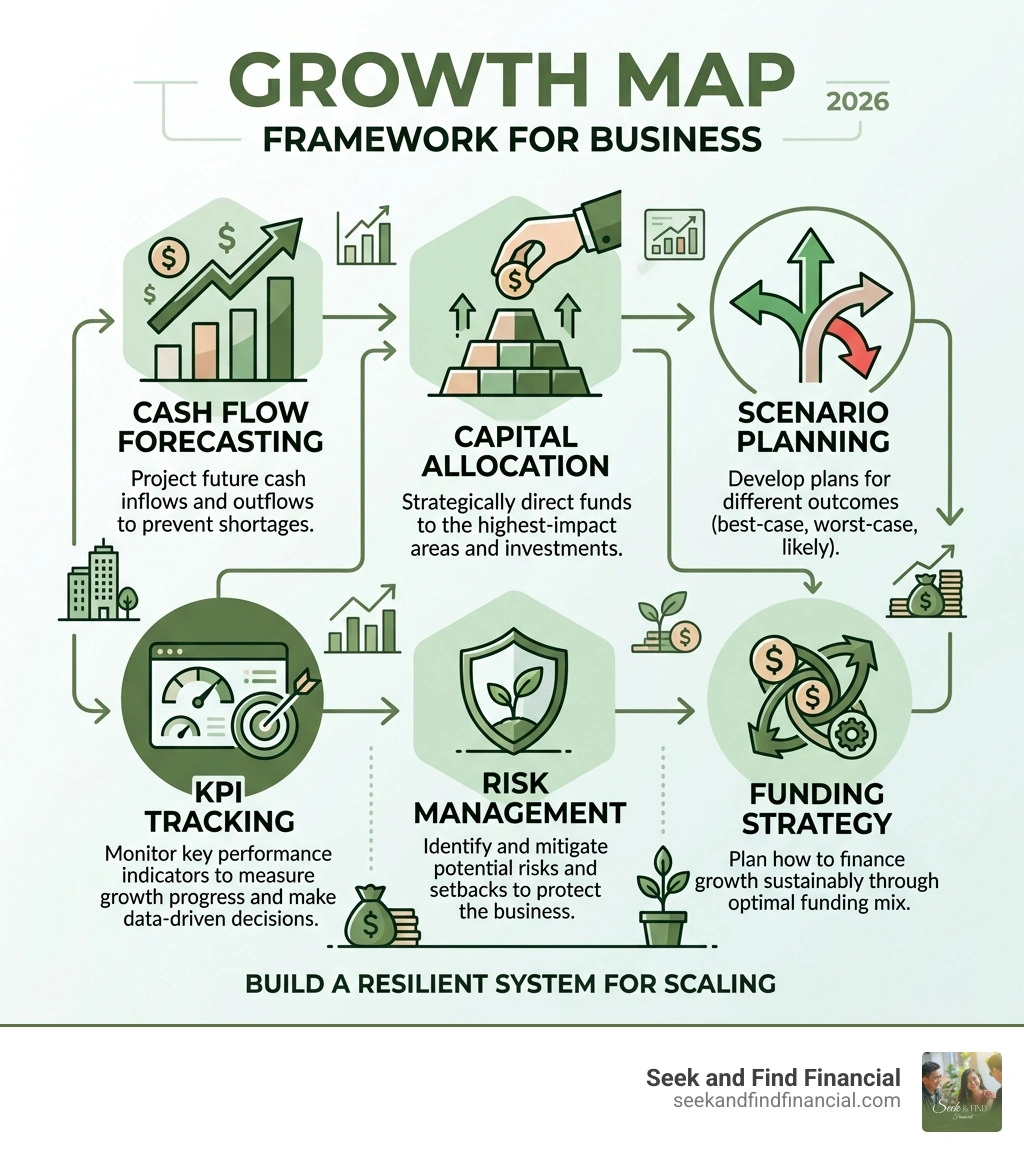
A solid growth map is built on four pillars:
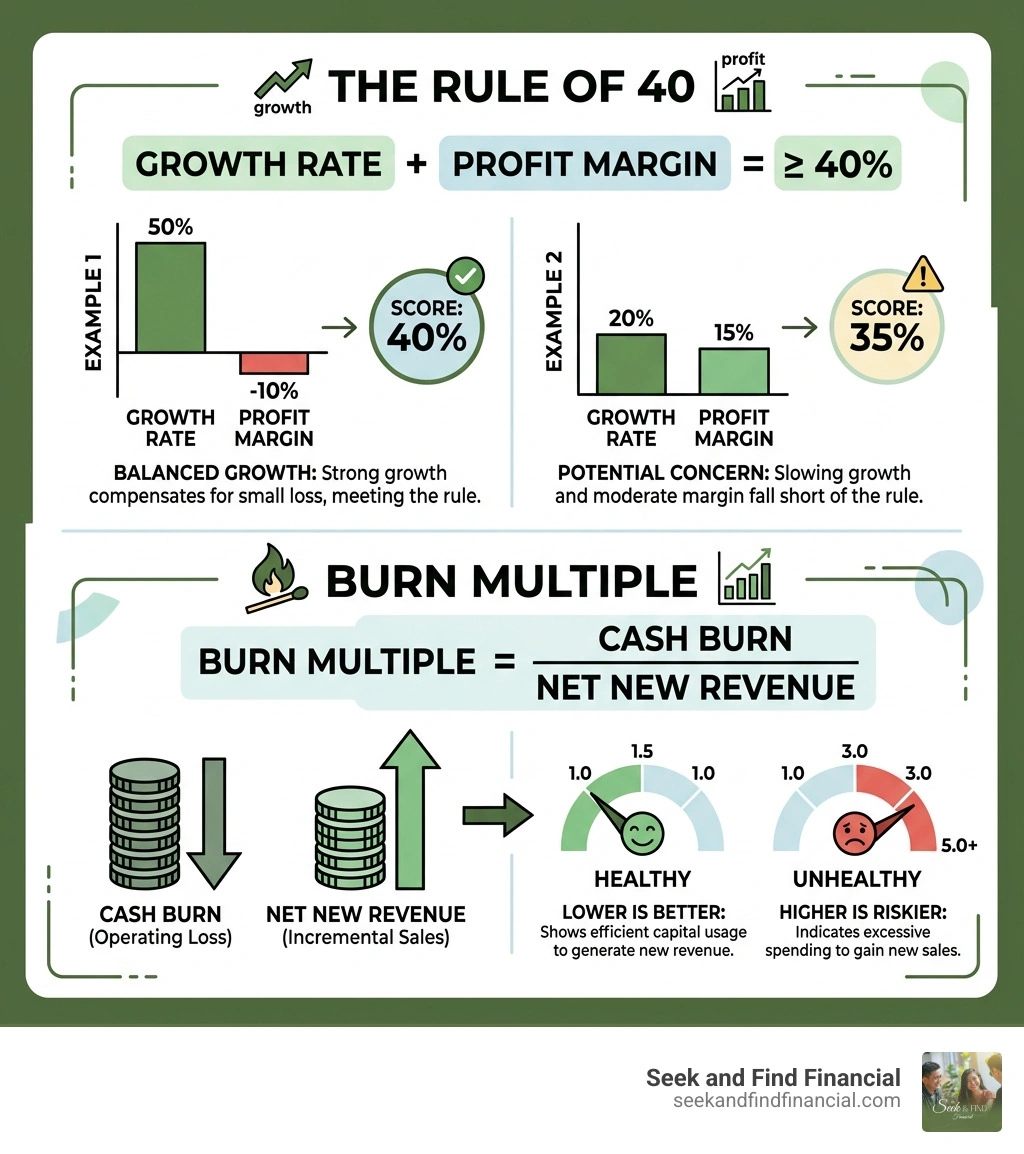
To manage growth, you must measure it. We focus on Business Capital Management by tracking specific metrics that show how efficient your growth really is.
One key metric is the Rule of 40. This is often used for software companies but is helpful for many businesses. It says your growth rate plus your profit margin should be at least 40%. For example, if you are growing at 50% but losing 5% in margin, your score is 45%. This shows you are balancing market capture with good economics.
Another important number is the burn multiple. This tells us how much you are spending to generate each dollar of new revenue. We also look at unit economics, which is the profitability of a single item or customer. If you lose money on every sale, growing bigger will only make your problems worse.

Before you hit the gas, we need to check the engine. Financial Management for Entrepreneurs starts with an honest look at your current financial health. Many owners lack an accurate understanding of what their company is actually worth. Obtaining a business valuation is a great first step to see if your business is ready for the next level.
We look at several indicators to see if you are ready to scale. One of the most important is comparing your Return on Invested Capital (ROIC) to your Weighted Average Cost of Capital (WACC). If your ROIC is higher than your WACC, you are creating value. If it is lower, you are actually destroying value by growing.
We also check your liquidity ratios and working capital. Scaling often requires buying inventory or hiring staff before you get paid by customers. You need enough cash on hand to bridge that gap.
| Metric | Current State | Expansion Goal |
|---|---|---|
| Monthly Revenue | $50,000 | $100,000 |
| Gross Margin | 40% | 45% |
| Cash Buffer | 2 Months | 4 Months |
| Customer Acquisition Cost | $500 | $450 |
The future is never certain. That is why we use scenario modeling. We create three different versions of your financial future:
This "what-if" analysis helps us find your breaking point. It allows us to build a plan that stays strong even if the market shifts.
Capital allocation is your most powerful strategic tool. It is the process of deciding where to put your money to get the best return. According to research, companies with structured capital allocation processes achieve 30% higher returns than those making ad-hoc decisions.
We often suggest a 50/30/20 framework for Financial Reinvestment Tips for Growth :
Using zero-based budgeting for new projects is also helpful. This means every expense must be justified from scratch, which helps eliminate waste.
How you fund your growth matters as much as the growth itself. You have a few main options:
We provide Financial Advice for Entrepreneurs to help you choose the right mix for your specific goals and risk tolerance.
A growth map is not a one-time document. It is a living guide. Long-term Business Planning requires you to look years ahead while managing the day-to-day.
Cash flow is the lifeblood of your business. We recommend a 13-week cash flow forecast that you update every week. This gives you a clear view of exactly what is coming in and going out.
You should also establish a Reserve Fund. Set aside at least 3 to 6 months of operating expenses. This buffer allows you to handle emergencies without panic. To keep cash moving, consider automated billing and reminders to reduce the time it takes for customers to pay you.
Scaling magnifies risks. You need to protect what you have built. This includes having the right insurance coverage, like liability and property insurance.
It also means having the right team. Strategic Financial Decisions are easier when you have professional advisors. We use technology-driven tools like Altruist to give you a clear, real-time view of your financial life. This allows us to coordinate your business goals with your personal wealth strategy.
You should review your financial metrics monthly. A deeper review of the entire growth plan should happen quarterly. This allows you to make course corrections before small issues become big problems. If there is a 10% variance between your plan and reality, investigate it immediately.
The most dangerous mistake is premature scaling. This happens when a business spends heavily on marketing or hiring before they have proven their unit economics or have a stable process. Growth magnifies existing leaks in your business. Fix the leaks first, then scale.
A good rule of thumb is 3 to 6 months of operating expenses. However, if your business is highly seasonal or has volatile revenue, you might want to keep closer to 12 months in a "runway" account.
Financial planning for business growth is about more than just numbers. It is about giving you the clarity and confidence to lead. By building a structured map, you turn growth from a source of stress into a manageable path toward success.
At Seek & Find Financial, we specialize in helping high-income business owners in places like Valparaiso, Crown Point, and Chicago navigate these complexities. We integrate your business goals with your personal wealth strategy so you can build a legacy that lasts.
Ready to see how a clear strategy can transform your business? More info about our services is just a click away.
Investing involves risk, including possible loss of principal. No investment strategy can ensure financial success or guarantee against losses. Past performance may not be used to predict future results. Provided content is for overview and informational purposes only, reflect the opinions of the author, and is not intended and should not be relied upon as individualized tax, legal, fiduciary, or investment advice.
This information is being provided only as a general source of information. These views may change as market or other conditions change. This information is not intended and should not be used to provide financial advice and does not address or account for an individual’s circumstances. Past performance does not guarantee future results and no forecast should be considered a guarantee. Please seek the guidance of a financial professional regarding your particular financial concerns.
Investment advisory services offered by duly registered individuals through Seek & find Financial LLC a Registered Investment Adviser. Licensed Insurance Professional