

The Side Hustler's Guide to Shrinking the Tax Man's Cut
Learn how to reduce taxable income with a side business: claim home office, mileage, retirement contributions & more!

Many high earners do not know how to reduce taxable income with a side business. It is simpler than you think. The savings can be very large.
Here are the main ways a side business lowers your taxes:
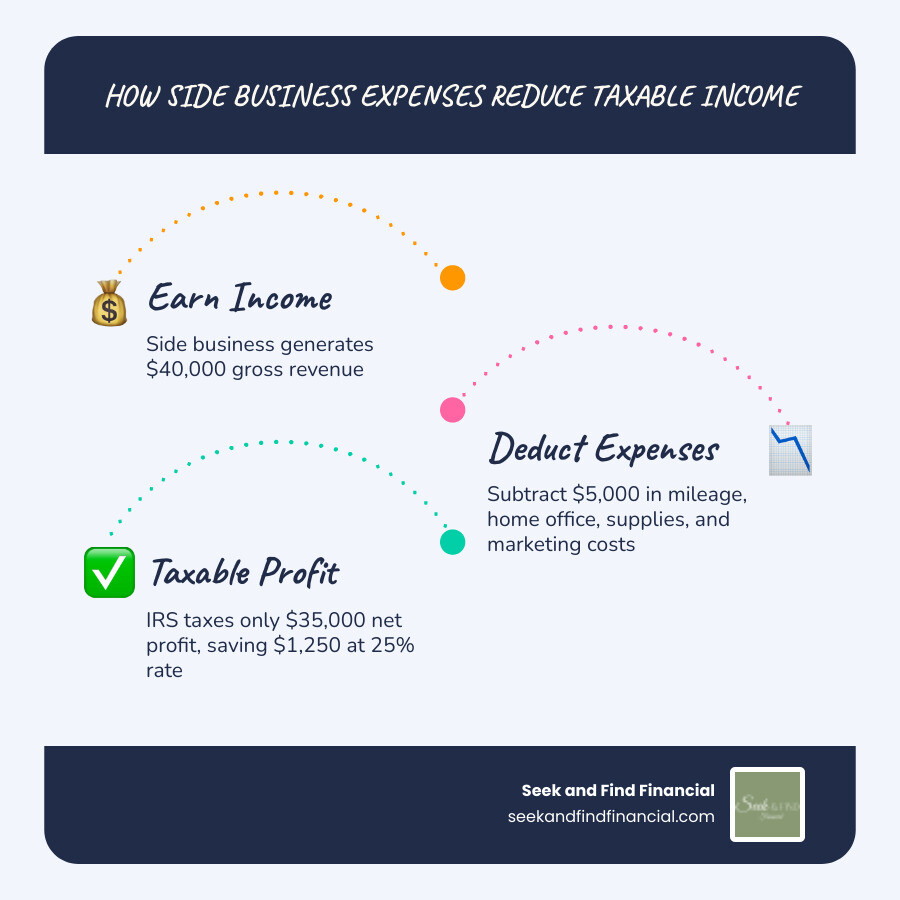
The math is easy. If your business earns $40,000 and you have $5,000 in costs, you only pay tax on $35,000. If your tax rate is 25%, you save $1,250.
There is one rule. The IRS must see your work as a business. It cannot be just a hobby. This is a very important rule.
I am Daniel Delaney. I am the Founder of Seek & Find Financial. I have spent years helping people learn how to reduce taxable income with a side business. I use clear and structured plans. In this guide, I will show you how to follow the rules and save money.
The first step is to make sure the IRS sees your work as a real business. If the IRS thinks your work is a hobby, you cannot deduct costs. This is important for people in Crown Point or Chicago who work on the side.
The IRS uses a nine-factor test to decide. They look for a profit motive. This means you are trying to make money. Do you keep good records? Do you spend a lot of time on it? If you say yes, you likely have a business.
You report your income on a form called Schedule C. This form is part of your tax return. You take your total earnings and subtract ordinary and necessary costs. An ordinary cost is common in your field. A necessary cost is helpful for your work.
Lowering your profit on Schedule C lowers your total income. This can put you in a lower tax bracket. Our clients often earn over $400,000. Every dollar saved on taxes helps them build wealth for the long term.
Once we know you have a real business, we look for ways to lower your bill. Many people miss out because they do not track every cost.

Startup costs are a good place to start. You can deduct up to $5,000 in your first year. This covers things like research or legal fees. Marketing fees are also deductible. This includes ads or a website. If you pay dues for a business group in Valparaiso or Merrillville, keep those receipts.
One big perk is the self-employment tax deduction. When you work for yourself, you pay a 15.3% tax. The IRS lets you deduct half of that amount. This lowers your taxable income before you look at other costs.
Other common costs include:
The home office deduction has strict rules. Your space must be used only for business. It cannot be a guest room or a playroom. It must be your main place of work.
You can use a simple method. This gives you $5 per square foot. You can claim up to 300 square feet. This is an easy $1,500 deduction.
Mileage is another big saver. For 2025, the standard mileage rate is 70 cents per mile. If you drive to meet a client in Portage or buy supplies in Hobart, those miles count. Driving from home to a regular job does not count. We suggest using an app to track every trip.
Supplies and tools are also important. Office supplies like paper and ink are easy to track. We also look at larger items.
Software for your business is deductible. If you buy a new laptop, you have choices. You can use Section 179 to deduct the full cost in one year. For 2025, the limit is $2.5 million. This covers almost any side business tool.
For high earners, the best way to protect income is to save for retirement. This is a big part of how we build wealth at Seek & Find Financial.
A side business lets you use special retirement plans. The Solo 401(k) and the SEP IRA are two of the best. These plans let you save much more than a standard plan at work.
In 2025, you can put up to $70,000 into these plans. If you are over age 50, you can add $7,500 more. If you are between age 60 and 63, you can add $11,250. This is a great way to move money into your wealth-building pile.
When you put money into these plans, you use pre-tax dollars. This lowers your income dollar-for-dollar. It is a great way to learn how to reduce taxable income with a side business.
The Solo 401(k) limits are very high. You act as both the boss and the worker. You can save as the worker and then your business can add more as the boss.
This helps you delay taxes. You do not pay taxes on this money now. It grows over time. You only pay taxes when you take the money out later. This is a key perk for small business owners.
Saving money is great. Staying out of trouble is even better. The IRS is watching side income very closely.
You will get a 1099-NEC if you earn $600 or more from one client. Apps like Venmo or PayPal may also send a 1099-K. You must report every dollar you earn even if you do not get a form.
If you expect to owe more than $1,000 in taxes, you should pay every three months. You use Form 1040-ES to find these payments. For 2025, the deadlines are April, June, September, and January.
If you do not pay on time, you may face fees. We tell our clients to keep digital receipts. Use an app to scan every purchase. Good records are your best protection.
Yes, you can. If your costs are higher than your income, you have a loss. This loss can often lower the tax on your main job. But if you have a loss for too many years, the IRS may call it a hobby. You should try to show a profit in three out of five years.
It is not a law, but we think it is a good idea. Having a separate account in Chesterton or Hebron makes it easy to track costs. It looks professional. It keeps your personal life and business life separate.
The QBI deduction lets you take 20% of your profit off your taxes. For 2025, you get the full amount if your income is under $197,300 for one person. If you are married, the limit is $394,600. If you earn more, the rules get harder to follow.
Building a side business is about more than extra cash. It is a tool for financial clarity. You can lower your tax bill and grow your wealth. Whether you are in Valparaiso or Chicago, the rules are the same. Stay organized and save for the future.
At Seek & Find Financial, we help high earners with these choices. We use tools like Altruist to show your progress. If you want to learn more, you can find more info about our financial services.
Investing involves risk, including possible loss of principal. No investment strategy can ensure financial success or guarantee against losses. Past performance may not be used to predict future results. Provided content is for overview and informational purposes only, reflect the opinions of the author, and is not intended and should not be relied upon as individualized tax, legal, fiduciary, or investment advice.
This information is being provided only as a general source of information. These views may change as market or other conditions change. This information is not intended and should not be used to provide financial advice and does not address or account for an individual’s circumstances. Past performance does not guarantee future results and no forecast should be considered a guarantee. Please seek the guidance of a financial professional regarding your particular financial concerns.
Investment advisory services offered by duly registered individuals through Seek & find Financial LLC a Registered Investment Adviser. Licensed Insurance Professional