

Keep the Cash Flowing: A Guide to Working Capital Management in Small Business
Master the importance of working capital management in small business to keep cash flowing and fuel growth.
Understanding the importance of working capital management in small business is one of the most practical things you can do to protect your company's financial health. Here is a quick summary of why it matters:
The core idea is simple: working capital is your current assets minus your current liabilities. It is the money available to run your business right now. When managed well, it acts like fuel in a tank. When ignored, even a profitable business can stall.
Research backs this up. Studies show that working capital management accounts for over half of the variation in small business financial performance. Yet surveys consistently find that fewer than three in ten small businesses maintain enough cash reserves to cover even three months of operations. That gap between appearance and reality is exactly where businesses get into trouble.
Many businesses that look healthy on paper are forced to close not because they lacked sales, but because they could not meet short-term obligations when those payments came due.
I'm Daniel Delaney, Founder of Seek & Find Financial, and having worked within established financial institutions before launching my own independent advisory firm, I have seen how overlooking the importance of working capital management in small business can undermine even the most promising companies. In the sections below, I will walk you through exactly how working capital works, how to measure it, and how to manage it strategically.
Investing involves risk, including possible loss of principal. No investment strategy can ensure financial success or guarantee against losses. Past performance may not be used to predict future results. Provided content is for overview and informational purposes only, reflect the opinions of the author, and is not intended and should not be relied upon as individualized tax, legal, fiduciary, or investment advice.
This information is being provided only as a general source of information. These views may change as market or other conditions change. This information is not intended and should not be used to provide financial advice and does not address or account for an individual's circumstances. Past performance does not guarantee future results and no forecast should be considered a guarantee. Please seek the guidance of a financial professional regarding your particular financial concerns.
Investment advisory services offered by duly registered individuals through Seek & Find Financial LLC a Registered Investment Adviser. Licensed Insurance Professional
Working capital is the money your business uses for its daily operations. To find your working capital, you take your current assets and subtract your current liabilities. Current assets include cash, unpaid customer invoices, and inventory. Current liabilities are the bills you must pay within one year, such as supplier invoices, taxes, and short-term debt.
Many business owners confuse profit with cash. You can have a highly profitable month on paper, but if that profit is tied up in unpaid customer bills, you cannot use it to pay your rent. This is called a cash flow timing gap.
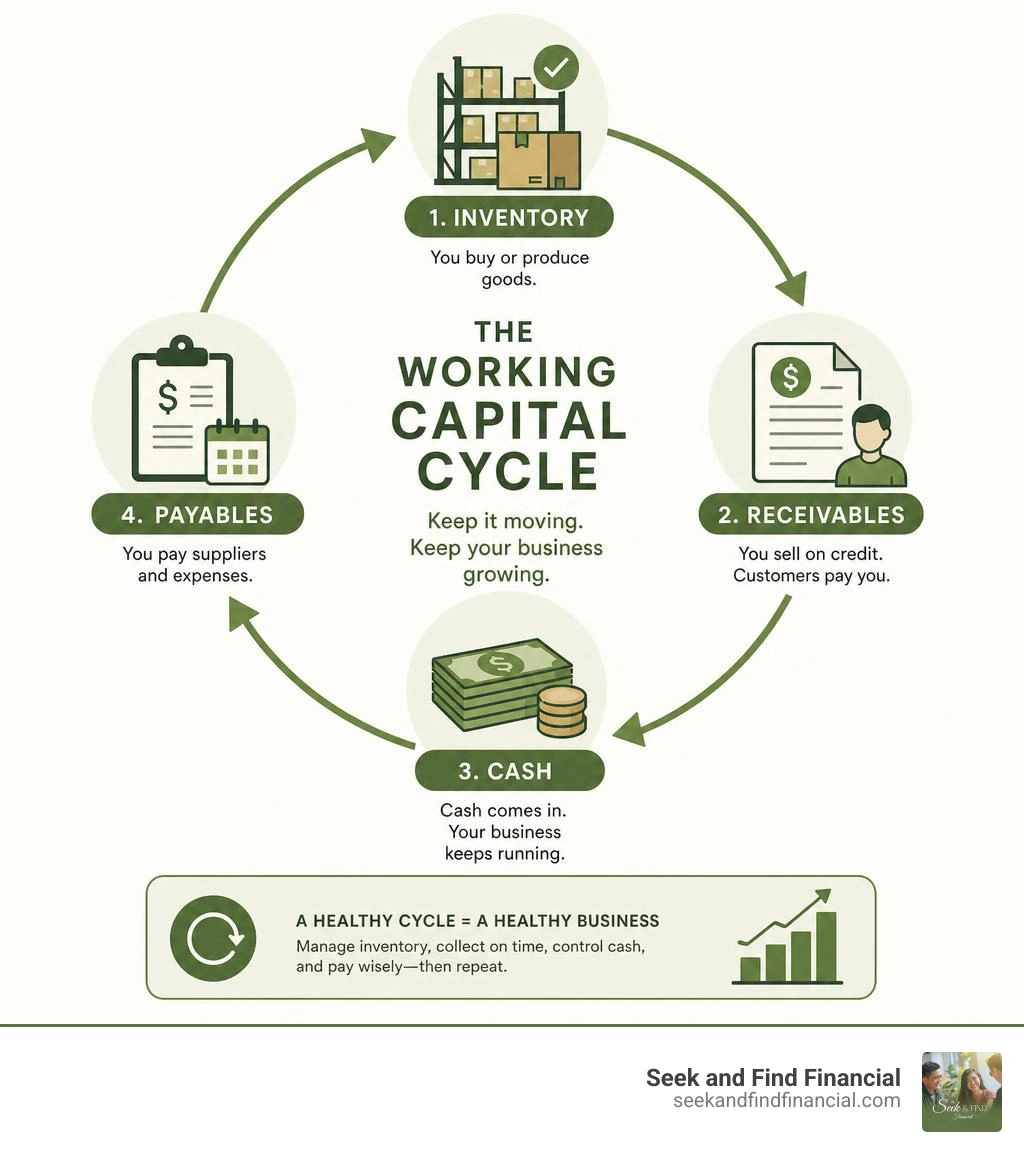
Timing gaps happen because your cash flows out before it flows back in. You must pay your employees and buy your inventory today. However, your customers might not pay you for 30, 60, or even 90 days. Working capital acts as a bridge. It keeps your business moving while you wait for those customer payments to arrive.
Maintaining healthy cash reserves is a major challenge for small firms. In fact, 44% of small business owners report having less than three months of cash reserves. Only 28% of small businesses have enough cash to cover three or more months of operations. Without a safety net, one late payment from a major customer can prevent you from meeting your payroll.
Taking control of your cash flow requires a plan. By focusing on Small Business Owner Financial Planning, you can prepare for these timing gaps and protect your business from sudden cash shortages.
To manage your working capital well, you must break it down into four main parts. Each part requires close attention:
Balancing these four components is a constant job. If you want to dive deeper into how these pieces fit together, you can read more about The Importance of Working Capital Management for a Small Business.
You cannot manage what you do not measure. To monitor your working capital, you should track a few key numbers.
First is the working capital ratio, which is also called the current ratio. You calculate it with this simple formula:
$$\text{Working Capital Ratio} = \frac{\text{Current Assets}}{\text{Current Liabilities}}$$
A ratio of 1.0 means your assets equal your liabilities. A ratio below 1.0 means you may struggle to pay your short-term bills. A healthy ratio is usually between 1.2 and 2.0. This range shows you have enough cushion to handle unexpected costs.
Second is the Cash Conversion Cycle (CCC). The CCC measures how many days it takes to turn your cash investments in inventory back into cash from sales. It uses three metrics:
The formula is:
$$\text{CCC} = \text{DIO} + \text{DSO} - \text{DPO}$$
Your goal is to keep this cycle as short as possible.
Keeping your ratio in the healthy zone takes consistent tracking. For a complete look at how to build these metrics into your business plan, check out our Business Owner Financial Planning Guide.
Effective working capital management provides several key benefits that keep your business stable.
First, it guarantees liquidity. Liquidity is your ability to convert assets into cash quickly to pay your immediate bills.
Second, it provides operational security. When you have a healthy cash cushion, you do not have to panic when an oven breaks, a vehicle needs repairs, or a tax bill arrives. You can handle these surprises without stopping your daily work.
Third, it builds your creditworthiness. Suppliers and banks look at your working capital ratio to see if you are a safe partner. If your ratio is strong, suppliers are more likely to offer you longer payment terms. Banks will also be more willing to approve loans when you need them.
Finally, managing your working capital improves your free cash flow. Free cash flow is the cash left over after you pay for your operating costs and capital expenses. This is the money you can use to pay down debt, reward yourself, or reinvest in the business.

To learn more about how cash stability leads to long-term success, read about Working capital: Why is it important for business growth?.
Scaling a business requires cash. When your sales grow, your expenses grow first. You must buy more inventory and hire more staff before you ever collect a dollar from your new customers. This extra cash needed for growth is called permanent working capital.
If you try to grow without planning for this extra cash, you can run out of money. This is called overtrading. You might have more orders than ever, but you cannot pay your suppliers to make the goods. Healthy working capital management ensures you are growth-ready. It gives you the "fuel" to take on larger contracts safely.
For ideas on how to fund your expansion, you can explore our guide on Investment Strategies for Small Business Owners.
Return on Invested Capital (ROIC) measures how good your business is at turning capital into profit. Working capital sits in the denominator of the ROIC formula. This means that if you can run your business with less working capital, your ROIC will go up.
Some highly efficient businesses even achieve negative working capital. This happens when your customers pay you upfront, but you do not have to pay your suppliers for 60 days. In this scenario, your customers and suppliers are funding your growth interest-free.
Reducing the amount of capital locked up in your business makes you far more efficient. To see how these management practices affect overall firm performance, you can read this study on OPUS at UTS: Improving small and medium-size enterprise performance.
To improve your working capital, you can use several practical tactics:
By taking these steps, you can lower your liquidity risks and keep your business safe. For more advice on managing these daily cash decisions, look at our resource on Financial Management for Entrepreneurs.
If you ever want to buy another business or sell your own, working capital is a major factor. During an acquisition, buyers look closely at the target company's historical working capital levels. They want to make sure the business has enough grease to keep the wheels turning after the sale.
If you need to seek external financing, your working capital history will also be reviewed. Credit availability is still a challenge for over a quarter of small businesses. Lenders want to see that you manage your internal cash well before they hand you a loan.
According to the pecking order theory, businesses prefer to use internal funds (retained earnings) first. They only look for external loans when internal funds are not enough. Keeping your working capital tight reduces your need to borrow expensive debt.
To understand the different ways you can fund your business operations, you can read this research on Strategies to Obtain Working Capital for Small Businesses.
No. Cash flow is the movement of money in and out of your business over a specific time. Working capital is a snapshot of your current financial health at a single point in time. It shows the resources you have available to meet your short-term obligations.
A ratio between 1.2 and 2.0 is generally considered healthy. However, the optimal ratio depends on your industry. A retail store that gets paid immediately by customers can operate safely with a lower ratio than a construction firm that waits months for payment.
Yes. Working capital loans are designed to cover short-term operational costs like payroll, rent, utilities, and inventory. However, you should not use these loans to buy long-term assets like buildings or heavy machinery.
Managing your working capital is not just about keeping score. It is about keeping your business alive and giving it the room to grow. By tracking your ratios, shortening your cash cycle, and using technology to monitor your numbers, you can protect your business from sudden cash shortages.
At Seek & Find Financial, we help business owners in Valparaiso, Chesterton, Portage, Hebron, Merrillville, Crown Point, Hobart, and Chicago build structured plans for long-term growth. We avoid generic advice and focus on personalized, technology-driven wealth planning.
To learn more about how we can help you manage your business finances, read about our approach to Business Capital Management.
Investing involves risk, including possible loss of principal. No investment strategy can ensure financial success or guarantee against losses. Past performance may not be used to predict future results. Provided content is for overview and informational purposes only, reflect the opinions of the author, and is not intended and should not be relied upon as individualized tax, legal, fiduciary, or investment advice.
This information is being provided only as a general source of information. These views may change as market or other conditions change. This information is not intended and should not be used to provide financial advice and does not address or account for an individual’s circumstances. Past performance does not guarantee future results and no forecast should be considered a guarantee. Please seek the guidance of a financial professional regarding your particular financial concerns.
Investment advisory services offered by duly registered individuals through Seek & find Financial LLC a Registered Investment Adviser. Licensed Insurance Professional