

How to Retire Without Selling Your Soul or Your Business
Discover top IRAs for business owners: SEP, SIMPLE & Solo 401(k). Maximize tax savings, compare limits & setup your plan today!
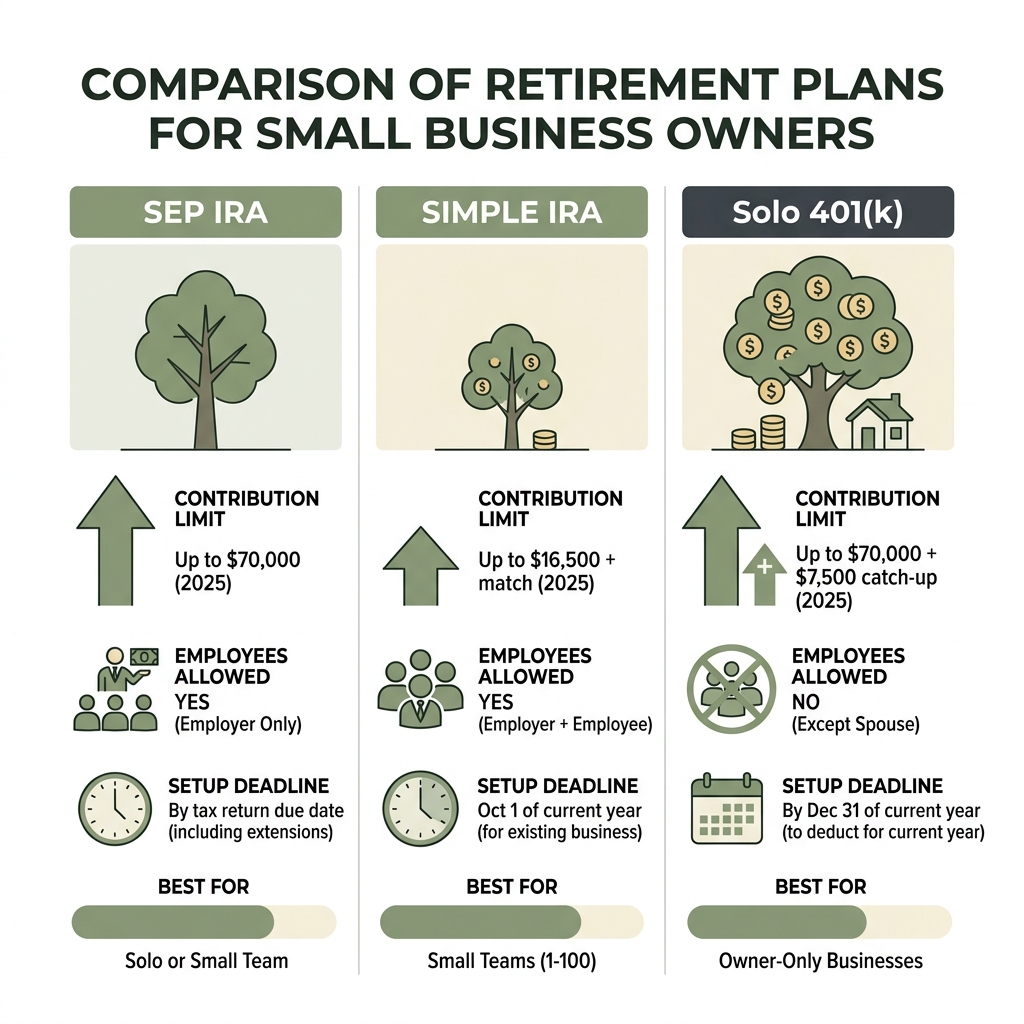
An IRA for business owners comes in three main forms, each built for a different situation:
SEP IRA
SIMPLE IRA
Solo 401(k)
Running a business while trying to save for retirement is harder than it looks.
You're already managing payroll, taxes, clients, and cash flow. Retirement planning often gets pushed to the back burner. But here's the reality: the longer you wait, the more you leave on the table -- both in savings and in tax deductions.
Business owners have access to retirement plans that most employees can only dream about. We're talking contribution limits up to $70,000 per year -- far beyond the standard $7,000 IRA cap. These plans can cut your taxable income significantly today while building serious long-term wealth.
The challenge is picking the right one. A SEP IRA, SIMPLE IRA, and Solo 401(k) all work differently. The wrong choice could mean leaving money on the table -- or creating unnecessary paperwork and cost.
This guide breaks down each option clearly so you can make a confident, informed decision.
I'm Daniel Delaney, Founder of Seek & Find Financial, and I've spent my career helping business owners navigate exactly this kind of decision -- from my early years at established wealth management firms to now running my own independent advisory practice focused on ira for business owners and long-term retirement strategy. Let's walk through your options together.
Investing involves risk, including possible loss of principal. No investment strategy can ensure financial success or guarantee against losses. Past performance may not be used to predict future results. Provided content is for overview and informational purposes only, reflect the opinions of the author, and is not intended and should not be relied upon as individualized tax, legal, fiduciary, or investment advice.
This information is being provided only as a general source of information. These views may change as market or other conditions change. This information is not intended and should not be used to provide financial advice and does not address or account for an individual's circumstances. Past performance does not guarantee future results and no forecast should be considered a guarantee. Please seek the guidance of a financial professional regarding your particular financial concerns.
Investment advisory services offered by duly registered individuals through Seek & Find Financial LLC a Registered Investment Adviser. Licensed Insurance Professional

When we talk to business owners in Valparaiso or Crown Point, the first question is usually about which plan fits their specific size. Choosing an ira for business owners is not a one-size-fits-all decision. It depends on your net earnings, how many people you employ, and how much you want to save each year.
The goal of any plan is tax deferral. This means you put money in now and do not pay taxes on it until you take it out later. For high earners making $400,000 or more, this is a massive advantage. It keeps more money in your business and your pocket today.
We look at your savings goals first. If you want to maximize every dollar, a Solo 401(k) might be the winner. If you want the least amount of paperwork possible, a SEP IRA is hard to beat. If you want your employees to help save for their own future, a SIMPLE IRA is a great tool.
Every dollar you put into a qualified retirement plan is a dollar the IRS cannot touch this year. For a business owner in the top tax bracket, a $70,000 contribution could mean saving tens of thousands of dollars in federal income taxes.
Beyond the immediate tax deduction, your money grows through compound interest. Inside these accounts, you do not pay taxes on dividends or capital gains. This allows your wealth to build much faster than it would in a standard brokerage account. It is one of the few "free wins" the tax code gives to entrepreneurs.
If you have a team, your choice changes. You are no longer just looking out for yourself. You are using these plans to attract and keep top talent. In competitive markets like Chicago or Merrillville, a solid retirement plan is a huge hiring power.
However, having employees means you must follow specific rules. For example, if you use a SEP IRA, you must contribute the same percentage of salary for every eligible worker. If you give yourself 15%, you give them 15%. This can get expensive quickly. We help you weigh worker loyalty against the total cost of the plan.
The two most common "IRA-based" plans are the SEP and the SIMPLE. Both are easier to set up than a traditional 401(k), but they serve different needs.
A SEP IRA is funded entirely by the employer. Employees do not put their own money into it. A SIMPLE IRA allows employees to take money out of their own paychecks to save, and the employer usually matches a portion of that.
According to the SIMPLE IRA Plans for Small Businesses | U.S. Department of Labor, these plans are designed for businesses with 100 or fewer employees. One big benefit of both is immediate vesting. This means the money belongs to the employee the moment it hits the account.
The SEP IRA is the king of simplicity. You can set it up by filling out Form 5305-SEP. You do not have to file annual reports with the government.
For 2024, you can contribute up to 25% of an employee's compensation, with a maximum cap of $69,000. In 2025, that cap rises to $70,000. If you are self-employed, the math is a little different because you have to use your net earnings minus half of your self-employment tax.
One downside of the SEP is that there are no "catch-up" contributions for those over age 50. However, it offers incredible flexibility. If your business has a bad year, you can choose to contribute 0%. If you have a great year, you can max it out.
The SIMPLE IRA stands for "Savings Incentive Match Plan for Employees." It is best for businesses that want a plan that looks like a 401(k) but without the high costs.
In 2024, the employee contribution limit is $16,000. In 2025, it goes up to $16,500. If you are 50 or older, you can add a $3,500 catch-up contribution.
As the employer, you generally have two choices for matching:
Be careful with withdrawals. If you take money out of a SIMPLE IRA within the first two years of joining the plan, the IRS hits you with a 25% penalty. That is much higher than the usual 10% penalty.
For the "solopreneur" or a business owned only by a husband and wife, the Solo 401(k) is often the strongest option. It is specifically mentioned in Publication 560 (2025), Retirement Plans for Small Business | Internal Revenue Service as a powerful tool for self-employed people.
If you are earning $400,000+, this plan allows you to save the most money. It treats you as both the employer and the employee. This "double role" lets you contribute to the plan from two different buckets.
The SECURE 2.0 Act has also made these plans better by allowing Roth options. This means you can choose to pay taxes now so that all your withdrawals in retirement are completely tax-free.
The limits for a Solo 401(k) are impressive. In 2024, you can put in $23,000 as an "employee" deferral. In 2025, that rises to $23,500.
On top of that, your business can contribute up to 25% of your compensation as the "employer." When you combine these two parts, the total limit is $69,000 for 2024 and $70,000 for 2025. If you are 50 or older, you can add a $7,500 catch-up contribution, bringing your total potential savings to $77,500.
There is a small catch with the Solo 401(k). It requires more paperwork than a SEP IRA. You have to officially "adopt" the plan with a legal document.
Once your plan holds more than $250,000 in total assets, you must file Form 5500-EZ with the IRS every year. This is not a tax bill, but it is a report that tells the government how much money is in the plan. Missing this deadline can lead to big fines, so we always keep a close eye on that $250,000 threshold for our clients.
Timing is everything. One of the best things about a SEP IRA is that you can set it up and fund it as late as your tax filing deadline, including extensions. If you file your taxes in October, you can still contribute for the previous year.
The SIMPLE IRA is stricter. It generally must be set up by October 1 of the year you want it to start. This ensures employees have enough time to make their salary elections.
There is also good news for your wallet. The government wants you to start these plans. Under SECURE 2.0, small businesses may be eligible for a tax credit of up to $500 per year for the first three years to cover the cost of starting a SEP or SIMPLE plan. This is a credit, not just a deduction, meaning it wipes $500 directly off your tax bill.
Yes, you can. However, your ability to deduct your personal Traditional IRA contribution might be limited if you or your spouse are covered by a plan at work. You can always contribute to a Roth IRA if you are under the income limits, or look into a "backdoor" Roth strategy if you earn too much.
Required Minimum Distributions (RMDs) generally start at age 73. This is when the IRS forces you to start taking money out so they can finally collect their taxes. If you do not take the RMD, the penalty is very steep. We help you plan for these "forced payouts" so they do not push you into a higher tax bracket later in life.
Retirement planning for business owners in places like Hobart or Chesterton should not feel like a second job. Whether you choose a SEP, a SIMPLE, or a Solo 401(k), the most important step is simply starting.
At Seek & Find Financial, we focus on clear strategies that fit your real life. We use modern technology like Altruist to give you a clear view of your growth without the jargon. If you are making $400,000 or more, your plan needs to be as hard-working as you are.
We are here to help you build a strategy that protects your business today and secures your freedom tomorrow. To see how we can help you navigate an ira for business owners, visit our services page.
Investing involves risk, including possible loss of principal. No investment strategy can ensure financial success or guarantee against losses. Past performance may not be used to predict future results. Provided content is for overview and informational purposes only, reflect the opinions of the author, and is not intended and should not be relied upon as individualized tax, legal, fiduciary, or investment advice.
This information is being provided only as a general source of information. These views may change as market or other conditions change. This information is not intended and should not be used to provide financial advice and does not address or account for an individual’s circumstances. Past performance does not guarantee future results and no forecast should be considered a guarantee. Please seek the guidance of a financial professional regarding your particular financial concerns.
Investment advisory services offered by duly registered individuals through Seek & Find Financial LLC a Registered Investment Adviser. Licensed Insurance Professional