

The Best Retirement Investment Options to Secure Your Future
Discover the best retirement investment options to secure your future with clear strategies and long-term planning.
Retirement investment options are the accounts and assets you use to build wealth for life after work. Here is a quick look at the main types:
| Option | Best For | Tax Benefit |
|---|---|---|
| 401(k) / 403(b) | Employees with employer access | Pre-tax contributions, tax-deferred growth |
| Traditional IRA | Anyone with earned income | Tax-deductible contributions, tax-deferred growth |
| Roth IRA | Those expecting higher taxes later | Tax-free growth and withdrawals |
| SEP IRA / SIMPLE IRA | Self-employed and small business owners | Higher contribution limits, tax-deferred growth |
| Annuities | Those wanting guaranteed income | Tax-deferred growth, lifetime income options |
| Government bonds / Cash-value life insurance | Conservative savers | Stability, some tax advantages |
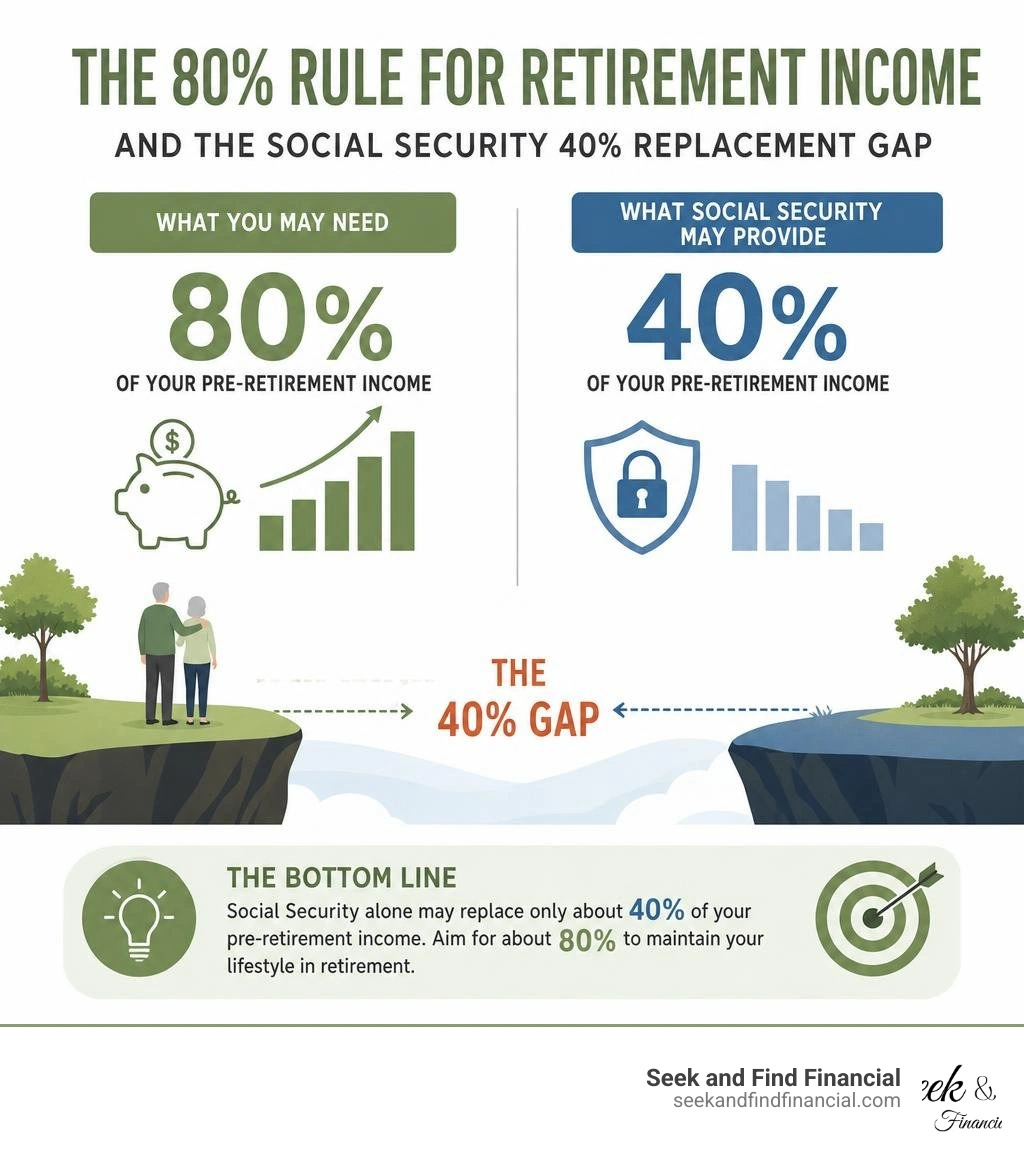
Here is why this matters: according to the Social Security Administration, Social Security benefits replace only about 40% of your pre-retirement income on average. Most financial planners suggest you will need roughly 80% of your final yearly income to maintain your lifestyle in retirement. That gap does not close on its own.
The good news? You have more tools available than most people realize. The challenge is knowing which ones fit your situation.
I'm Daniel Delaney, Founder of Seek & Find Financial, and I've spent my career across established financial institutions and independent advisory work helping clients navigate retirement investment options at every income level. In this guide, I'll break down each option clearly so you can build a strategy that actually fits your life.
Investing involves risk, including possible loss of principal. No investment strategy can ensure financial success or guarantee against losses. Past performance may not be used to predict future results. Provided content is for overview and informational purposes only, reflect the opinions of the author, and is not intended and should not be relied upon as individualized tax, legal, fiduciary, or investment advice.
This information is being provided only as a general source of information. These views may change as market or other conditions change. This information is not intended and should not be used to provide financial advice and does not address or account for an individual's circumstances. Past performance does not guarantee future results and no forecast should be considered a guarantee. Please seek the guidance of a financial professional regarding your particular financial concerns.
Investment advisory services offered by duly registered individuals through Seek & Find Financial LLC a Registered Investment Adviser. Licensed Insurance Professional
To build a strong financial house, you need to understand your building blocks. Retirement plans generally fall into two main categories. These are defined benefit plans and defined contribution plans.
A defined benefit plan is what most people call a traditional pension. This plan promises to pay you a specific monthly amount when you retire. The math is usually based on how long you worked and how much money you made.
A defined contribution plan is different. With this plan, you or your employer put money into an individual account. Your final retirement balance depends on how much money is put in and how your investments grow or shrink over time. You are in charge of directing your own investments in these accounts.
Understanding these differences is the first step to choosing the right path. You can learn more about how these plans work in our guide on Retirement Plans. For official government guidelines on plan types and rules, you can also review the Department of Labor Retirement Savings Guide.
For many workers in Valparaiso, Chesterton, and Portage, the first place they start saving is at work. Employer-sponsored plans like 401(k) and 403(b) accounts are excellent tools.
A 401(k) plan is offered by private companies. A 403(b) plan is very similar, but it is offered by non-profit groups, schools, and public employers. If you work in education, you might find details on these through resources like the Retirement & Investment Plans - HR.uillinois.edu page.
The biggest benefit of these plans is the employer match. This is often called free money. For example, if your employer matches 100% of your contributions up to 3% of your salary, you should try to save at least that much. If you make $100,000, that is an extra $3,000 added to your account by your employer.
However, you must pay attention to vesting schedules. Vesting means ownership. If your employer has a five-year vesting schedule, you might only own 20% of their matching contributions after one year. If you leave your job early, you might lose the unvested portion of that match.
These plans allow you to make pre-tax contributions. This means the money is taken out of your paycheck before taxes are calculated, which lowers your taxable income today. Your money then grows tax-deferred until you withdraw it in retirement.
If you do not have an employer plan, or if you want to save even more, you can open an Individual Retirement Account (IRA). Anyone with earned income can open an IRA.
In June 2026, the annual contribution limit for an IRA is $7,500. This is about $625 per month. If you are age 50 or older, you can make an extra catch-up contribution of $1,000, bringing your total limit to $8,500.
The two main types are Traditional IRAs and Roth IRAs.
With a Traditional IRA, your contributions may be tax-deductible. Your money grows tax-deferred, and you pay ordinary income tax when you take the money out in retirement. You must also start taking Required Minimum Distributions (RMDs) from a Traditional IRA once you reach age 73 or 75, depending on your birth year.
With a Roth IRA, you make contributions with after-tax money. Because you already paid taxes on the money, your investment grows completely tax-free. When you retire, your qualified withdrawals are also 100% tax-free. Another benefit is that Roth IRAs do not have RMDs during your lifetime. You can leave the money in the account as long as you want.
To learn more about the rules, you can read the IRS Roth IRA Information page or check out the Roth IRA Tax-free retirement growth guide.
| Feature | Traditional IRA | Roth IRA |
|---|---|---|
| Tax Treatment Now | Pre-tax (contributions may be deductible) | After-tax (no upfront tax break) |
| Growth | Tax-deferred | Tax-free |
| Tax Treatment Later | Withdrawals taxed as ordinary income | Withdrawals are tax-free |
| RMDs | Required starting at age 73 or 75 | None during your lifetime |
| Withdrawal Flexibility | Early withdrawals face taxes and 10% penalty | Can withdraw original contributions anytime penalty-free |
If you are a business owner or entrepreneur in Crown Point, Hobart, or Merrillville, you have access to larger retirement plans. These plans let you save much more than a standard IRA.
A SEP IRA (Simplified Employee Pension) is a great option for self-employed individuals and small business owners. With a SEP IRA, employers can contribute up to 25% of an employee's salary or a specific annual limit set by the IRS. It requires very little paperwork to set up.
A SIMPLE IRA (Savings Incentive Match Plan for Employees) is designed for businesses with 100 or fewer employees. It requires employers to make matching contributions, but it has lower setup costs than a traditional 401(k).
Choosing the right plan can save you thousands of dollars in taxes while helping you recruit top talent. For a deeper look at these options, read our Simple IRA Complete Guide 2026 and our Retirement Planning Entrepreneurs Guide.
Once you choose your retirement account container, you must decide what to put inside it. This is where asset allocation comes in. Asset allocation is how you divide your money among different types of investments, like stocks and bonds.
Stocks represent ownership in a company. They offer the highest potential for growth, but they also come with the highest risk. Bonds are loans you make to governments or corporations. They offer lower returns but provide stability and steady income.
Your personal strategy should depend on two main factors. These are your risk tolerance and your time horizon. Your risk tolerance is how much market volatility you can stand without panicking. Your time horizon is how many years you have left before you need to withdraw your money.

If you do not want to manage your own investments, you are not alone. Many people prefer a hands-off approach.
Target-date funds are a popular, all-in-one option. You simply choose a fund with a year closest to when you plan to retire. For example, if you plan to retire around 2030, you might look at a fund like the AAETX - American Funds 2030 Target Date Retirement Fund ® Class A | Fidelity Investments.
These funds use a glide path. This means the fund automatically adjusts its asset mix over time. When you are young, the fund invests heavily in stocks for growth. As you get closer to your retirement date, the fund automatically rebalances to hold more bonds and cash to protect your savings.
Other options include pre-built portfolios like the One Choice Portfolios® from American Century Investments or Vanguard Target Retirement Funds | Vanguard. These funds are known for keeping costs low. The average Vanguard target-date fund expense ratio is 0.08%, which is 80% less than the industry average of 0.41%. To understand how these funds work, you can read the SEC Guide on Target-Date Funds.
If you enjoy researching the market, you can build your own portfolio. You can choose from mutual funds, Exchange-Traded Funds (ETFs), and individual stocks.
Mutual funds pool money from many investors to buy a large basket of stocks or bonds. ETFs are similar, but they trade on the stock exchange like regular stocks, often offering lower fees and better tax efficiency.
When managing your own investments, you must watch out for risks. Market risk is the chance that the stock market will drop. Inflation risk is the danger that your money will lose purchasing power over time. If your investments do not grow faster than inflation, you are actually losing money.
Another danger is excessive trading. Many investment platforms have strict excessive trading policies to protect fund performance. Frequent trading increases fund expenses and hurts long-term returns. For example, some plans use a 6/11/20 rule. If you make 6 trades in a quarter, you receive a warning. If you make 11 trades over two quarters, you may face restrictions. If you make 20 trades in a year, you may be restricted to mail-only trading.
How much money do you actually need to retire? This is the most common question we hear in our Valparaiso and Chesterton offices.
A good starting point is the 80% rule. This rule suggests you will need about 80% of your final gross yearly income to maintain your lifestyle after you stop working. If you make $100,000 a year, you should aim for an annual retirement income of $80,000.
To estimate your own needs, you can use interactive tools like the Retirement Plan Calculator - Hebron Savings Bank. You can also learn more about customizing your plan in our Personalized Retirement Planning Guide.
You do not have to save for the entire 80% on your own. You will likely have other sources of income.
First is Social Security. Social Security is only meant to replace about 40% of your pre-retirement earnings. This leaves a 40% gap that your personal savings must cover.
To fill this gap, some investors look for guaranteed income options. Annuities are insurance contracts that can convert a lump sum of money into regular, guaranteed checks for life.
Other conservative options include government bonds and cash-value life insurance policies. These options offer lower growth, but they provide a safe foundation for your overall strategy.
If you are a high earner making $400,000 or more in Chicago or the surrounding Indiana suburbs, standard retirement strategies may not be enough. The IRS limits how much you can contribute to traditional plans.
This is where tax diversification becomes critical. You want to have a mix of pre-tax, tax-free, and taxable accounts. This gives you flexibility to control your tax bracket when you start taking withdrawals.
For high earners, a Backdoor Roth IRA is a valuable tool. If your income is too high to contribute to a Roth IRA directly, you can contribute to a non-deductible Traditional IRA and then convert it to a Roth IRA. To learn how to navigate these rules safely, read our guides on Retirement Plans for High Earners and the Roth IRA for High Earners Guide. You can also check out our regional insights at Chicago High Earner Retirement.
When you change jobs, you have to decide what to do with your old employer-sponsored retirement plans. Leaving your money behind can make it hard to track your progress.
A rollover lets you move your old 401(k) or 403(b) into a single Rollover IRA. This consolidation keeps your accounts organized and often gives you access to better, lower-cost investment options.
Another excellent strategy is a Spousal IRA. Usually, you must have earned income to contribute to an IRA. However, a Spousal IRA allows a working spouse to contribute to an IRA for a non-working spouse. This is a great way for families to double their retirement savings and lower their combined tax bill.
The 80% rule is a simple benchmark. It suggests that you will need approximately 80% of your pre-retirement gross yearly income to maintain your current standard of living once you retire. This accounts for the fact that you will no longer be saving for retirement, and your tax bracket may be lower.
In 2026, the standard contribution limit for both Traditional and Roth IRAs is $7,500 per year. If you are age 50 or older, you can make an additional catch-up contribution of $1,000, bringing your total annual limit to $8,500.
The main difference is when you pay taxes. A Traditional IRA offers tax-deductible contributions today, but you pay ordinary income tax on your withdrawals in retirement. A Roth IRA uses after-tax money today, but your withdrawals in retirement are completely tax-free.
Choosing the best retirement investment options is not a one-time decision. It is a continuous process of building, protecting, and adjusting your wealth.
If you live in Valparaiso, Chesterton, Portage, Hebron, Merrillville, Crown Point, Hobart, or Chicago, you do not have to navigate these choices alone. At Seek & Find Financial, we focus on helping you find clarity. We build personalized, technology-driven strategies that fit your real-life goals, avoiding generic, cookie-cutter advice.
Ready to build a clear path forward? Explore our wealth management services to see how we can help you secure your financial future.
Investing involves risk, including possible loss of principal. No investment strategy can ensure financial success or guarantee against losses. Past performance may not be used to predict future results. Provided content is for overview and informational purposes only, reflect the opinions of the author, and is not intended and should not be relied upon as individualized tax, legal, fiduciary, or investment advice.
This information is being provided only as a general source of information. These views may change as market or other conditions change. This information is not intended and should not be used to provide financial advice and does not address or account for an individual’s circumstances. Past performance does not guarantee future results and no forecast should be considered a guarantee. Please seek the guidance of a financial professional regarding your particular financial concerns.
Investment advisory services offered by duly registered individuals through Seek & find Financial LLC a Registered Investment Adviser. Licensed Insurance Professional