

401(k) Fee Disclosures: What Plan Administrators Actually Need to Know
Master retirement plan fee disclosure rules to stay compliant, cut hidden costs, and protect your fiduciary duty.
Retirement plan fee disclosure is the process by which service providers and plan administrators are required by federal law to communicate all fees, expenses, and compensation tied to an employer-sponsored retirement plan — to both the plan sponsor and plan participants.
Here is what you need to know at a glance:
| What | Who Is Responsible | When |
|---|---|---|
| Service provider fee disclosures (408(b)(2)) | Recordkeepers, advisors, TPAs | Before plan engagement; updates within 60 days of changes |
| Participant fee disclosures (404(a)(5)) | Plan administrator (employer) | Before first investment direction; annually + quarterly |
| Covered plans | ERISA Title I plans (401(k), 403(b), defined benefit) | Effective July 1, 2012 |
| Excluded plans | Owner-only plans, SEP IRAs, SIMPLE IRAs | Not subject to these rules |
Most business owners know they run a retirement plan. Far fewer know what they are legally required to disclose — or what their service providers are required to disclose to them.
That gap is expensive. Fees like revenue sharing, 12b-1 payments, and wrap fees can quietly reduce employee returns year after year. According to GAO research, 64% of plan participants do not even know they pay plan fees. And fewer than one in five small to mid-sized businesses say they are very familiar with retirement plan fees.
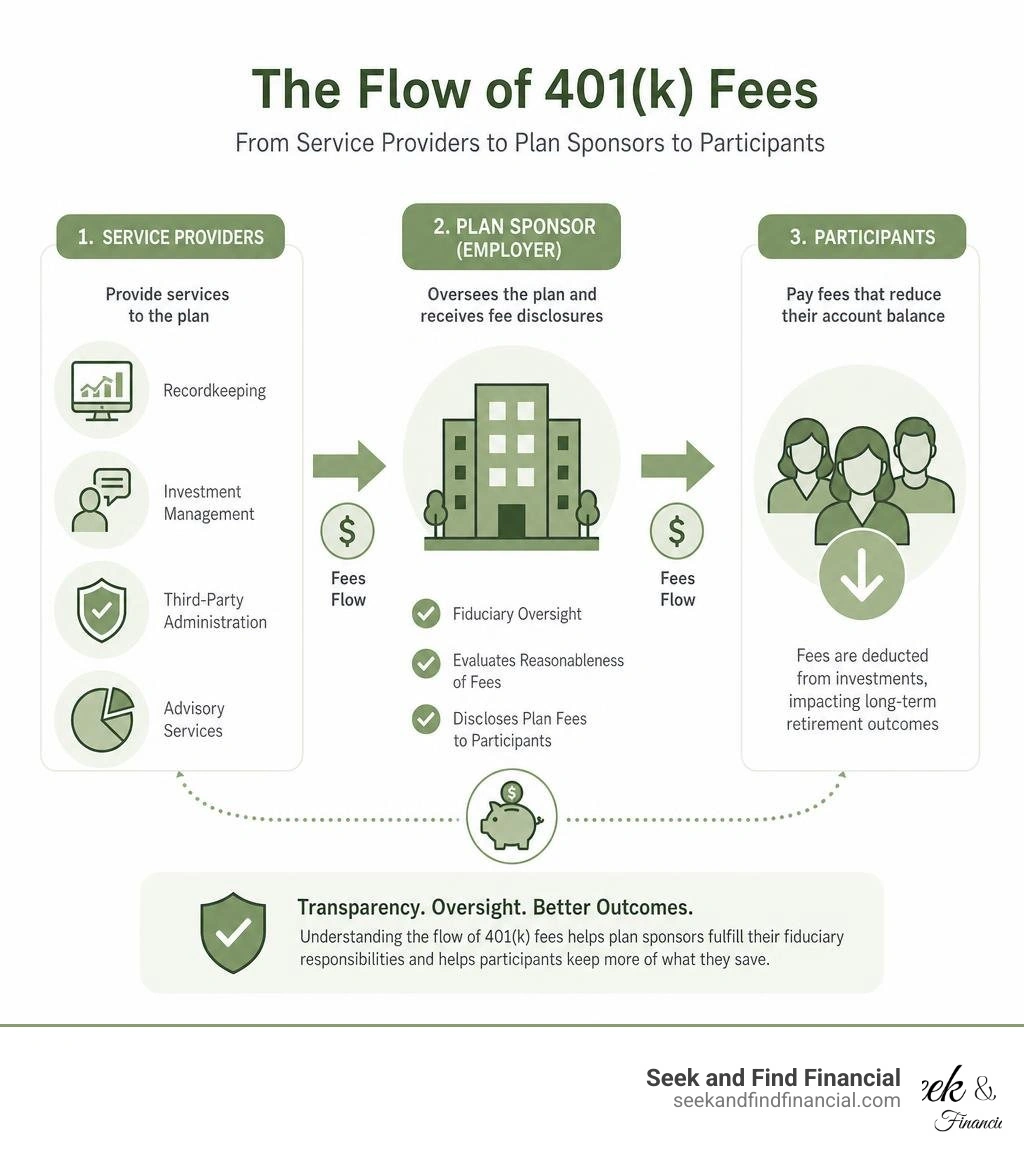
This is not just a participant problem. It is a fiduciary problem. As a plan sponsor, you are legally responsible for ensuring that plan fees are reasonable. If you are not reading and understanding the disclosures you receive, you may be exposing yourself to serious liability.
I'm Daniel Delaney, Founder of Seek & Find Financial. My background includes years working within established financial institutions, where I developed hands-on experience with retirement plan fee disclosure requirements and the fiduciary responsibilities that come with sponsoring an employer plan. That experience now shapes how I help business owners cut through the complexity and make confident, informed decisions about their plans.
Investing involves risk, including possible loss of principal. No investment strategy can ensure financial success or guarantee against losses. Past performance may not be used to predict future results. Provided content is for overview and informational purposes only, reflect the opinions of the author, and is not intended and should not be relied upon as individualized tax, legal, fiduciary, or investment advice.
This information is being provided only as a general source of information. These views may change as market or other conditions change. This information is not intended and should not be used to provide financial advice and does not address or account for an individual's circumstances. Past performance does not guarantee future results and no forecast should be considered a guarantee. Please seek the guidance of a financial professional regarding your particular financial concerns.
Investment advisory services offered by duly registered individuals through Seek & Find Financial LLC a Registered Investment Adviser. Licensed Insurance Professional
Retirement plan fee disclosure terms at a glance:
To understand fee disclosures, we must first look at the law that governs them. The Employee Retirement Income Security Act of 1974, known as ERISA, sets the rules for most private employer retirement plans. Specifically, Title I of ERISA protects the interests of employees who participate in these plans.
If you offer retirement plans to your staff, you are likely subject to Title I. This includes both defined contribution plans, like a standard 401(k) or 403(b), and defined benefit plans, like traditional pensions. Under Title I, you are a plan sponsor and a fiduciary. This means you must act solely in the best interest of your workers. Part of that duty is knowing exactly what your plan costs.
Whether you run a manufacturing company in Portage, Indiana, a medical practice in Crown Point, or a professional services firm in Chicago, Illinois, the law is the same. You cannot ignore plan costs. You must actively monitor them to protect your business and your team.
The U.S. Department of Labor, or DOL, created rules to make plan costs clear. The goal is complete transparency. These rules require service providers to show you exactly how they get paid. They also require you to pass clear fee information along to your workers.
The regulations break costs down into direct and indirect compensation. Direct compensation is easy to spot. It is the flat fee or percentage you pay directly from plan assets to a provider. Indirect compensation is harder to find. This happens when an investment fund pays a third party behind the scenes. The DOL requires all of these payments to be written down clearly. You can learn more about these transparency rules in the Final Rule to Improve Transparency of Fees and Expenses to Workers in 401(k)-Type Retirement Plans.
Not every retirement plan has to follow these strict disclosure rules. If your plan does not cover common-law employees, you are generally exempt.
For example, owner-only plans, often called Solo 401(k)s, do not have to follow these rules because you are only covering yourself. Similarly, simplified employee pensions, known as SEP IRAs, and SIMPLE IRAs are excluded from these specific DOL regulations. These accounts are governed by different parts of the tax code. If you want to compare these simpler options, you can read our guide on retirement savings plans for small business owners.

Under ERISA Section 408(b)(2), your plan service providers must give you a detailed written disclosure. This rule applies to any covered service provider who expects to receive $1,000 or more in direct or indirect compensation from your plan.
This includes your recordkeeper, your third-party administrator, and your financial advisor. The law requires them to hand over this disclosure before you sign a contract. If they do not, the arrangement is considered a prohibited transaction under ERISA, which can lead to severe penalties for you. To see what a standard disclosure looks like, you can review the official 401(k) Plan Disclosure Form.
The service provider disclosure must be highly detailed. It cannot just list a single flat fee. It must include:
This document helps you see if a provider is receiving extra payments from the funds they recommend. These hidden payments can create conflicts of interest.
Service providers must take these rules seriously. If a provider fails to deliver the required disclosure, they are engaging in a prohibited transaction.
As the plan sponsor, you must demand the missing information in writing. If they do not provide it within 90 days, you must notify the DOL. You must also prepare to terminate their contract. If you fail to take these steps, you could face excise taxes and personal liability. The provider must correct any errors within 30 days of discovery to avoid penalties.
Once you receive the necessary details from your providers, you must share fee information with your employees. Under ERISA Section 404(a)(5), plan administrators must give participants clear, regular updates about plan costs.
This rule applies to all plans that allow participants to direct their own investments. The goal is to make sure your employees can make smart choices about their retirement savings. You must provide these details in a standard format so workers can easily compare their options. You can read the official legal guidelines in the Final Rule: Fiduciary Requirements for Disclosure in Participant-Directed Individual Account Plans.
Your participant disclosures must cover three main areas:
You must also provide detailed information on investment performance, including historical returns and expense ratios. This helps workers compare their retirement investment options side by side.
Timing is critical when sending these notices. You must give participants their initial disclosures on or before the date they can first direct their investments. After that, you must send an updated notice at least once every 12 months.
If you plan to change any fees, you must send a notice to participants between 30 and 90 days before the change takes effect. You must also send quarterly statements showing the actual dollar amounts deducted from their accounts during that period. You can deliver these notices on paper or electronically, provided you meet the DOL safe harbor rules for electronic delivery. For detailed questions on delivery, refer to Field Assistance Bulletin No. 2012-02R (1) | U.S. Department of Labor.

As a business owner in Merrillville, Portage, or Hobart, Indiana, you cannot just collect fee disclosures and file them away. You must read them. You must evaluate them. Under ERISA, your job is to make sure the fees your plan pays are reasonable for the services you receive.
This does not mean you must always choose the cheapest provider. A low-cost provider might offer terrible customer service or poor investment options. Instead, you must weigh the cost against the quality of the service. To help you build a solid review process, you can read the DOL guide on Understanding Retirement Plan Fees and Expenses.
To evaluate your fees, start by breaking down how you are billed. Providers typically charge fees in one of two ways: bundled or unbundled.
A bundled plan combines recordkeeping, administration, and investment management into one overall fee, often paid through mutual fund expense ratios. An unbundled plan separates these services, charging distinct fees for each.
Here is how they compare:
| Fee Type | Bundled Structure | Unbundled Structure |
|---|---|---|
| Recordkeeping | Paid through fund expense ratios (revenue sharing) | Paid as a flat annual or per-participant fee |
| Investment Costs | Often higher due to built-in marketing and service fees | Lower, institutional-class fund shares |
| Transparency | Harder to see exactly who gets paid and how much | Very clear, line-item pricing for each service |
| Fiduciary Risk | Higher risk of hidden conflicts and excessive costs | Lower risk because fees are easy to audit and benchmark |
Look closely at your fund expense ratios and check for wrap fees, which can quietly inflate your costs. Compare these numbers against industry benchmarks for plans of your size. If you run a high-earning business in Chicago or Northwest Indiana, working with an independent advisor who uses modern, transparent tools like Altruist can help you clean up your plan structure and keep costs low.
The final regulations under ERISA Section 408(b)(2) became effective on July 1, 2012. This rule changed the industry by requiring service providers to deliver written fee summaries to plan sponsors. The participant disclosure rules under Section 404(a)(5) went into effect shortly after, requiring initial disclosures to be sent by late August 2012.
Direct compensation is paid directly from your plan assets or your company bank account to a service provider. This includes flat recordkeeping fees or hourly legal fees. Indirect compensation is paid to a provider from other sources, such as mutual fund managers. This often takes the form of 12b-1 fees, sub-transfer agency fees, or revenue sharing, which are built into the funds' internal expense ratios.
Failing to send required disclosures is a serious fiduciary breach. It can expose you to personal liability for any losses your participants experience. It can also trigger audits by the IRS or DOL, leading to heavy fines, sanctions, or even the disqualification of your retirement plan's tax-exempt status.
Managing a retirement plan does not have to be a source of constant worry. When you understand retirement plan fee disclosure rules, you can protect your business, stay compliant with the law, and help your employees build real wealth.
At Seek & Find Financial, we specialize in helping high-earning entrepreneurs and business owners build clear, efficient wealth strategies. We do not believe in generic financial products or hidden fees. We focus on personalized, technology-driven planning to help you grow. If you want to see how we can help you optimize your business and personal finances, read about what we do or explore our retirement planning entrepreneurs guide.
Whether you are based in Valparaiso, Chesterton, Portage, Hebron, Merrillville, Crown Point, Hobart, or Chicago, we are here to provide the clear direction you need. Let us help you build a plan you can feel good about.
Investing involves risk, including possible loss of principal. No investment strategy can ensure financial success or guarantee against losses. Past performance may not be used to predict future results. Provided content is for overview and informational purposes only, reflect the opinions of the author, and is not intended and should not be relied upon as individualized tax, legal, fiduciary, or investment advice.
This information is being provided only as a general source of information. These views may change as market or other conditions change. This information is not intended and should not be used to provide financial advice and does not address or account for an individual’s circumstances. Past performance does not guarantee future results and no forecast should be considered a guarantee. Please seek the guidance of a financial professional regarding your particular financial concerns.
Investment advisory services offered by duly registered individuals through Seek & find Financial LLC a Registered Investment Adviser. Licensed Insurance Professional