

The Complete Guide to Retirement Plans
Compare retirement plans, contribution limits, and withdrawal rules to choose the best options for your future.
If you are unsure how to save for retirement, you are not alone. Many people have access to several account types but still do not know which one to use first, how taxes work, or how to build a plan that fits real life.
Retirement plans are tax-advantaged accounts and structures that help you save and invest for the future. There are many types, and choosing the right one can save you a large amount in taxes over time.
Here is a quick look at the main retirement plan types:
Even with more choices than ever, many workers feel behind on retirement savings. At the same time, fewer private-sector workers have traditional pensions. That means most people need to build their own system for saving, investing, and creating future income.
The hard part is not only saving money. It is knowing which accounts to use, when to use them, and how to combine them in a tax-smart way. For business owners and high earners, the wrong setup can mean missed deductions and less flexibility later.
This guide explains the main retirement plan types, 2025 and 2026 contribution limits, tax rules, and how to build a strategy that fits your situation.
I'm Daniel Delaney, Founder of Seek & Find Financial. I have spent my career helping individuals and business owners build clear, practical retirement plans through work at established institutions and now as an independent advisor. In the sections below, I will walk through the key rules and tradeoffs so you can make informed decisions.
Investing involves risk, including possible loss of principal. No investment strategy can ensure financial success or guarantee against losses. Past performance may not be used to predict future results. Provided content is for overview and informational purposes only, reflect the opinions of the author, and is not intended and should not be relied upon as individualized tax, legal, fiduciary, or investment advice.
This information is being provided only as a general source of information. These views may change as market or other conditions change. This information is not intended and should not be used to provide financial advice and does not address or account for an individual’s circumstances. Past performance does not guarantee future results and no forecast should be considered a guarantee. Please seek the guidance of a financial professional regarding your particular financial concerns.
Investment advisory services offered by duly registered individuals through Seek & find Financial LLC a Registered Investment Adviser. Licensed Insurance Professional
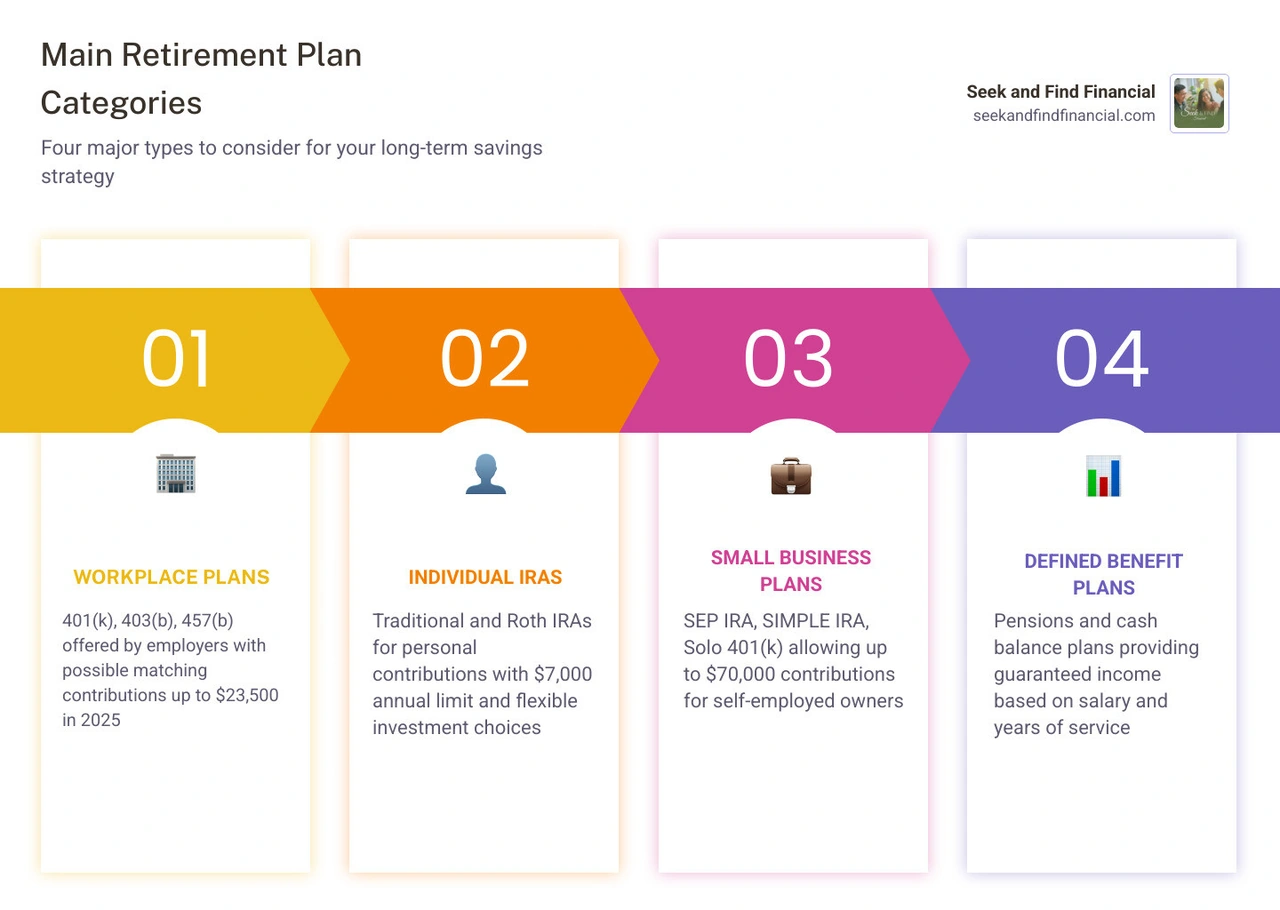
Most retirement plans fall into a few main groups:
The IRS keeps a broad list of recognized plan types here: Retirement plans | Internal Revenue Service

This is the first split that matters.
A defined benefit plan promises a future benefit. This is often a monthly payment in retirement based on salary, years of service, or a plan formula. Traditional pensions fit here. Cash balance plans do too, even though they may look like account balances.
A defined contribution plan does not promise a monthly payment later. Instead, contributions go into your account, and your future income depends on:
401(k)s, 403(b)s, 457(b)s, IRAs, SEPs, and SIMPLE plans are defined contribution plans.
In simple terms, a pension puts more funding risk on the employer. A 401(k) puts more saving and investment responsibility on you.
These are plans tied to your job. Common examples include:
IRAs are accounts you open outside work, though they can also receive rollovers from old employer plans.
Main IRA types include:
If you own a business or work for yourself, you usually have more control and more responsibility. Common choices are:
The IRS has a strong overview here: Retirement plans for self-employed people | Internal Revenue Service
These three plans look similar at first glance because they all allow salary deferrals and tax-deferred growth. But the rules are not identical.
| Feature | 401(k) | 403(b) | 457(b) |
|---|---|---|---|
| Typical employer | Private company | Public school, church, nonprofit | Government, some tax-exempt employers |
| Employee limit 2025 | $23,500 | $23,500 | $23,500 |
| Employee limit 2026 | $24,500 | $24,500 | $24,500 |
| Roth option | Often available | Often available | Sometimes available |
| Match | Common | Sometimes | Varies |
| Early withdrawal penalty before 59 1/2 | Usually yes | Usually yes | Often no for governmental 457(b) after separation |
A 401(k) is the main workplace retirement plan in the private sector. Employees elect to defer part of salary into the plan, usually pre-tax or Roth. Employers may add:
IRS guidance is here: 401(k) plan overview | Internal Revenue Service
There are a few common versions:
Safe harbor plans require employer contributions that are fully vested right away and can help employers avoid some annual nondiscrimination testing. SIMPLE 401(k)s are for smaller employers and come with their own rules.
403(b) plans are often used by:
They work a lot like 401(k)s, but the employer type is different. Investment menus may include mutual funds or annuity contracts. Eligibility and match rules depend on the plan sponsor.
457(b) plans are common for:
Their biggest headline feature is withdrawal flexibility. In many governmental 457(b) plans, distributions after leaving the employer are not hit with the usual 10 percent early withdrawal penalty before age 59 1/2. That can make them more flexible than 401(k)s and 403(b)s for someone retiring early.
For 2025, the employee deferral limit for 401(k), 403(b), and 457(b) plans is $23,500.
For 2026, that limit rises to $24,500.
Catch-up rules:
Also remember that plans have an annual additions limit and compensation cap. Research notes the compensation cap was $345,000 for 2024 for 401(k) calculations. These limits generally adjust over time, so current-year confirmation matters.
IRAs are simple in concept but often confusing in practice.
An IRA can give you:
For more detail, see our IRA for Business Owners Complete Guide

A traditional IRA may give you a tax deduction for contributions, depending on income and whether you are covered by a workplace plan. Money grows tax-deferred, and withdrawals are usually taxable later.
A Roth IRA does not usually give you a deduction up front. But qualified withdrawals in retirement are tax-free.
A simple rule of thumb:
Roth IRA contributions, but not earnings, can generally be withdrawn at any time without tax or penalty. That makes Roth dollars more flexible than many people think.
Related reads:
A SEP IRA is funded only by the employer. Employees do not make salary deferrals into a SEP. For 2025, contributions can be up to 25 percent of compensation or $70,000, whichever is less, based on the research provided. Contributions must generally be made uniformly for eligible employees, and they are immediately vested.
IRS SEP guidance: Simplified Employee Pension plan (SEP) | Internal Revenue Service
A SIMPLE IRA is designed for smaller employers. Employees can defer salary, and the employer must generally either:
The employee contribution limit for 2025 is $16,500 based on the research above.
More on small business planning: Retirement Savings Plans for Small Business Owners
A rollover IRA is often used when you leave a job and move money from an old workplace plan.
A direct rollover is usually the cleanest method because funds move straight from one custodian to another. That helps avoid accidental taxes or withholding issues.
Reasons to use one:
For 2025, the IRA contribution limit is $7,000, plus a $1,000 catch-up if age 50 or older.
For 2026, the IRS notes the IRA limit increases to $7,500.
Roth IRA eligibility and traditional IRA deduction rules can phase out at higher incomes, so high earners should confirm income thresholds before assuming full eligibility.
The plan type matters. But the fine print often matters more.
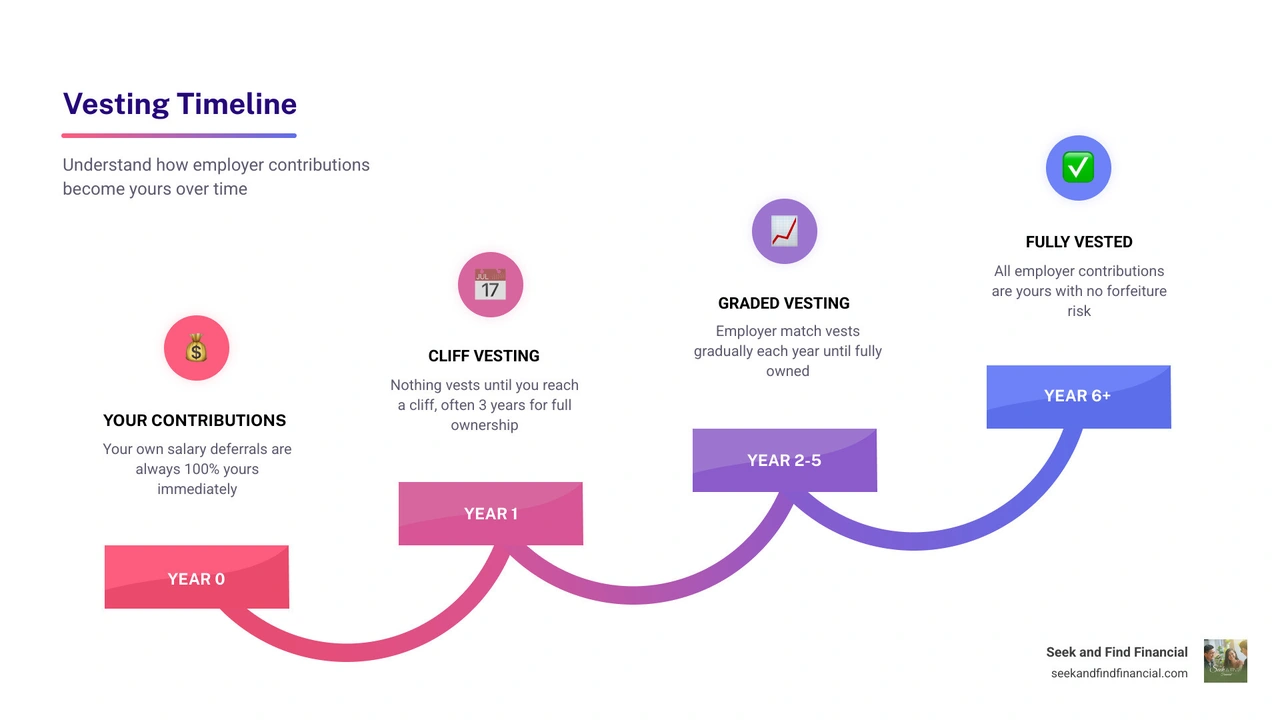
A match means your employer contributes when you contribute. A common formula is something like 100 percent of the first 3 percent of pay, or 50 percent of the first 6 percent.
Important point: your own salary deferrals are always yours. Employer contributions may vest over time.
Common vesting schedules:
Exceptions matter:
In many plans, withdrawals before age 59 1/2 can trigger:
But there are exceptions.
Examples:
Just because you can access money does not mean you should. Cashing out retirement accounts early is one of the fastest ways to shrink future wealth.
RMDs generally begin after age 73 under current IRS guidance referenced in the research.
That means most traditional pre-tax retirement accounts eventually force taxable withdrawals, including:
Roth treatment is different. Roth IRAs generally do not require lifetime RMDs for the original owner. Rules for inherited accounts are separate and can get tricky fast.
Here is the simple framework:
Choosing between pre-tax and Roth often comes down to one core question: do you expect your tax rate to be higher now or later?
Business owners often need retirement plans to do two jobs at once:
That is where planning gets strategic.
For entrepreneurs, we also cover this here: Retirement Planning: An Entrepreneur's Guide
If you are self-employed with no employees, the solo 401(k) is often the most flexible choice.
Why many people like it:
The research notes a solo 401(k) total annual contribution limit of $70,000 for 2025, not counting catch-up contributions.
SEP IRA strengths:
SIMPLE IRA strengths:
Tradeoff: SIMPLE IRA limits are lower, and employer contributions are generally required.
For high earners with strong, steady income, a cash balance or defined benefit plan can allow much larger deductible contributions than a SEP or solo 401(k).
These plans often make the most sense when:
They are more complex and usually require actuarial work, but the tax deductions can be powerful.
More here: Retirement Plans for High Earners
These are not the first plans most people use, but they matter in the right situation.
Nonqualified deferred compensation plans let some executives defer income outside qualified plan limits. They can be useful, but they carry employer-credit risk and fewer protections.
Annuities are insurance contracts that can turn savings into guaranteed income. They may fit people who want predictable income and are willing to trade some flexibility.
Pensions are still valuable where available, but they are much less common than they once were.
We usually look at these factors first:
For business owners, one wrong choice can cost years of missed deductions. One right choice can create a meaningful tax strategy.
The best retirement plan is not just the one with the highest limit. It is the one you actually use well, year after year.
The IRS also provides employer planning guidance here: Choosing a retirement plan: Plan options | Internal Revenue Service
A practical savings order often looks like this:
This order is not universal, but it is a strong starting point.
A few habits matter more than heroic one-time efforts:
Common errors we see:
Usually the top choices are:
The solo 401(k) often wins on flexibility and contribution design. SEP IRAs win on simplicity.
Yes. Many people can contribute to both in the same year.
But there is a catch:
So "can I contribute?" and "can I deduct it?" are not always the same question.
In general, the more flexible options include:
Flexibility is nice. Tax benefits are nice too. The real trick is balancing both.
There is no single best answer for everyone when it comes to retirement plans. The right strategy depends on your job, income, business structure, tax bracket, and long-term goals.
For some people, the best next step is simple: get the 401(k) match and fund an IRA. For others, especially business owners and high earners, a better answer may be a layered strategy using a solo 401(k), SEP IRA, or even a cash balance plan.
What matters most is having a clear structure. Good retirement planning is not about chasing a new idea every year. It is about making steady, tax-aware decisions over time.
If you want to go deeper, here are two helpful next steps:
Investing involves risk, including possible loss of principal. No investment strategy can ensure financial success or guarantee against losses. Past performance may not be used to predict future results. Provided content is for overview and informational purposes only, reflect the opinions of the author, and is not intended and should not be relied upon as individualized tax, legal, fiduciary, or investment advice.
This information is being provided only as a general source of information. These views may change as market or other conditions change. This information is not intended and should not be used to provide financial advice and does not address or account for an individual’s circumstances. Past performance does not guarantee future results and no forecast should be considered a guarantee. Please seek the guidance of a financial professional regarding your particular financial concerns.
Investment advisory services offered by duly registered individuals through Seek & find Financial LLC a Registered Investment Adviser. Licensed Insurance Professional