

How to Make Your Future Self Rich with a Roth IRA
Discover Roth IRA for business owners: tax-free growth, backdoor strategies, and 2026 limits to build retirement wealth.
A Roth IRA for business owners is a personal retirement account that lets you invest after-tax dollars and withdraw your money completely tax-free in retirement — including all the growth.
Here is a quick summary of the key benefits:
| Feature | What It Means for You |
|---|---|
| Tax-free growth | Your investments grow without being taxed each year |
| Tax-free withdrawals | No taxes owed in retirement on qualified distributions |
| No required minimum distributions | You are never forced to take money out during your lifetime |
| Flexible contributions | Contribute even if you already have a SEP IRA or Solo 401(k) |
| Estate planning advantage | Pass tax-free wealth to your heirs |
Running your own business comes with real financial freedom. But it also means you are responsible for your own retirement. No employer match. No automatic enrollment. No safety net.
For high-earning entrepreneurs, that gap can be costly.
Most business owners focus on growing revenue, cutting expenses, and managing cash flow. Retirement planning often gets pushed to the back burner — sometimes until it is too late to make the most of it.
The challenge is that income fluctuates. A great year can push you above IRS income limits. A slow year might make contributions feel impossible. And generic advice rarely fits the complexity of a business owner's financial life.
That is exactly where a Roth IRA — used strategically — can make a meaningful difference.
I'm Daniel Delaney, founder of Seek & Find Financial, and throughout my career at Riverstone Financial Advisors and Brightway Wealth Management, I have helped business owners navigate the nuances of Roth IRA for business owners strategies alongside broader retirement and investment planning. In this guide, I will walk you through everything you need to know to use this powerful account to your advantage.
Investing involves risk, including possible loss of principal. No investment strategy can ensure financial success or guarantee against losses. Past performance may not be used to predict future results. Provided content is for overview and informational purposes only, reflect the opinions of the author, and is not intended and should not be relied upon as individualized tax, legal, fiduciary, or investment advice.
This information is being provided only as a general source of information. These views may change as market or other conditions change. This information is not intended and should not be used to provide financial advice and does not address or account for an individual's circumstances. Past performance does not guarantee future results and no forecast should be considered a guarantee. Please seek the guidance of a financial professional regarding your particular financial concerns.
Investment advisory services offered by duly registered individuals through Seek & Find Financial LLC a Registered Investment Adviser. Licensed Insurance Professional.
Must-know roth ira for business owners terms:
As we look at the landscape in April 2026, the value of tax-free growth has never been clearer. For those of us running businesses in Valparaiso or Crown Point, we know that every dollar saved on taxes is a dollar that can be reinvested into our growth or our families.
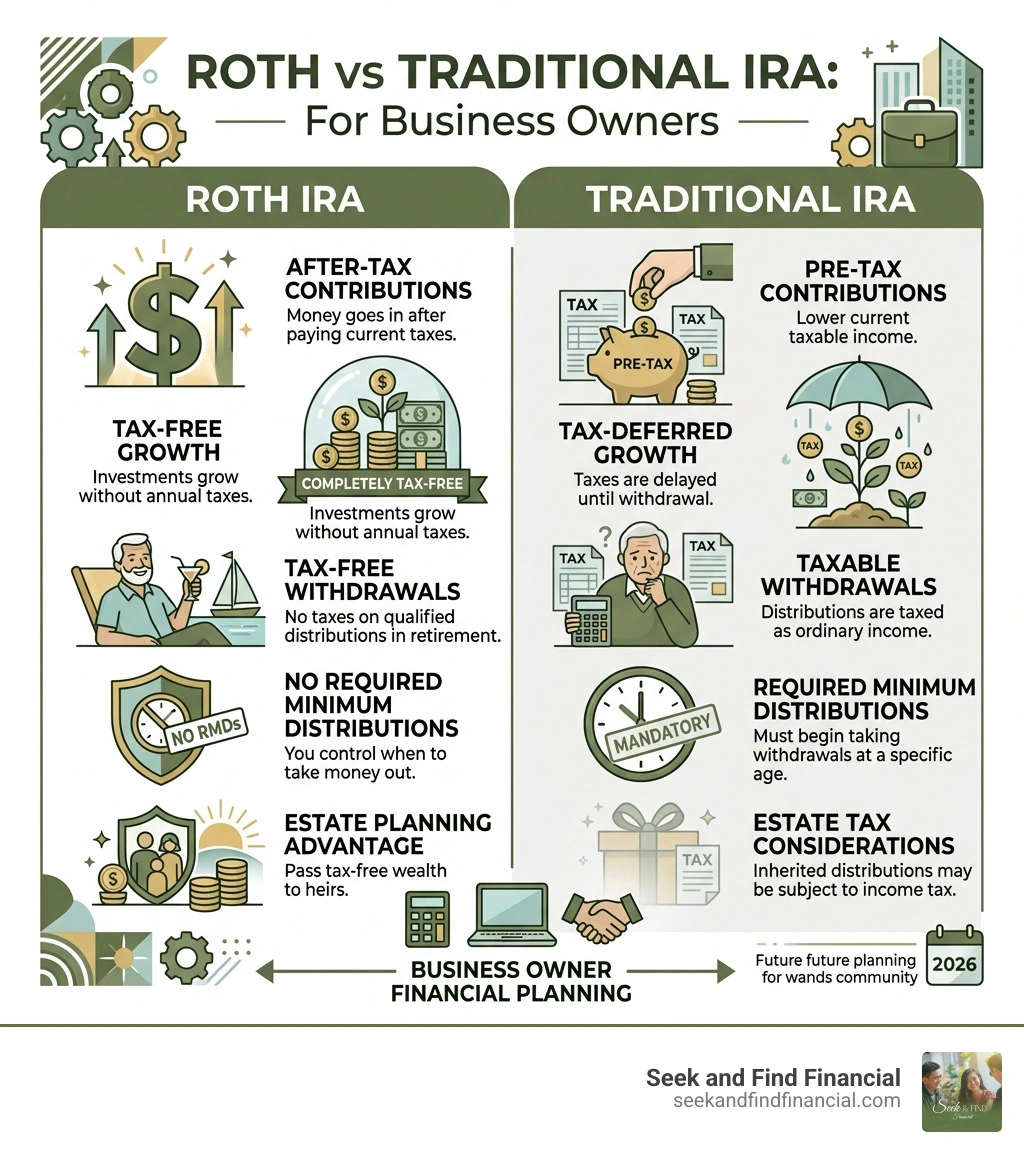
A roth ira for business owners works differently than a Traditional IRA. With a Traditional IRA, you get a tax break today, but you pay taxes when you take the money out later. With a Roth, you pay your taxes now. In exchange, the IRS stays out of your pocket forever on that money. This includes all the interest, dividends, and capital gains your investments earn over decades.
One of the biggest perks for entrepreneurs is the lack of Required Minimum Distributions (RMDs). Most retirement accounts force you to start taking money out once you hit age 73 or 75. A Roth IRA does not. If your business is still spinning off plenty of cash in your 70s, you can leave your Roth money alone. It can keep growing tax-free for your spouse or your kids. This makes it an incredible tool for business owner tax planning.
Another vital point is portability. Many business owners hope to sell their company to fund retirement. However, research shows that only about 20% of businesses actually sell for the value the owner expects. Having a Roth IRA provides a "portable" bucket of wealth that is not tied to your business operations. You can learn more about how these compare in this guide on Roth vs. Traditional IRA: How Small Business Owners Can Save More for Retirement - J.R. Martin & Associates.
The IRS does not let everyone contribute to a Roth IRA directly. They use your Modified Adjusted Gross Income (MAGI) to decide if you qualify. For business owners, this can be tricky because our income changes every year.
For the 2025 tax year, the limits are quite specific. If you are a single filer, you can make a full contribution if your MAGI is below $150,000. If you earn between $150,000 and $165,000, your ability to contribute starts to phase out. If you earn more than $165,000, you cannot contribute directly at all.
For married couples filing jointly, the full contribution limit is a MAGI below $236,000. The phase-out range goes up to $246,000. If your household earns more than that, the front door to the Roth IRA is closed.
If you find yourself in the high-earner category, do not worry. There are other ways to get money into a Roth account, which we will cover in the advanced strategies section. For a deeper dive into these rules, check out our Roth IRA for high earners guide.
In the past, business owners had to choose between a "business" plan like a SEP IRA and a "personal" Roth IRA. Thanks to the SECURE 2.0 Act, the lines have blurred in a way that helps us.
Now, you can actually have a Roth SEP IRA or a Roth SIMPLE IRA. This means you can get the high contribution limits of a business plan while still getting the tax-free growth of a Roth. Before this law, all SEP and SIMPLE contributions had to be pre-tax. Now, you can choose to designate employer contributions as Roth, meaning you pay the tax now so you don't have to later.
This is a game changer for a roth ira for business owners strategy. It allows you to put away much more than the standard $7,000 or $8,000 limit. For 2025, a SEP IRA allows you to contribute up to 25% of your compensation, capped at $70,000. Being able to put a portion of that into a Roth bucket is a massive win for long-term wealth building. You can see how these plans stack up at Self employed and small-business retirement plans | Compare plans.
Staying on top of the numbers is part of the job when you run a business. The IRS adjusts contribution limits for inflation, so they usually go up every year or two.
For 2025, the standard contribution limit for a Roth IRA is $7,000. If you are age 50 or older, you get a "catch-up" contribution of an extra $1,000, bringing your total to $8,000. As we move into 2026, these numbers are expected to stay steady or increase slightly based on final inflation data.
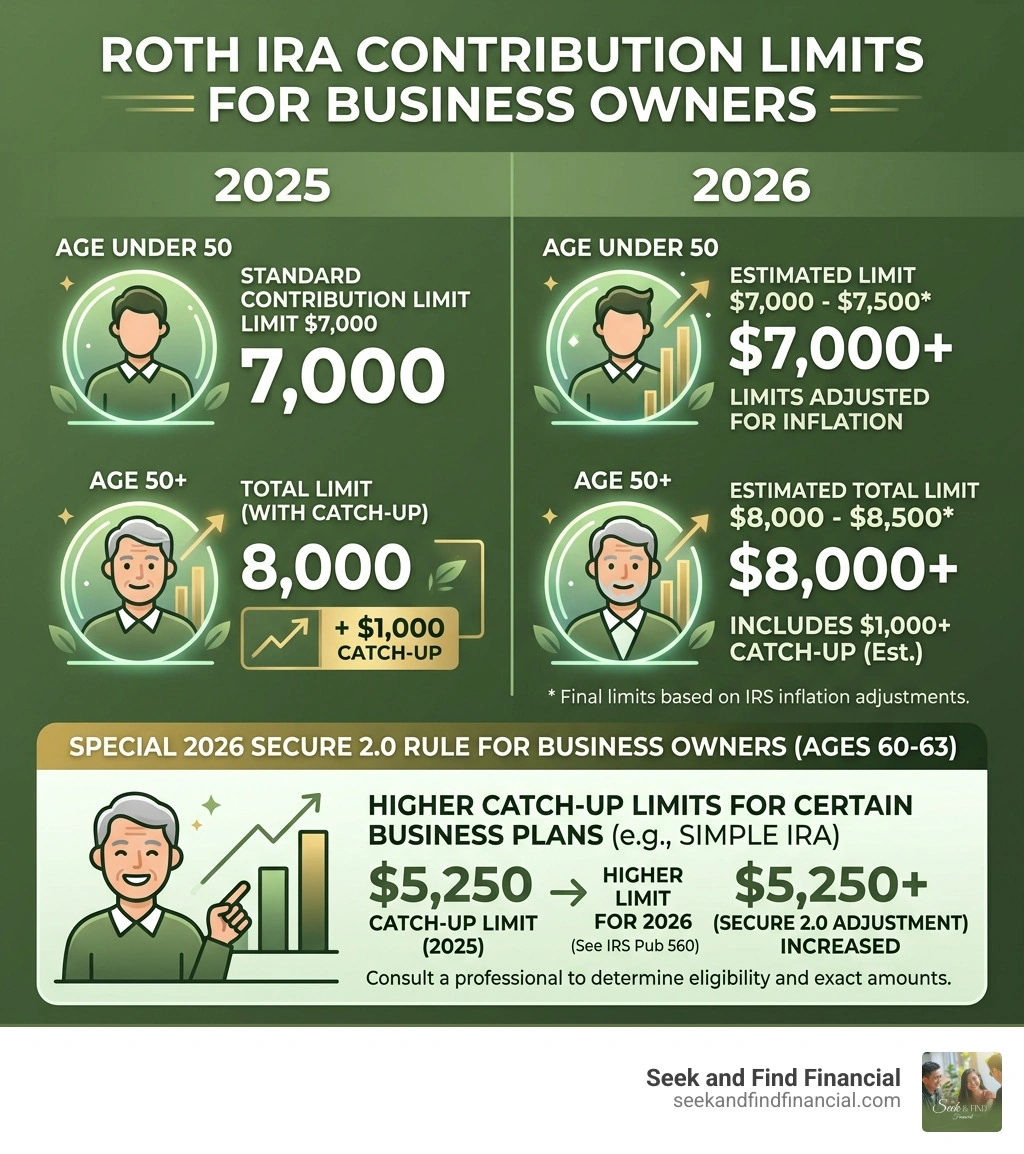
One special rule to watch for in 2026 involves older business owners. For those aged 60 to 63, the SECURE 2.0 Act introduced even higher catch-up limits for certain plans like SIMPLE IRAs. In 2025, this limit is $5,250 for SIMPLE plans. This allows those nearing retirement to supercharge their savings.
You have until the tax filing deadline (usually April 15th) to make your contribution for the previous year. This gives you time to look at your final profit and loss statement before deciding how much to put in. You can find the full technical details in the Publication 560 (2025), Retirement Plans for Small Business | Internal Revenue Service.
If your business in Hobart or Portage is doing well and you earn over the income limits, you might think you are out of luck. That is not the case. We often help clients use the "Backdoor Roth" strategy.
The Backdoor Roth is a two-step process. First, you make a non-deductible contribution to a Traditional IRA. Since it is non-deductible, you don't get a tax break. Second, you immediately convert that money into a Roth IRA. Because you didn't take a deduction, there is generally no tax on the conversion.
However, you must be careful of the "pro-rata rule." If you have other pre-tax IRAs (like a SEP IRA from a previous year), the IRS looks at all your IRAs as one big bucket. This could lead to a surprise tax bill. To avoid this, many business owners roll their pre-tax IRA money into a Solo 401(k). Since 401(k)s are not IRAs, they don't count toward the pro-rata rule. This is a core part of a smart tax strategy for business owners.
For the highest earners, there is also the "Mega Backdoor Roth." This involves using a Solo 401(k) that allows after-tax contributions. You can contribute up to the total limit ($70,000 in 2025) and then move the after-tax portion into a Roth account. This is one of the most powerful high net worth tax planning tools available today.
Setting up a roth ira for business owners is fairly straightforward, but doing it right requires a bit of planning.
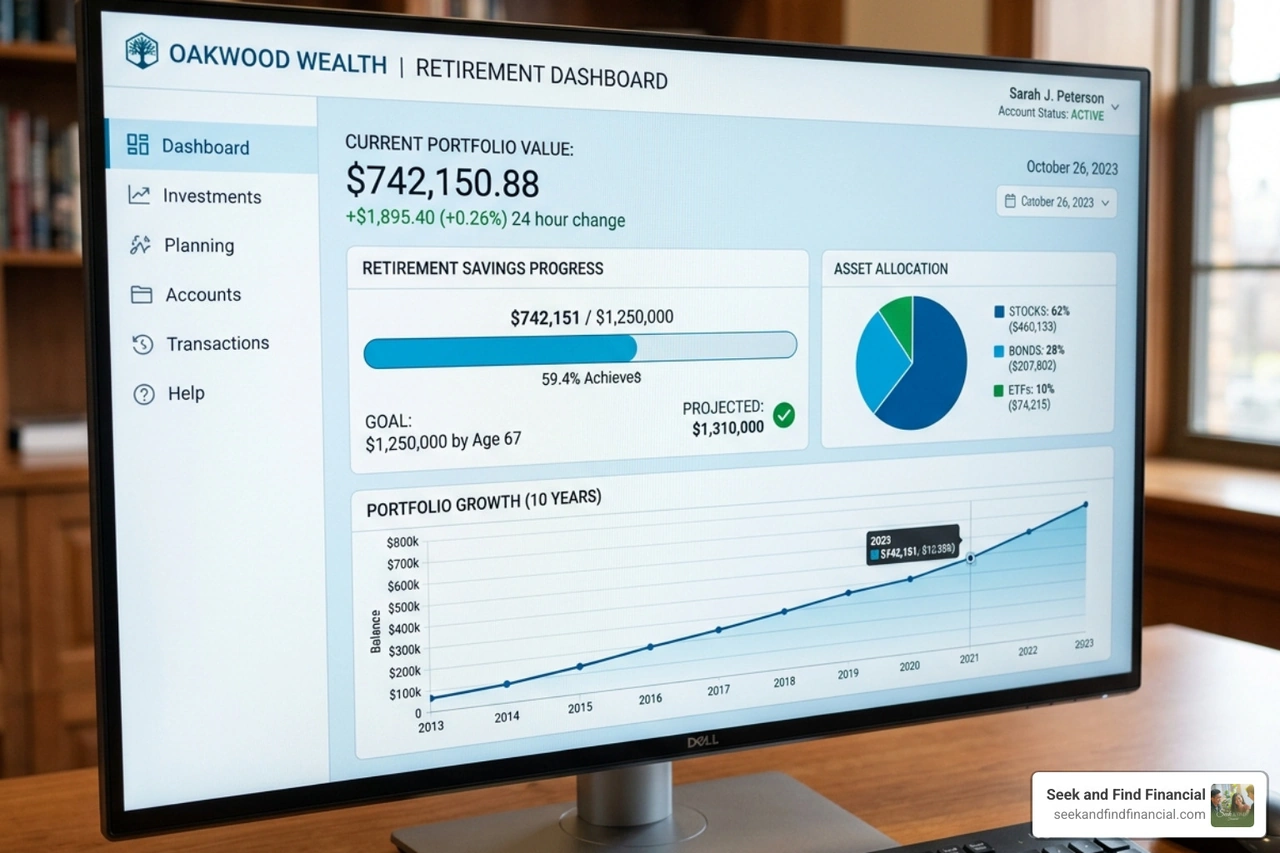
Optimization is where the real wealth is built. Instead of just picking random stocks, we look at investment strategies for small business owners that focus on low-cost index funds or target-date funds. This keeps your fees low and your growth steady.
Managing your cash flow is also part of financial management for entrepreneurs. If you have a slow month, you can pause your contributions. If you have a windfall, you can maximize your limits early in the year to let that money start compounding sooner.
Yes. Having a Solo 401(k) at work does not stop you from having a personal Roth IRA. In fact, many people do both. You can put $23,500 (2025 limit) into your Solo 401(k) as an employee deferral and still put $7,000 into your Roth IRA, provided you meet the income requirements.
The beauty of the Roth IRA is that you can always withdraw your contributions (the money you put in) at any time, for any reason, without taxes or penalties. However, if you withdraw the earnings before age 59½ and before the account has been open for five years, you will generally owe income tax and a 10% penalty.
There are actually two 5-year rules. The first says you must wait five years after your first contribution before you can take tax-free earnings. The second applies to "conversions" (like the Backdoor Roth). Each conversion has its own 5-year clock. If you are under 59½ and take converted money out too soon, you might hit a penalty.
Building wealth as a business owner is about more than just making sales. It is about keeping what you earn and letting it grow. A roth ira for business owners is a foundational tool that provides a tax-free finish line for your hard work.
At Seek & Find Financial, we don't believe in generic advice. We know that a business owner in Merrillville has different needs than a corporate executive in Chicago. Our goal is to provide a structured strategy that accounts for your fluctuating income, your big goals, and your long-term legacy.
Whether you are just starting out or you are managing a high-revenue company, the right retirement plan can change your future. If you want to see how a personalized strategy can work for you, learn more about more info about what we do.
Investing involves risk, including possible loss of principal. No investment strategy can ensure financial success or guarantee against losses. Past performance may not be used to predict future results. Provided content is for overview and informational purposes only, reflect the opinions of the author, and is not intended and should not be relied upon as individualized tax, legal, fiduciary, or investment advice.
This information is being provided only as a general source of information. These views may change as market or other conditions change. This information is not intended and should not be used to provide financial advice and does not address or account for an individual’s circumstances. Past performance does not guarantee future results and no forecast should be considered a guarantee. Please seek the guidance of a financial professional regarding your particular financial concerns.
Investment advisory services offered by duly registered individuals through Seek & find Financial LLC a Registered Investment Adviser. Licensed Insurance Professional