

The Sneaky Guide to Tax-Aware Investing
Master tax efficient investment strategies: Boost after-tax returns with asset location, tax-loss harvesting, and smart account choices.
Tax efficient investment strategies are the methods investors use to legally reduce the taxes taken from their investment returns, so more of their money stays invested and keeps growing.
Here are the core strategies at a glance:
Most investors focus on what they earn. The investors who actually build lasting wealth focus on what they keep.
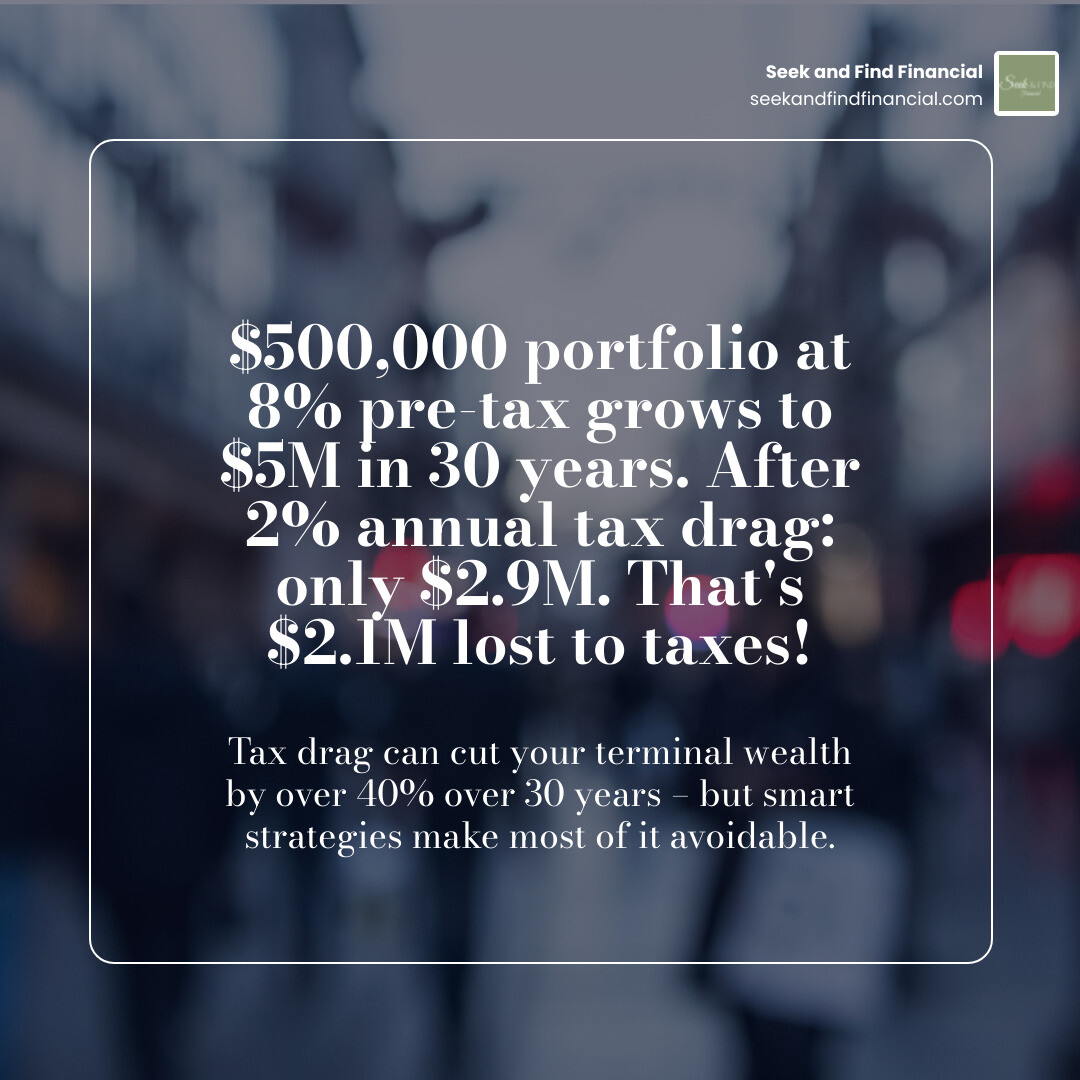
Taxes are one of the biggest drains on investment returns, often reducing compounded wealth by 1 to 2 percentage points every year. That may sound small. But over 30 years, a 2-point annual tax drag can cut your terminal wealth by more than 40%. On a $500,000 portfolio earning 8% pre-tax, that gap can represent hundreds of thousands of dollars in lost growth.
The frustrating part? Much of that loss is avoidable.
This guide walks you through the practical, proven strategies to reduce your tax burden without changing your investment goals or taking on unnecessary risk.
I'm Daniel Delaney, Founder of Seek & Find Financial, and throughout my career, I've worked hands-on with clients implementing tax efficient investment strategies to protect and grow their after-tax wealth. That experience is the foundation for everything covered here.
Investing involves risk, including possible loss of principal. No investment strategy can ensure financial success or guarantee against losses. Past performance may not be used to predict future results. Provided content is for overview and informational purposes only, reflect the opinions of the author, and is not intended and should not be relied upon as individualized tax, legal, fiduciary, or investment advice.
This information is being provided only as a general source of information. These views may change as market or other conditions change. This information is not intended and should not be used to provide financial advice and does not address or account for an individual's circumstances. Past performance does not guarantee future results and no forecast should be considered a guarantee. Please seek the guidance of a financial professional regarding your particular financial concerns.
Investment advisory services offered by duly registered individuals through Seek & Find Financial LLC a Registered Investment Adviser. Licensed Insurance Professional
Simple Tax efficient investment strategies word guide:

When we talk about tax efficient investment strategies, we are looking at how to keep the IRS from taking a bigger bite of your sandwich than necessary. Not all investment income is treated the same. If you earn a dollar from a bond, the government might take 37 cents. If you earn a dollar from selling a stock you held for two years, they might only take 20 cents.
Understanding these differences is the first step toward building a smarter portfolio. At Seek & Find Financial, we help our clients in Valparaiso and Crown Point look at their total portfolio to see where these "tax leaks" are happening. For a simple outside overview of tax-aware investing, the IRS investment income page is a useful place to start.
Think of taxes like a toll road. Some lanes cost more than others.
For high earners making over $200,000 (single) or $250,000 (married), there is also a sneaky 3.8% Medicare surtax on investment income. This is why "tax drag" is so dangerous. It is the slow erosion of your money caused by paying these tolls every single year.
The "one-year rule" is one of the simplest tax efficient investment strategies you can use. By waiting just 366 days to sell an investment, you could move from a 37% tax rate down to 20%. That is a massive raise you give yourself just by being patient.
In our practice, we often see investors in the Chicago and Northwest Indiana area get excited about a quick gain and sell too early. We help them calculate the "after-tax" return. Sometimes, waiting a few extra months to hit that long-term mark is the smartest financial move you can make.
Where you put your money is just as important as what you buy. We generally look at three types of buckets:
Learning about Tax Reduction Strategies means knowing which bucket to fill first.
Asset location is a fancy term for putting the "tax-heavy" investments in "tax-shielded" accounts.
By using Tax Effective Investing principles, you can reduce the amount of taxes you owe today without changing your overall mix of stocks and bonds.
We are big fans of Tax Efficiency ETF options. ETFs (Exchange-Traded Funds) are built differently than mutual funds. Because of how they are structured, they rarely trigger big tax bills for you at the end of the year.
Passive investing through index funds is another winner. Because these funds don't trade very often, they don't "realize" gains that you have to pay taxes on. This keeps your money working for you instead of going to the government.
One of the most powerful tools we use is called tax-loss harvesting. It sounds complicated, but it is just like pruning a garden. When an investment goes down in value, you sell it to "capture" that loss. You can use that loss to cancel out gains you made elsewhere. If you have more losses than gains, you can even use up to $3,000 to lower your regular income tax bill.
This is a core part of smart investment management. At Seek & Find Financial, we use technology like Altruist to help automate this process for our clients in places like Merrillville and Portage.
You have to be careful when harvesting losses. The IRS has a "wash-sale rule." It says you can't sell a stock for a loss and then buy the exact same thing (or something "substantially identical") within 30 days. If you do, the IRS won't let you claim the loss.
To get around this, we use Advanced Tax Strategies. For example, if you sell an S&P 500 fund at a loss, you might buy a "Total Stock Market" fund. They are similar but not identical, so you stay invested in the market while still getting your tax break.
Mutual funds can be "tax bombs." If a mutual fund manager sells a stock inside the fund for a profit, you have to pay taxes on that gain, even if you didn't sell a single share of the fund!
ETFs use "in-kind redemptions." This is a technical way of saying they can move stocks around without triggering a tax bill for you. This structural advantage makes them the gold standard for tax efficient investment strategies in taxable accounts.
For our clients earning $400,000 or more, standard advice isn't enough. You need High Net Worth Tax Planning.
One advanced move is the Mega Backdoor Roth. If your company's 401(k) plan allows it, you can put away tens of thousands of extra dollars into a Roth account every year. This creates a massive bucket of money that will never be taxed again.
We call the Health Savings Account (HSA) the "Triple Tax Threat":
If you don't need it for health bills, it can act like a second IRA.
Another great tool is the municipal bond. These are loans to cities or states (like Indiana or Illinois). The interest you earn is usually free from federal taxes. For someone in the top tax bracket, a 4% municipal bond might be better than a 6% regular bond after you factor in the taxes.
If you own a business in Chesterton or Hobart, your tax efficient investment strategies should include your company structure. Tax Strategy for Business Owners might involve using a C Corp to take advantage of specific tax rates or setting up a specialized retirement plan that lets you shield more income than a standard 401(k).
As you get closer to retirement, how you take money out is just as important as how you put it in. This is called Tax Efficient Wealth Management.
The general rule is to spend your taxable money first, then your tax-deferred money, and save your Roth money for last. This allows your tax-free money to grow for as long as possible. You also have to watch out for Required Minimum Distributions (RMDs), which are forced withdrawals from your Traditional IRAs starting at age 73.
Estate planning is the ultimate tax strategy. In 2025, you can give away up to $19,000 per person without even telling the IRS. This helps move wealth to your kids or grandkids without tax.
Even better is the "step-up in basis." If you hold an appreciated stock until you pass away, your heirs get it at the current market value. All the gains that happened during your life are never taxed. This is a key part of Bespoke Investment Strategies for families looking to leave a legacy.
Tax laws change constantly. What worked in 2025 might be different by 2027. A financial advisor doesn't just pick stocks; they act as a "tax alpha" manager, looking for every legal way to keep more of your money in your pocket.
If you are a business owner or high-income professional in Northwest Indiana or Chicago, generic advice doesn't cut it. You need a plan that looks at your business, your investments, and your family goals all at once.
Usually, yes. Because of how they handle buying and selling stocks (in-kind redemptions), they avoid passing on capital gains to you. Mutual funds often have to pay out "capital gains distributions" at the end of the year, which you have to pay taxes on even if you didn't sell your shares.
Generally, you want to keep taxable bonds in tax-deferred accounts like a Traditional IRA or 401(k). This is because bond interest is taxed at the highest rates. By keeping them in these accounts, you "hide" that income from the IRS. If you have to hold bonds in a taxable account, consider municipal bonds.
You shouldn't just do it in December. Market volatility happens all year long. At Seek & Find Financial, we look for harvesting opportunities whenever the market dips. This year-round approach helps us "bank" losses that can be used for years to come.
At Seek & Find Financial, we believe that wealth isn't just a number on a screen. It is the freedom to live your life on your own terms. By using smart tax efficient investment strategies, you aren't just being "cheap" with the IRS. You are being a good steward of your hard-earned money.
Whether you are in Valparaiso, Chicago, or anywhere in between, we are here to provide the clarity and structured planning you need to grow. Don't let tax drag slow you down. Let's build a strategy that works as hard as you do.
More info about our wealth management services
Investing involves risk, including possible loss of principal. No investment strategy can ensure financial success or guarantee against losses. Past performance may not be used to predict future results. Provided content is for overview and informational purposes only, reflect the opinions of the author, and is not intended and should not be relied upon as individualized tax, legal, fiduciary, or investment advice.
This information is being provided only as a general source of information. These views may change as market or other conditions change. This information is not intended and should not be used to provide financial advice and does not address or account for an individual’s circumstances. Past performance does not guarantee future results and no forecast should be considered a guarantee. Please seek the guidance of a financial professional regarding your particular financial concerns.
Investment advisory services offered by duly registered individuals through Seek & find Financial LLC a Registered Investment Adviser. Licensed Insurance Professional