

Smart Traditional IRA Deduction Strategies to Lower Your Taxes
Learn traditional IRA deduction strategies to lower taxes in 2026 with smart contribution and phase-out planning.
Traditional IRA deduction strategies are one of the most underused tax tools available to American workers, especially those earning well above average.
Here is a quick answer to what actually works:
Top Traditional IRA Deduction Strategies at a Glance
| Strategy | Who It Helps Most | Key Benefit |
|---|---|---|
| Contribute the full annual limit ($7,500 in 2026) | Anyone with earned income | Reduces taxable income dollar-for-dollar |
| Reduce MAGI via 401(k) and HSA contributions | Earners near phase-out thresholds | Preserves full or partial deductibility |
| Use a spousal IRA for a non-working partner | Married couples | Up to $7,500 additional deduction |
| Make backdoor Roth conversions when phased out | High earners above income limits | Captures tax-free growth via non-deductible contributions |
| Contribute early in the tax year | All IRA holders | Maximizes tax-deferred compounding |
Many high earners assume they earn too much to benefit. That assumption is often wrong, and it costs real money every year.
The rules are more nuanced than most people realize. Whether you can deduct your contribution depends on three things: your income, your filing status, and whether you or your spouse participate in a workplace retirement plan. Each factor shifts the math in ways that open or close specific planning opportunities.
In 2026, the IRA contribution limit is $7,500 (or $8,600 if you are age 50 or older). A full deduction at a 32% marginal tax rate saves you $2,400 in federal taxes in a single year. Over decades, that compounding advantage is significant.
I'm Daniel Delaney, Founder of Seek & Find Financial, and throughout my career, I've helped clients at every income level implement traditional IRA deduction strategies that align with their broader tax and retirement plan. The strategies that follow are the same frameworks I use with clients today.
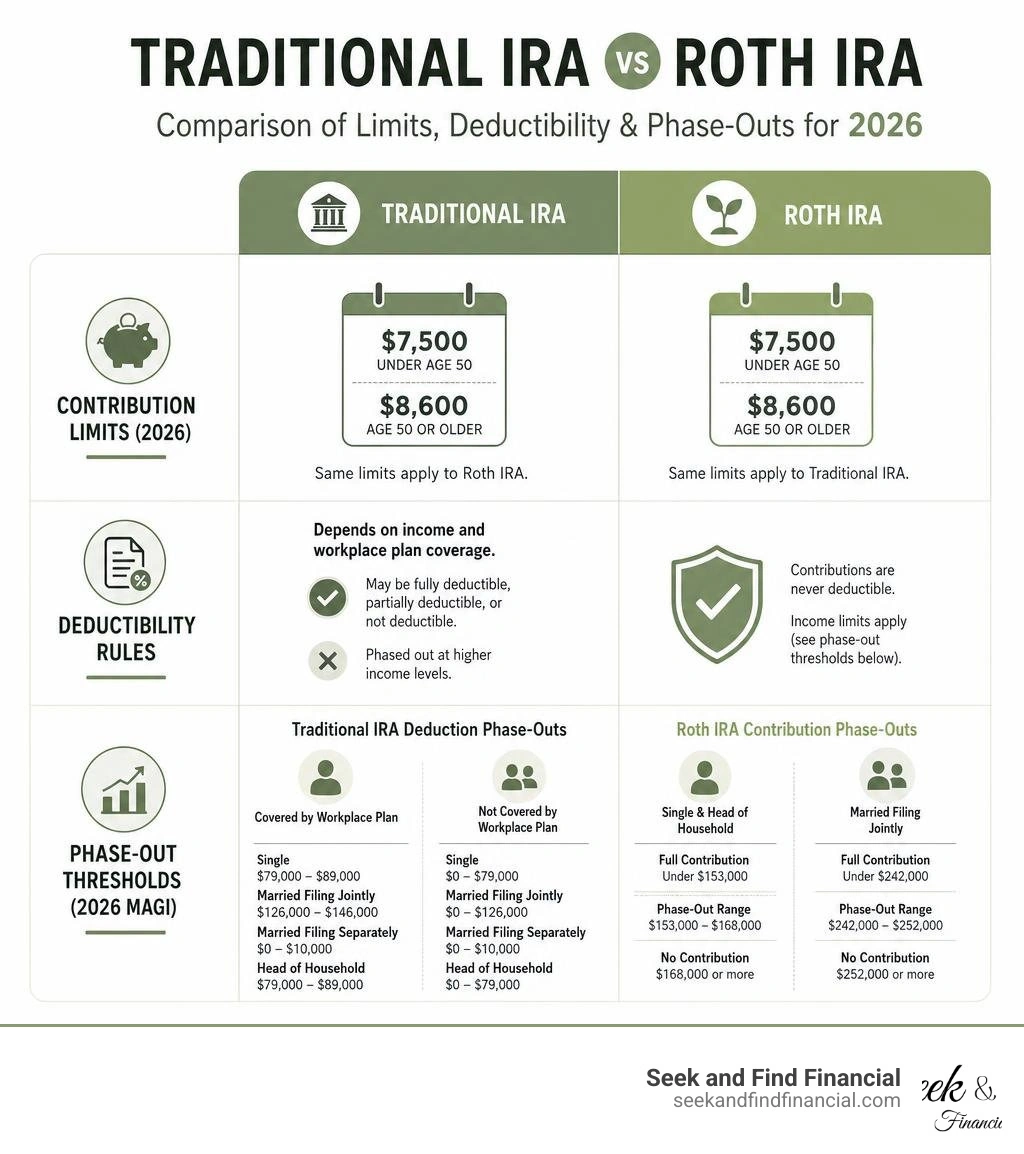
Traditional ira deduction strategies terminology:
A traditional IRA is a personal savings plan that gives you tax advantages for saving for retirement. It lets your money grow on a tax-deferred basis. This means you do not pay taxes on the growth or earnings inside the account until you withdraw the money in retirement.
To get the details on how these accounts work, you can read What is a traditional IRA and how does it work? - Fidelity Investments.
For many people, the biggest benefit is the ability to deduct their contributions on their tax returns. This deduction lowers your taxable income for the year. That means you pay less in federal income taxes today.
The main difference between a traditional IRA and a Roth IRA is when you pay taxes.
With a traditional IRA, you make pre-tax contributions if you qualify for the deduction. You pay ordinary income tax later when you take the money out in retirement.
With a Roth IRA, you make post-tax contributions. You do not get a tax break today. However, your money grows tax-free, and your withdrawals in retirement are completely tax-free.
This difference sets up a strategy called tax bracket arbitrage. If you are in a high tax bracket today, a traditional IRA deduction saves you a lot of money. You can take the deduction now and withdraw the money later when you might be in a lower tax bracket. If you are in a low tax bracket today, a Roth IRA is usually better.
You can read more about how these limits change in our guide on Traditional IRA Deduction Phaseouts.
For the 2026 tax year, the IRS allows you to contribute up to $7,500 to your IRAs. This limit is shared across both traditional and Roth IRAs. If you are age 50 or older, you can make an extra catch-up contribution of $1,100. This brings your total 2026 limit to $8,600.
To contribute, you must have taxable compensation. This includes wages, salaries, tips, and self-employment income. If you contribute more than you earn, or more than the IRS limit, you face an excess contributions penalty. The IRS charges a 6% excise tax every year on the excess amount until you correct it. To avoid this penalty, you must withdraw the excess contribution and any earnings on it before your tax filing deadline.
Many people do not realize that participating in an employer-sponsored retirement plan, like a 401(k), changes the rules for your traditional IRA. If you are an active participant in a workplace plan, your ability to deduct your traditional IRA contribution is limited by your income.
To know if you are an active participant, look at Box 13 on your W-2 form. If the "Retirement plan" box is checked, you are covered. This is true even if you did not contribute any of your own money to the plan during the year.
If you are covered by a workplace plan, we must look at your income to see if you can still use traditional ira deduction strategies. This is a key part of Tax Planning for High Income earners.
If you have a workplace retirement plan, your traditional IRA deduction phases out as your income rises. Here are the phase-out ranges for 2026:
If your income falls inside these ranges, you get a partial deduction. To find your exact deduction, you can use the Traditional IRA Deduction Calculator 2026 - Tax47. You can also study detailed examples in the Traditional IRA Deduction 2026: Income Limits, Phaseouts, Examples, and Calculator guide.
To find out where you stand, you must calculate your Modified Adjusted Gross Income (MAGI). Your MAGI is your Adjusted Gross Income (AGI) with certain tax deductions added back.
To calculate your MAGI for IRA purposes, start with your AGI from your tax return. Then, add back these common items:
Once you add these items back to your AGI, you have your MAGI. You will use this number to check if you qualify for the traditional IRA deduction.

When your income is high, you must use advanced strategies to keep your tax bill low. This is a core focus of our work in High Net Worth Tax Planning and Tax Strategy for Business Owners.
Normally, you must have earned income to contribute to an IRA. However, the spousal IRA rule is a great exception for married couples. If one spouse does not work or has very low income, they can still contribute to a traditional IRA. They can use the working spouse's earned income to qualify.
If the working spouse has a workplace retirement plan but the non-working spouse does not, the non-working spouse gets a much higher income limit. In 2026, the non-working spouse can claim a full deduction if the couple's joint MAGI is $242,000 or less. The deduction phases out between $242,000 and $252,000. This strategy allows a married couple to double their household IRA deduction.
If your income is too high to deduct your traditional IRA contribution, you can still make a non-deductible contribution. When you do this, you must file Form 8606 with your tax return. This form tracks your cost basis so you do not pay taxes twice on that money when you withdraw it.
Many high earners use non-deductible contributions to perform a backdoor Roth conversion. They put money into a traditional IRA and then quickly convert it to a Roth IRA.
However, you must watch out for the pro-rata rule. The IRS does not let you convert only your non-deductible contributions if you have other pre-tax IRA balances. Instead, the IRS looks at all of your traditional, rollover, SEP, and SIMPLE IRAs as one big pool.
If 90% of your total IRA money is pre-tax, then 90% of your Roth conversion will be taxable. To make the backdoor Roth strategy work cleanly, you may need to roll your pre-tax IRA balances into an active workplace 401(k) plan first.

Tax planning does not stop when you retire. In fact, traditional IRAs require careful management in your later years. This is where we focus on Tax Reduction Strategies that protect your retirement wealth.
When you reach age 73, the IRS requires you to start taking Required Minimum Distributions (RMDs) from your traditional IRAs. These distributions are taxed as ordinary income. If your traditional IRA is very large, these RMDs can push you into a much higher tax bracket.
If you plan to retire early, you can use a Roth conversion ladder. During early retirement, you might have years where your income is very low. This is the perfect time to convert portions of your traditional IRA to a Roth IRA.
You will pay taxes on the converted amount, but you will pay them at a very low tax rate. Once the money is in the Roth IRA, it grows tax-free. It can also be withdrawn tax-free later. This strategy helps you manage your tax brackets over your lifetime.
Large RMDs can cause other financial headaches. They increase your MAGI, which can trigger higher Medicare premiums (known as IRMAA surcharges). They can also cause more of your Social Security benefits to be taxed.
To minimize this impact, you can use Qualified Charitable Distributions (QCDs). If you are age 70.5 or older, you can transfer up to $100,000 per year directly from your traditional IRA to an eligible charity. This transfer counts toward your RMD but is not added to your taxable income. This keeps your MAGI lower and protects your Social Security and Medicare benefits.
To get the most out of your retirement savings, you must coordinate all your accounts. We help clients build a Tax Efficient Investment Strategy and implement Tax Efficient Wealth Management to keep more of their hard-earned money. These Advanced Tax Strategies are vital for long-term growth.
Many people wait until the tax deadline on April 15 of the following year to make their IRA contributions. While this is legal, it is not the best strategy for growth.
Making early-year contributions in January gives your money more time to benefit from tax-deferred compounding. Over a 20 or 30-year career, contributing 15 months early every year can add tens of thousands of dollars to your retirement nest egg. We recommend setting up automated savings to build a consistent habit.
If your income is just above the phase-out limit for the traditional IRA deduction, you can take active steps to lower your MAGI. This is a powerful technique in our Advanced Tax Strategy for Entrepreneurs.
You can lower your MAGI by:
By stacking these accounts, you can drop your MAGI back down into the range where you qualify for a full traditional IRA deduction.
The best strategies include using a spousal IRA if one partner does not work, or lowering your MAGI through pre-tax 401(k) and HSA contributions. If you are completely phased out of the deduction, the best strategy is to make non-deductible contributions and perform a backdoor Roth conversion, provided you do not have other pre-tax IRA balances that trigger the pro-rata rule.
The deadline is the tax filing deadline for that year, which is usually April 15 of the following year. Filing for a tax extension does not extend the deadline to make your IRA contribution. You must make the contribution by April 15 to claim it on your tax return.
Your contribution will grow on a tax-deferred basis. You must file Form 8606 to report the contribution and establish your cost basis. When you withdraw the money in retirement, you will not pay taxes on the principal contribution, but you will pay ordinary income tax on the earnings.
Maximizing your traditional IRA deduction requires a structured financial planning approach. It is not just about putting money into an account. It is about understanding how your income, your workplace benefits, and your filing status work together.
At Seek & Find Financial, we help professionals and business owners in Valparaiso, Chesterton, Portage, Hebron, Merrillville, Crown Point, Hobart, and Chicago build personalized tax strategies. We avoid generic advice and focus on clear, long-term wealth strategy. To learn more about how we can help you optimize your retirement plan, read our guide on Traditional IRA for High Income Earners.
Investing involves risk, including possible loss of principal. No investment strategy can ensure financial success or guarantee against losses. Past performance may not be used to predict future results. Provided content is for overview and informational purposes only, reflect the opinions of the author, and is not intended and should not be relied upon as individualized tax, legal, fiduciary, or investment advice.
This information is being provided only as a general source of information. These views may change as market or other conditions change. This information is not intended and should not be used to provide financial advice and does not address or account for an individual’s circumstances. Past performance does not guarantee future results and no forecast should be considered a guarantee. Please seek the guidance of a financial professional regarding your particular financial concerns.
Investment advisory services offered by duly registered individuals through Seek & find Financial LLC a Registered Investment Adviser. Licensed Insurance Professional