

How to Turn Your Startup Success into a Personal Fortune
Discover wealth building strategies entrepreneurs use: protect assets, cut taxes, invest smartly, and secure your legacy for lasting fortune.
Wealth building strategies entrepreneurs actually use look very different from generic financial advice — and that gap is exactly where most high earners lose ground.
Here is a quick overview of the core strategies:
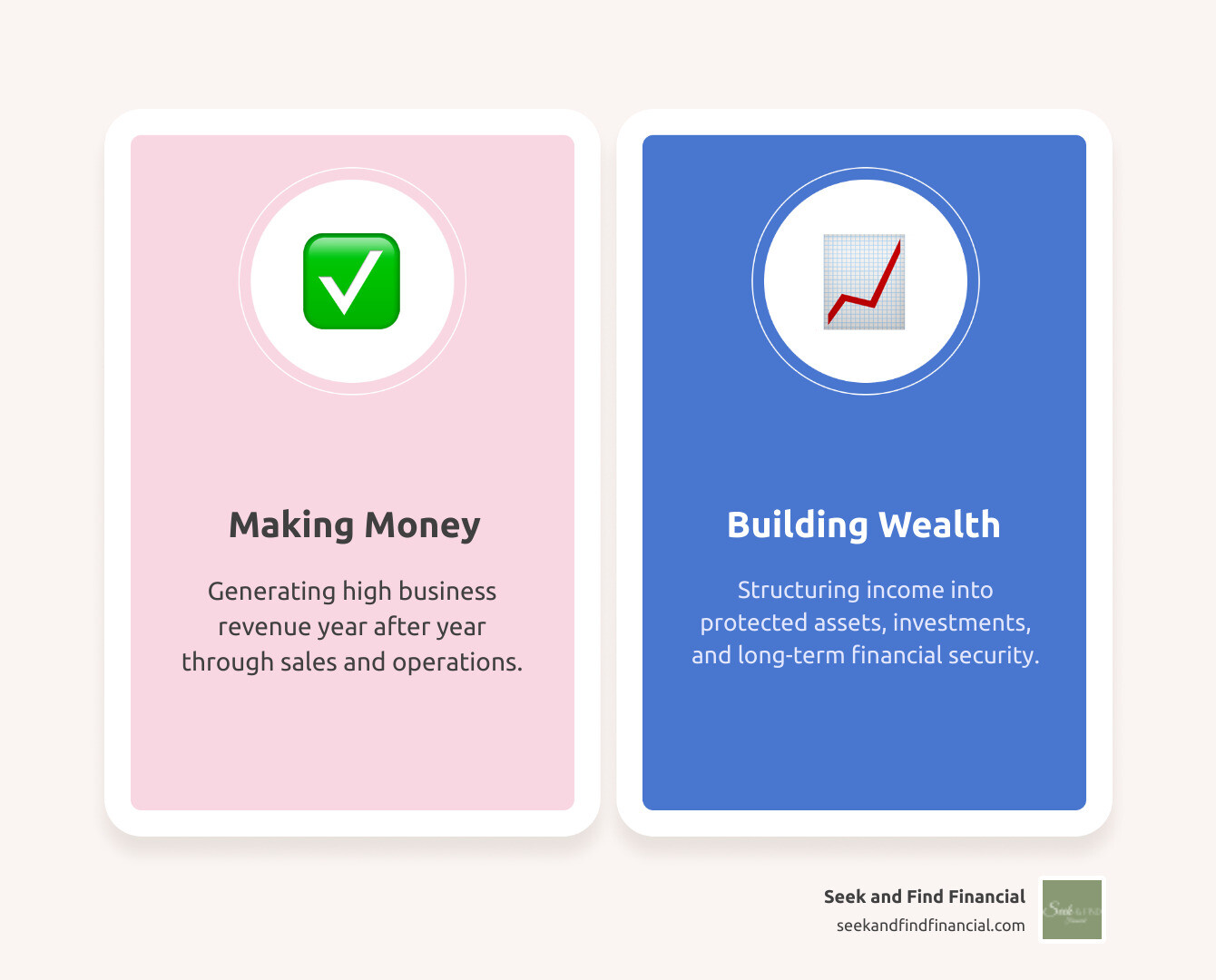
Roughly 88% of millionaires are self-made. Most built their wealth through business ownership. But here is the part that often gets overlooked: making money and building wealth are not the same thing.
Many business owners generate strong revenue every year, then watch it loop back into operations, taxes, or lifestyle spending. There is no shortage of income. There is a shortage of structure.
The result? A thriving business with very little personal financial security sitting underneath it.
That is the paradox this guide is designed to solve. Whether you are pulling in $400K a year or well past that, the strategies here will help you turn what your business earns into wealth that actually lasts.
I'm Daniel Delaney, founder of Seek & Find Financial, and my background spans investment planning and client advisory at established financial institutions before I launched my own independent firm. I have built my practice around helping entrepreneurs like you cut through the noise and apply wealth building strategies entrepreneurs can actually act on. Let's get into it.
One of the biggest mistakes we see entrepreneurs make is treating their business bank account like a personal piggy bank. When your personal life and your business life are tangled together, you create a "wealth leak." This makes it hard to see how much you are actually making. Even worse, it puts your personal home and savings at risk if your business ever faces a lawsuit.
At Seek & Find Financial, we focus on what we do by helping you draw a hard line between these two worlds. This separation is the foundation of any real wealth plan. Without it, you aren't building a fortune; you are just managing a very complicated checking account.
Your business structure is your first line of defense. Many people start as a sole proprietorship because it is easy. However, this offers zero protection for your personal assets. If the business gets sued, your personal bank account is on the line.
To fix this, you should choose the right business entity structure. Most entrepreneurs in Indiana and Illinois find that a Limited Liability Company (LLC) or an S-corporation works best. These structures create a "corporate veil." This means your personal assets, like your house in Valparaiso or your savings in Crown Point, are generally protected from business liabilities.
Once the legal structure is set, you must act like it exists. This means having separate bank accounts and credit lines for the business.
Why does this matter?
We recommend paying yourself a set salary. This forces you to live on a budget while the "extra" profit stays in the business to be invested or saved for taxes.
Taxes are likely your biggest expense. For an entrepreneur earning over $400K, the "make-tax-spend" cycle is a trap. Most employees get paid, pay taxes, and then spend what is left. Successful entrepreneurs flip this. They use their business to "make, spend on growth, and then pay tax" on what remains.
You should always look for ways to lower your taxable income. This isn't about "cheating" the system; it is about using the rules the government wrote to encourage business growth. You can learn about business tax credits that change every year.
Common deductions include:
Inflation and interest rates change how much your money is worth. If inflation is high, the $100,000 you have sitting in a standard savings account is actually losing value every day.
We help our clients perform quarterly projections. This helps you see how much tax you will owe before the end of the year. It also helps you decide if you should spend money now on things that grow the business or save it to take advantage of higher interest rates in a money market account.
Did you know that over one-third of entrepreneurs have no retirement savings? Many assume their business is their retirement plan. But what if the market changes? What if you want to walk away but can't find a buyer?
Relying only on your business is a "concentration risk." To build a personal fortune, you need to move money out of the business and into assets you don't control, like the stock market or real estate. You can find more info about financial planning on our website to see how these pieces fit together.
Diversification is just a fancy word for "not putting all your eggs in one basket." If your business is in Merrillville, you don't want all your wealth tied to that one building or that one local economy.
We suggest using the Pareto Principle: 80% of your results often come from 20% of your efforts. In investing, this means focusing on high-quality index funds or real estate that provides steady income. Set clear SMART goals for your investments so you know exactly why you are putting money into a Solo 401(k) or a SEP IRA.
Advanced options for high earners include:
The hardest part of building wealth is remembering to do it. We all get "decision fatigue." If you have to decide to save money every month, eventually you will forget or find an excuse to spend it.
The secret is automation. Set up a recurring transfer from your business to your personal investment accounts. Treat this like a "tax" you pay to your future self. This ensures you "pay yourself first" and lets compound growth work its magic over decades.
Cash flow is the heartbeat of your business. If it stops, everything else dies. But cash flow isn't just for paying bills; it is a tool for building value.
Not all debt is bad. Credit card debt at 25% interest is "bad debt." It drains your wealth. However, a low-interest business loan used to buy equipment that makes you $10,000 more per month is "good debt."
In places like Hebron or Hobart, we see owners use lines of credit to manage the "gaps" in their income. Using debt strategically allows you to keep your cash invested in high-growth areas while using the bank's money to handle daily operations.
To master cash flow, you need to know three numbers:
We recommend keeping a business emergency fund of three to six months of expenses. This prevents you from having to raid your personal savings if the business has a slow month.
The final step in turning startup success into a fortune is making sure that fortune lasts beyond you. This is where estate planning and succession planning come in.
If the business can't run without you, it isn't an asset—it's a job. To get the highest price when you sell, you need to build a self-managing company. This means grooming a successor or building systems so that the business functions while you are on vacation in Chicago or traveling the world.
A business that runs itself is worth much more to a buyer. This is the ultimate "exit strategy."
You've worked hard to build this. Don't let the government or legal battles take it away. You must get adequate insurance coverage, including life, disability, and "key person" insurance.
Your estate plan should include:
The best way is to form an LLC or S-Corp and keep your finances strictly separate. Never use personal assets as collateral for business loans if you can avoid it. Also, carry high-quality liability insurance.
Your business is a "concentrated" risk. If your industry changes or a competitor moves in, your entire net worth could vanish. Investing in the stock market or real estate provides a "safety net" that is not tied to your daily work.
Year-round planning is key. Don't wait until April. Use retirement accounts like a Solo 401(k), maximize your business deductions, and ensure your entity structure (like an S-Corp) is optimized to reduce self-employment taxes.
Building wealth as an entrepreneur is about more than just a high income. It requires a system of wealth building strategies entrepreneurs use to protect their time, their families, and their futures. By separating your assets, planning for taxes, and investing outside your business, you turn your startup success into a lasting personal fortune.
At Seek & Find Financial, we don't believe in generic advice. We provide personalized, structured planning for business owners in Indiana and Illinois who want to see real-life growth. If you are ready to stop just "making money" and start building a legacy, we are here to help. Explore more info about our services and let's start building your fortune today.
Investing involves risk, including possible loss of principal. No investment strategy can ensure financial success or guarantee against losses. Past performance may not be used to predict future results. Provided content is for overview and informational purposes only, reflect the opinions of the author, and is not intended and should not be relied upon as individualized tax, legal, fiduciary, or investment advice.
This information is being provided only as a general source of information. These views may change as market or other conditions change. This information is not intended and should not be used to provide financial advice and does not address or account for an individual’s circumstances. Past performance does not guarantee future results and no forecast should be considered a guarantee. Please seek the guidance of a financial professional regarding your particular financial concerns.
Investment advisory services offered by duly registered individuals through Seek & Find Financial LLC a Registered Investment Adviser. Licensed Insurance Professional.