

Why Every Business Owner Needs a Specialized Financial Advisor
Discover why every business owner needs a business transition advisor for proactive exit planning and wealth protection.
A business transition advisor is a specialized professional who helps business owners plan and execute the transfer of their company — whether through a sale, succession, ESOP, or other exit strategy.
Here's what a business transition advisor typically does:
You've spent years building your business. But here's a number worth sitting with: about 80% of a business owner's wealth is typically tied up in that one illiquid asset. When it's time to exit, the decisions you make — and when you make them — can mean the difference between a financially secure next chapter and leaving significant money on the table.
The challenge is that most owners don't plan ahead. Nearly 50% of business owners have done no transition planning at all. And with an estimated 5 million businesses expected to change hands by 2033 as baby boomers retire, the stakes have never been higher.
What makes this even more urgent: roughly half of all business transitions are involuntary — triggered by health events, partner disputes, or market shifts. Without a plan in place, owners are forced to react instead of lead.
I'm Daniel Delaney, Founder of Seek & Find Financial. My background working within established financial institutions before building an independent advisory practice has given me a clear view of how critical it is for business owners to work with a qualified business transition advisor well before they need one. The sections below break down exactly what to look for, when to start, and how to avoid the most costly mistakes.
Investing involves risk, including possible loss of principal. No investment strategy can ensure financial success or guarantee against losses. Past performance may not be used to predict future results. Provided content is for overview and informational purposes only, reflect the opinions of the author, and is not intended and should not be relied upon as individualized tax, legal, fiduciary, or investment advice.
This information is being provided only as a general source of information. These views may change as market or other conditions change. This information is not intended and should not be used to provide financial advice and does not address or account for an individual's circumstances. Past performance does not guarantee future results and no forecast should be considered a guarantee. Please seek the guidance of a financial professional regarding your particular financial concerns.
Investment advisory services offered by duly registered individuals through Seek & Find Financial LLC a Registered Investment Adviser. Licensed Insurance Professional
Handy Business transition advisor terms:
A business transition advisor is not a general financial planner. They are specialists who understand both the operational side of running a company and the personal side of wealth management. Their main job is to help you move from owner to what comes next.
When you work with a transition advisor, they look at your entire financial life. They help you build a clear plan for your exit. This process is often called succession planning or exit planning. It is about more than just finding a buyer. It is about making sure your business can run without you.
A transition advisor provides several key services:
Many owners in Northwest Indiana, from Valparaiso to Crown Point, assume their business is ready to sell because it makes a profit. But profitability is not the same as transferability. A specialized advisor helps you bridge that gap. For a deeper look at this process, read our guide on Exit Planning for Business Owners.
Waiting to plan your exit is a major risk. Many transitions are involuntary. They happen because of sudden health problems, partner disagreements, or changing family situations. If you do not have a plan, you might be forced to sell your business fast. This usually means selling for a lower price.
Most of your personal wealth is locked up in your company. If 80% of your net worth is tied to one asset, you have a concentrated risk. A proactive plan helps you protect that wealth.
The baby boomer retirement wave is happening right now in 2026. Thousands of small business owners retire every day. Many of these businesses do not have a clear successor. This means there are many businesses on the market at the same time. To stand out and get the best price, your business must be prepared.
For local support, you can check out resources like the Transition - ISBDC to learn about regional business planning help. You can also explore our article on Exit Strategy for Founders to see how early planning protects your hard work.
Here is a quick look at the difference between planning ahead and reacting to events:
| Proactive Planning | Reactive Transition |
|---|---|
| You choose the timing of your exit | External events force you to exit |
| Multiple exit options are available | Limited options, often a rushed sale |
| Time to reduce taxes and build value | High tax bills and lower sale price |
| Smooth handoff to new leadership | Chaos and confusion for employees |

There is no single way to transition a business. The right path depends on your personal goals, your industry, and your family situation. A business transition advisor helps you look at each option objectively.
Some owners want to sell to a third party. Others want to keep the business in the family. Some want to reward their loyal employees. We help you weigh these paths so you can make the best choice. You can learn more about these strategies on our Business Sale Advisory page.
An Employee Stock Ownership Plan, or ESOP, is a unique way to transition your business. It allows you to sell your company to your employees over time.
An ESOP has great tax benefits. In some cases, you can defer or avoid capital gains taxes on the sale. It also allows you to preserve your legacy. Your business stays in the local community, whether that is Portage, Hobart, or Merrillville. Your employees keep their jobs, and the company culture remains intact.
An advisor will run a feasibility study. They check if your cash flow can support an ESOP. They also make sure the plan meets all federal regulations.
If you decide to sell to a private equity firm or a strategic buyer, you need to prepare early. Buyers look for businesses that do not depend entirely on the owner.
If you make every decision and hold every client relationship, your business is hard to transfer. A transition advisor helps you build a strong management team. They help you document your systems and processes. This makes your business attractive to buyers and increases its value. To get your company ready, use our checklist on how to Prepare Business for Sale.
Many business owners think their CPA or corporate attorney can handle their transition. While these professionals are critical, they look at your business through a narrow lens.
An attorney focuses on legal contracts. A CPA focuses on historical taxes. A traditional stockbroker focuses on your public stock portfolio.
A business transition advisor acts as the quarterback. We coordinate all these professionals to make sure everyone is working toward the same goal. We help connect the dots between your business sale, your personal tax strategy, and your long-term estate plan. This holistic approach is essential for business owners with complex financial lives. To understand how this fits into your overall life, read our Business Owner Financial Planning Guide.
When choosing a business transition advisor, look for specialized training. A great credential to look for is the Certified Exit Planning Advisor, or CEPA, designation. This shows the advisor understands the holistic process of exit planning.
You also want an advisor who understands business valuations. They should have a track record of helping owners build transferable value, not just managing liquid money.
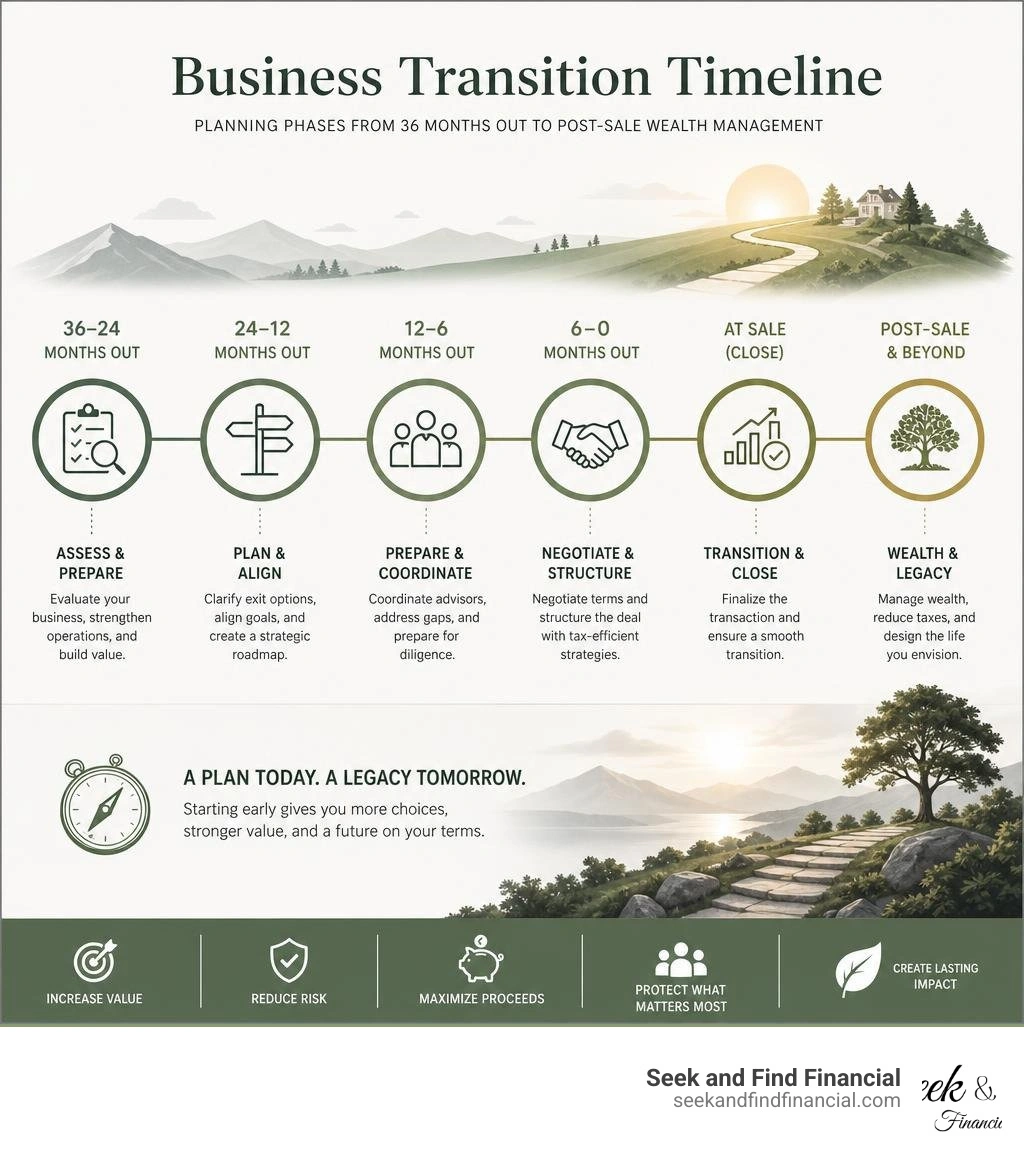
The timeline is also critical. A successful transition is not a quick event. It is a process that takes time. You should start working with an advisor at least 36 months before you want to exit. This three-year window gives you time to fix operational weaknesses, reduce your tax exposure, and clean up your financial records. For more on this long-term approach, read about Long-term Business Planning.
Transition planning is the broad process of transferring the ownership of your business. It deals with the financial, tax, and legal aspects of selling or gifting your shares. Succession planning is a subset of this process. It focuses on leadership. It answers the question of who will run the day-to-day operations of the company when you leave. Both are necessary for a smooth handoff.
For most business owners, about 80% of their net worth is locked up in the business. This makes the transition the most important financial event of their life. It is why we focus on diversifying your wealth before and after the sale. We want to make sure your personal lifestyle does not depend on a single illiquid asset forever.
You should start at least 36 months before your target exit date. If you want to sell in three years, the planning starts today. This gives you enough time to implement tax strategies, build up your management team, and maximize your business valuation. Starting early gives you control over the process.
Exiting your business is one of the biggest personal and financial decisions you will ever make. It is not just about signing a contract. It is about securing your family's future and protecting the legacy you built.
At Seek & Find Financial, we specialize in helping business owners in Northwest Indiana and Chicago navigate these complex decisions. We use personalized, technology-driven planning on the Altruist platform to build a clear strategy for your life after business ownership. We help you see the big picture, from tax efficiency to personal wealth management.
If you are ready to start planning your next chapter, we are here to help. Discover how we work with business owners by visiting our services page.
Investing involves risk, including possible loss of principal. No investment strategy can ensure financial success or guarantee against losses. Past performance may not be used to predict future results. Provided content is for overview and informational purposes only, reflect the opinions of the author, and is not intended and should not be relied upon as individualized tax, legal, fiduciary, or investment advice.
This information is being provided only as a general source of information. These views may change as market or other conditions change. This information is not intended and should not be used to provide financial advice and does not address or account for an individual’s circumstances. Past performance does not guarantee future results and no forecast should be considered a guarantee. Please seek the guidance of a financial professional regarding your particular financial concerns.
Investment advisory services offered by duly registered individuals through Seek & find Financial LLC a Registered Investment Adviser. Licensed Insurance Professional