

Chicago Family Governance Planning 101: Preserving Wealth and Sanity
Discover how Chicago family governance planning preserves wealth, aligns values, and ensures smooth generational transitions for Illinois families.
Chicago family governance planning is one of the most overlooked tools available to high-net-worth families and business owners who want to protect wealth across generations.
Here is a quick answer if that is what you need:
What is Chicago family governance planning?
Most families with significant wealth already have a will or a trust. That is a good start. But a legal document alone cannot teach your children how to handle money, resolve disagreements, or lead a business through a difficult transition.
The numbers tell the story clearly. Only about 30% of family businesses survive into the second generation. Just 12% make it to the third. The threat is rarely a bad investment or a market crash. More often, it is a lack of structure, shared values, and clear communication.
That is exactly what family governance is designed to fix.
I am Daniel Delaney, founder of Seek & Find Financial. My background spans years of working within established financial institutions, advising families and business owners on investment planning, estate strategy, and long-term wealth management. Today, I work with clients navigating the full spectrum of Chicago family governance planning, from structuring entities to preparing the next generation for leadership. In the sections ahead, I will break down how this process works and what you need to get started.
Investing involves risk, including possible loss of principal. No investment strategy can ensure financial success or guarantee against losses. Past performance may not be used to predict future results. Provided content is for overview and informational purposes only, reflect the opinions of the author, and is not intended and should not be relied upon as individualized tax, legal, fiduciary, or investment advice.
This information is being provided only as a general source of information. These views may change as market or other conditions change. This information is not intended and should not be used to provide financial advice and does not address or account for an individual's circumstances. Past performance does not guarantee future results and no forecast should be considered a guarantee. Please seek the guidance of a financial professional regarding your particular financial concerns.
Investment advisory services offered by duly registered individuals through Seek & Find Financial LLC a Registered Investment Adviser. Licensed Insurance Professional
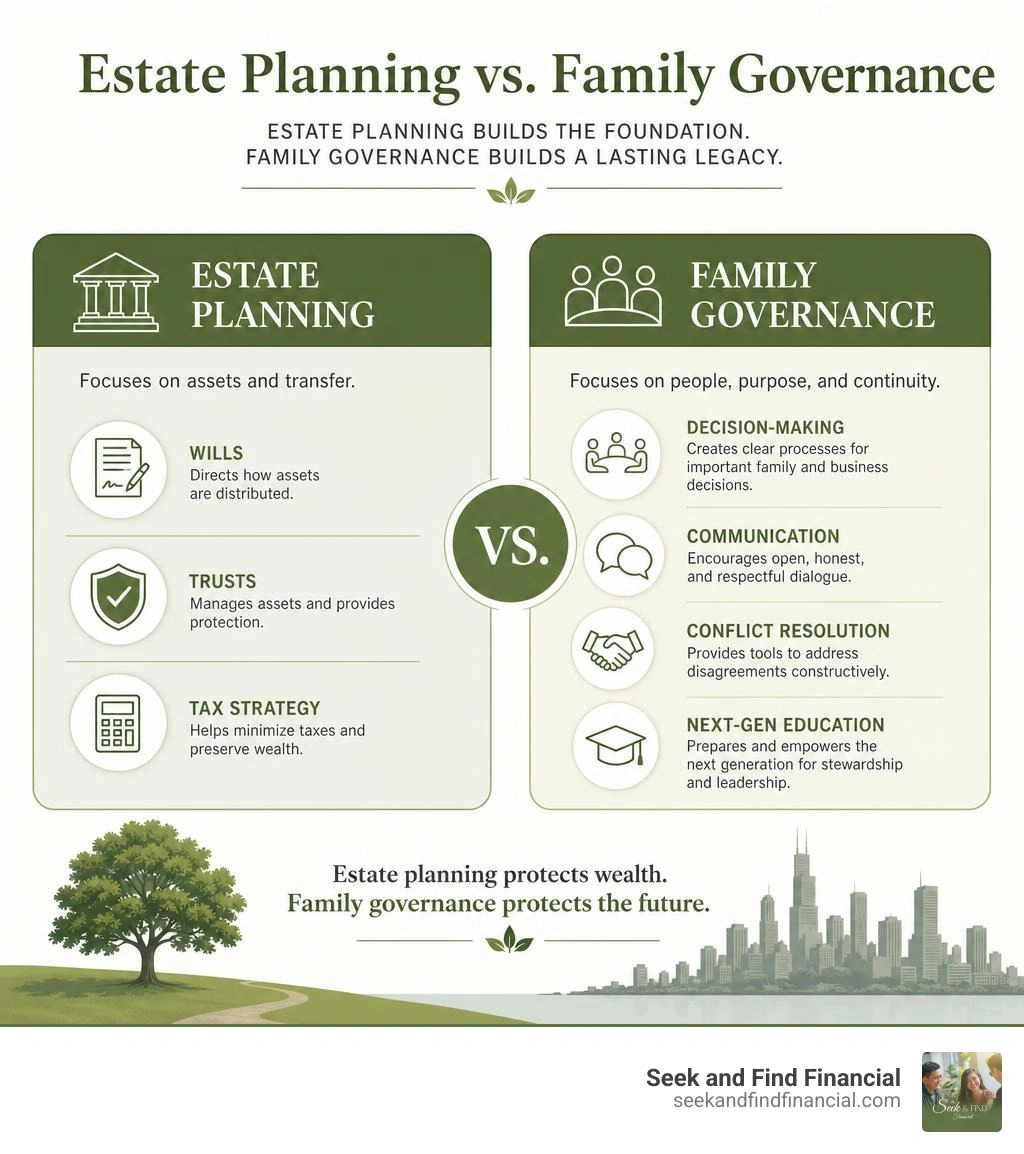
Family governance is a structured way for families to guide their relationships with their shared wealth and business. It is not just about who gets what when you pass away. Instead, it is about how your family makes decisions together while you are still here and after you are gone.
For high-net-worth families in Chicago, this planning is essential. It helps you preserve both your financial capital and your human capital. Financial capital is your money, your properties, and your business. Human capital is your family members, their education, their values, and their ability to work together.
Without a clear plan, wealth can easily cause division. When you align your family values with your long-term estate plans, you create a roadmap. This roadmap helps everyone understand their role, which keeps the family unified.
Many people believe that having a solid trust or will is enough. While those legal tools are very important, they have limits. A trust can say who gets your money, but it cannot teach your children how to spend it wisely. It cannot stop siblings from arguing over who gets to make decisions.
Traditional estate planning focuses mainly on the technical transfer of assets. It does not address the human side of wealth. When communication gaps exist, even the best tax strategies can fail.
By Integrating Family Governance Into High Net Worth Estate Planning | Gierach Law Firm, you add the missing human piece. This integration helps you pass down values about saving, investing, and giving. It ensures your heirs are actually ready to receive the wealth you leave behind. For a deeper look at how to structure these transfers, read our Tax Efficient Wealth Transfer Guide.
The reality of wealth transfer can be tough to face. Only about 30% of family businesses make it to the second generation. By the third generation, that number drops to just 12%.
Why is the drop-off so steep? It is rarely because the business itself was bad. Most of the time, the business fails because of family conflict, unprepared heirs, or a lack of shared goals.
Families that beat these odds do things differently. They do not just focus on making more money. They prioritize the education of the next generation. They establish shared goals and build a lasting legacy through structured governance. By doing this, they turn their family identity into a strength rather than a source of tension.

Chicago is home to many incredible family-owned businesses. These companies drive our local economy. However, transitioning a business from one generation to the next is one of the hardest things a founder will ever do.
The transition brings up complex emotional and financial challenges. You must balance what is best for the business with what is best for the family. This is where specialized Wealth Management for Business Owners becomes so valuable.
To navigate these transitions safely, you need to coordinate your personal estate plans with your business documents. Working with a professional like a Chicago Family Business Attorney — Succession | Lysinski can help you align your operating agreements, buy-sell provisions, and trust structures so they work together as one cohesive system.
One common source of conflict in family businesses is the tension between active and passive owners. Active owners work in the business every day. They often want to reinvest profits back into the company to fuel future growth.
Passive owners do not work in the business, but they own shares. They often prefer to receive dividends or distributions.
To keep the peace, you need a clear dividend policy. This policy should balance business reinvestment with shareholder liquidity. You can use industry benchmarks to determine a fair reinvestment rate. When you have a transparent, data-driven process, passive shareholders are much more likely to feel treated fairly.
Not every family business should stay in the family forever. Sometimes, the next generation does not have the interest or the skills to run the company. Other times, market conditions make a sale the most sensible financial move.
Knowing when to sell requires objective exit triggers. You must evaluate whether continuing the business aligns with your family’s long-term goals. If the family is deeply divided, a sale might actually be the best way to preserve family harmony.
If you do decide to exit, you need a clear plan. We walk through this step-by-step process in our guide on Exit Planning for Business Owners.
A good governance framework does not have to be overly complicated. It simply provides clear rules for how the family interacts with the business and the wealth.
To help you understand the different pieces, we can look at Family Governance and Succession Planning | CCA Advisors. A comprehensive plan typically uses three main components.
Family Constitution: A written charter of values and rules for the entire family. Its purpose is to establish the family mission and core policies.
Family Council: A representative governing body made up of selected family members. Its purpose is to support structured decision-making and conflict resolution.
Family Assembly: A regular, large-scale gathering for all generations and spouses. Its purpose is education, updates, and family bonding.
The family constitution, sometimes called a family charter, is the foundation of your governance plan. It is a written document that outlines your family's history, core values, and vision for the future.
This document is not a legally binding contract in the traditional sense. Instead, it is a social contract. It outlines how family members agree to treat one another and how they will manage shared assets.
Your constitution should cover important policies, such as:
If your family is large, it can be hard to make decisions with everyone in the room. That is where a family council comes in. The family council acts like a representative board for the family.
The council is responsible for managing communication between the family and the business. It helps resolve conflicts before they turn into major legal battles.
To be effective, the family council needs clear representation guidelines. Members should be chosen through a fair process. The council should also establish clear communication rules so that every family member, active or passive, feels heard.
You cannot expect the next generation to step into leadership roles without preparation. Preparing heirs is a long-term process that involves education, mentorship, and gradual responsibility.
This preparation is about more than just business skills. It is about building financial literacy and decision-making skills.
You want to help your children and grandchildren become responsible stewards of wealth. This means teaching them investment fundamentals, tax awareness, and the history of how the family wealth was built.
Family meetings are the perfect place to start this education. However, these meetings can easily get off track if they are not structured correctly.
Here are some best practices for holding productive family meetings:
For more insights on structuring these gatherings, you can read about Family Governance frameworks.
Starting this process can feel overwhelming, but you do not have to do it all at once. The best way to start is with an assessment of where your family stands today.
First, gather your key family members and ask simple questions about your shared goals. Identify where the potential conflicts lie.
Next, set realistic timelines. Building a complete governance system can take several years of discussion and refinement. If you want to see how this fits into a broader financial strategy, explore our Advanced Wealth Strategies Ultimate Guide.
Your family governance plan must be backed up by the right legal and tax structures. In Illinois, we face unique rules that require careful planning.
The goal is to create structures that protect your assets while allowing your governance plan to function smoothly. This often involves a mix of trusts, holding companies, and family offices.
One of the biggest hurdles for wealthy Chicago families is the Illinois state estate tax. While the federal estate tax exemption is quite high, Illinois sets its state exemption at just $4 million per person.
This means that if your estate is worth more than $4 million, your heirs could face a significant state tax bill.
To minimize this tax hit, you need proactive planning. This can include lifetime gifting strategies, utilizing valuation discounts through Family Limited Partnerships, or setting up specialized trusts. We break down these strategies in detail in our guide on High Net Worth Tax Planning.
A comprehensive governance plan must also include asset protection. You want to make sure the wealth you build is shielded from outside threats.
This is especially important for business owners who face higher risks of lawsuits. It is also vital for protecting assets in the event of a family divorce.
By using irrevocable trusts and family holding companies, you can separate ownership from control. This makes it much harder for creditors or former spouses to access family wealth. To learn more about these legal shields, read our overview of Asset Protection Strategies.
Philanthropy is a powerful tool for bringing a family together. When family members work on charitable projects, they focus on shared values rather than financial returns.
Including charitable giving in your governance plan helps teach the next generation about stewardship. It gives them a safe space to practice making financial decisions together.
You can use vehicles like private foundations or Donor-Advised Funds to structure your giving. This allows you to support causes you care about while also enjoying valuable tax benefits. Most importantly, it helps build a shared legacy that your family can be proud of for generations to come.
A board of directors is responsible for overseeing the business operations and protecting the interests of the business shareholders. A family council, on the other hand, represents the family's interests and manages the relationships among family members. The family council focuses on family harmony, values, and education, while the board of directors focuses on business performance and strategy.
Illinois has specific tax and regulatory rules that family offices must follow. For example, the state's lower estate tax threshold means family offices must place a high priority on state-level tax planning. Additionally, family offices must ensure they comply with local employment laws and corporate registration requirements in Illinois.
It is best to start drafting a family constitution before a major transition occurs. Good times to start include when the business is growing rapidly, when the third generation is entering adulthood, or when you are beginning to think about retirement. Starting early allows you to build the framework when stress levels are low, rather than trying to make rules in the middle of a family crisis.
Building a lasting family legacy takes more than just making smart investments. It requires a commitment to communication, education, and structured decision-making.
At Seek & Find Financial, we specialize in helping entrepreneurs and business owners earning $400K+ navigate these complex challenges. We do not believe in generic, cookie-cutter advice. Instead, we use personalized, technology-driven planning on the Altruist platform to help you build a clear, real-life strategy for your wealth.
If you are ready to protect both your wealth and your family's peace of mind, we are here to help. Learn more about our approach and how we can partner with you to secure your family's future.
Investing involves risk, including possible loss of principal. No investment strategy can ensure financial success or guarantee against losses. Past performance may not be used to predict future results. Provided content is for overview and informational purposes only, reflect the opinions of the author, and is not intended and should not be relied upon as individualized tax, legal, fiduciary, or investment advice.
This information is being provided only as a general source of information. These views may change as market or other conditions change. This information is not intended and should not be used to provide financial advice and does not address or account for an individual’s circumstances. Past performance does not guarantee future results and no forecast should be considered a guarantee. Please seek the guidance of a financial professional regarding your particular financial concerns.
Investment advisory services offered by duly registered individuals through Seek & find Financial LLC a Registered Investment Adviser. Licensed Insurance Professional