

Long Term Wealth and How to Actually Enjoy It
Build a strong Entrepreneur retirement plan in 2026 with SEP IRA, Solo 401(k), and exit strategies that turn business equity into lasting wealth.
Many business owners wake up to the same problem later than they should. They spent years building income but never built a clear retirement system.
An entrepreneur retirement plan is not one account. It is a system. It often includes tax-advantaged accounts, business equity, and a plan for what happens when you stop running the business.
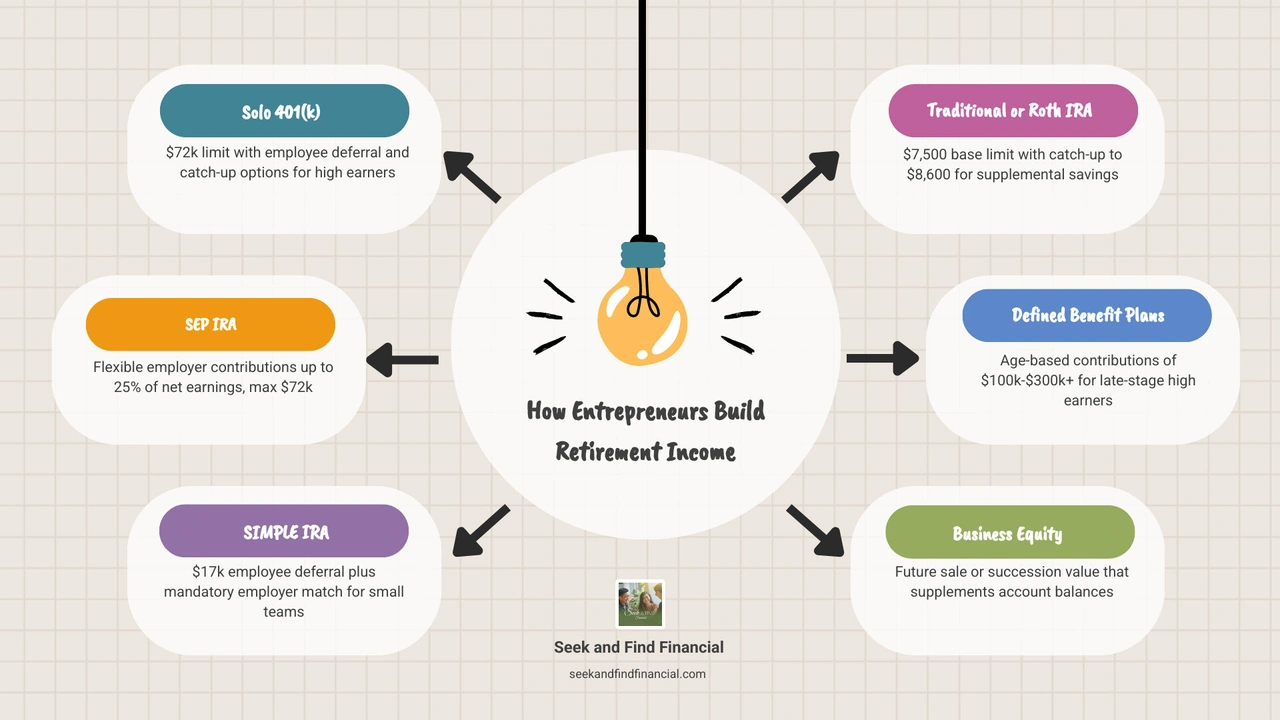
Here is a quick look at the main options available to business owners in 2026:
Most employees get a workplace plan handed to them. If you are self-employed, you have to build that system yourself.
That is the gap.
The challenge is not only picking a plan. It is saving when income goes up and down. It is deciding how much of your future depends on the business. It is knowing what happens if you never sell, or if the sale comes later than expected.
Financial advisors often suggest saving 15% to 25% of pretax income each year. Late starters may need 20% to 30%. But for many business owners, the first problem is simpler. They need to know where that money should go.
This guide walks through the main retirement plan options for business owners, how to save when income is uneven, and how your exit plan connects to retirement security.
At Seek & Find Financial, we help business owners think about retirement as part of a bigger wealth plan. That means looking at accounts, taxes, cash flow, and business value together instead of treating them like separate decisions.
Easy Entrepreneur retirement plan word list:
A real Entrepreneur retirement plan usually includes more than one bucket. For many owners, that means a business retirement plan plus an IRA, and sometimes an HSA for future healthcare costs.
Self-employed people can use many of the same tax-deferred tools available in larger companies. The difference is that you are the one setting up the system, funding it, and staying compliant.
The main choices are:
Each one solves a different problem.
If you want a broader look at plan structures, see our guide to Retirement Savings Plans for Small Business Owners.
Eligibility matters more than most people think.
A key point: one-participant 401(k) plans are generally exempt from discrimination testing when there are no employees other than a spouse. That makes them especially appealing for solo entrepreneurs.
You may still hear the term "Keogh plan." That is mostly old language. The IRS no longer treats Keogh plans as a separate modern category in the way people once did. Today, business owners usually choose from SEP IRAs, 401(k)s, SIMPLE IRAs, profit-sharing plans, or defined benefit plans.
Why does this matter? Because some entrepreneurs think there is a secret old-school plan they are missing. Usually there is not. It is just outdated terminology.
Below is the quick comparison most owners want first.

These are the two plans most solo owners compare.
A SEP IRA is usually easier to open and maintain. It is funded only by the employer side, which means contributions are flexible. If cash flow is tight this year, you can contribute less or even skip a year. SEP plans can also generally be set up by your tax filing deadline, including extensions.
A Solo 401(k) is often more powerful when income is high or when you want to save aggressively. You can contribute both as employee and employer. That can make it easier to reach the maximum at lower income levels than a SEP IRA.
Solo 401(k) plans can also be designed with features like participant loans or hardship rules, depending on plan design. But they bring more paperwork. Once plan assets exceed $250,000, Form 5500-EZ is generally required.
For a deeper comparison, read our IRA for Business Owners Complete Guide.
A SIMPLE IRA can be a useful middle ground for businesses with employees. In 2026, the employee contribution limit is $17,000, with a $4,000 catch-up for those over 50. The tradeoff is that the employer must make required contributions each year.
Traditional and Roth IRAs are much easier to set up, but the limits are much lower. In 2026, the limit is $7,500, plus a $1,000 catch-up if age 50 or older. These accounts are usually best used as supplements to a larger business plan.
The tax difference matters:
Roth IRA eligibility can phase out at higher incomes. For married couples filing jointly in 2026, the phaseout range begins at high income levels, so many successful business owners need to check eligibility carefully.
You can learn more in our guides to Traditional IRA for High Income Earners and Roth IRA for High Earners Guide.
For high-income entrepreneurs, especially those earning $300,000 to $400,000+, defined benefit and cash balance plans deserve serious attention.
These plans can allow six-figure annual contributions. In many cases, that means far larger deductions than a SEP IRA or Solo 401(k). Age matters here. Older owners can often contribute much more because the funding goal is based on reaching a target retirement benefit in a shorter time frame.
The tradeoff is commitment.
These plans usually require:
They are not ideal for every owner. If your cash flow is unpredictable or you may not want to keep funding for several years, the plan can feel hard to keep up with.
But when income is strong and tax pressure is high, they can be one of the most effective tools available. See our Retirement Plans for High Earners.
Entrepreneurs do not get neat, tidy paychecks every two weeks. Some months are feast. Some are ramen. Your plan should respect that reality.
A good starting point is still the standard savings target:
But the right account depends on:
This is where many good plans fail in real life. The account may be right, but the funding habit is wrong.
What tends to work better:
Consistent small savings usually beats waiting for the magical future month when everything is finally "settled down." For most entrepreneurs, that month never arrives.
We cover this mindset more in our Retirement Planning Entrepreneurs Guide.
The right plan at startup may not be the right plan five years later.
This is also where compensation design matters. S corporation wages, owner draws, and timing of contributions can all affect how much you can save.
For more on this, see our Business Owner Financial Planning Guide.
Every plan changes your tax picture a little differently.
Timing matters too. Some plans must be set up by certain dates. Others can be funded later. That can create planning opportunities, but only if you look ahead before year-end.
More on that in our Financial Advice for Entrepreneurs.
ROBS stands for Rollovers for Business Startups. It is a structure that allows certain retirement funds to be rolled into a new company retirement plan, which then buys stock in a new C corporation. That means you may access retirement money for business funding without an early withdrawal penalty or immediate tax bill.
A basic overview of the process is available here: ROBS FAQ.
Some owners like ROBS because it can provide:
It is often considered for buying a business, launching a franchise, or creating a debt-free start.
This is where the glossy brochure usually gets quiet.
ROBS can create major concentration risk. You are taking retirement money that could be invested across many assets and putting it into one private business, your own. If the business struggles, both your income and your retirement capital can get hit at the same time.
Other issues include:
In plain English, ROBS is not free money. It is swapping diversified retirement capital for concentrated business risk.
Before using retirement money to fund a business, we think owners should ask:
ROBS can be valid in the right case. But it should be modeled carefully, not chosen because it sounds easier than a loan.
A lot of entrepreneurs assume the business will pay for retirement. Sometimes it will. Sometimes it will not. That is why exit planning should sit inside retirement planning, not off to the side.
This idea is explored well in Funding Your Exit Without Selling Equity MYCPE ONE Insights.
Your business may be one of your biggest assets. It should not be your only one.
Why?
If retirement depends on a perfect sale at a perfect price in a perfect year, that is not a plan. It is a guess.
Building wealth outside the business matters. That can include retirement accounts, taxable investments, and sometimes an HSA for future healthcare costs.
Your business value affects how much retirement income you may have later. But value is not only revenue. Buyers and successors often look for:
A family succession plan is different from an internal sale. An internal sale is different from a third-party sale. Each path can change timing, taxes, and how much cash you may actually receive.
If you want to understand this side of the puzzle, our related content on founder exits can help:
Some choices are simple enough to do on your own. Others are not.
It often makes sense to get professional help when:
This is where coordinated planning matters. Retirement planning, tax strategy, compensation design, and exit planning should work together. That is the difference between having a few accounts and having a real strategy.
For a broader view, see our article on Entrepreneur Wealth Management.
Yes, often you can. Many entrepreneurs contribute to both an IRA and a SEP IRA or Solo 401(k). The main caution is that IRA deductibility and Roth eligibility may depend on income. The account limits are separate, but the tax rules can overlap.
For many solo owners, the Solo 401(k) is the strongest all-around option because of high contribution potential and the ability to contribute as both employee and employer. A SEP IRA can still be great if you want simplicity and contribution flexibility. For very high earners, especially older owners, a defined benefit or cash balance plan may create much larger tax savings.
Usually when one of these changes happens:
A strong Entrepreneur retirement plan is not about finding the fanciest account. It is about matching the right plan to your income, your business size, your tax picture, and your long-term exit path.
For some owners, that means starting with a simple IRA or SEP. For others, it means using a Solo 401(k) to save more in strong income years. And for high earners getting closer to retirement, it may mean adding a defined benefit or cash balance plan to catch up faster.
What matters most is structure.
Save steadily, even when income is uneven. Build wealth outside the business. Treat tax strategy and exit planning as part of retirement planning, not as separate jobs for later. Review the plan as your business changes.
Having a clear, personalized strategy makes a real difference. The right structure turns scattered decisions into a system that works over time.
If you want a clearer framework for that process, here is what we do.
Investing involves risk, including possible loss of principal. No investment strategy can ensure financial success or guarantee against losses. Past performance may not be used to predict future results. Provided content is for overview and informational purposes only, reflect the opinions of the author, and is not intended and should not be relied upon as individualized tax, legal, fiduciary, or investment advice.
This information is being provided only as a general source of information. These views may change as market or other conditions change. This information is not intended and should not be used to provide financial advice and does not address or account for an individual's circumstances. Past performance does not guarantee future results and no forecast should be considered a guarantee. Please seek the guidance of a financial professional regarding your particular financial concerns.
Investment advisory services offered by duly registered individuals through Seek & find Financial LLC a Registered Investment Adviser. Licensed Insurance Professional