

The Ultimate Guide to Manage Working Capital Effectively
Master proven strategies to manage working capital effectively and boost your business cash flow.
Knowing how to manage working capital is one of the most important financial skills a business owner can have — and one of the most overlooked.
Here is a quick answer to get you started:
How to manage working capital effectively:
A business can show strong profits on paper and still run out of cash. This happens when the timing between money going out and money coming in is off. Consider an HVAC contractor bringing in $3.2 million in annual revenue — but unable to make payroll because $480,000 in invoices sat unpaid. That is not a profitability problem. That is a working capital problem.
Research from the 2024-2025 Growth Corporates Working Capital Index found that top-performing middle-market businesses see an average bottom-line benefit of $11 million annually from actively managing their working capital cycle. And at the global level, if underperforming companies in the Global 1000 simply matched best-practice standards, they would unlock nearly $800 billion in cash flow.
The gap between good and great working capital management is not mysterious. It comes down to clear processes, the right metrics, and disciplined execution.
I'm Daniel Delaney, Founder of Seek & Find Financial, and my background working within established financial institutions — and now independently — has given me a front-row view of how high-earning business owners either manage working capital well and build lasting wealth, or let cash timing erode the gains their revenue should be creating. In this guide, I'll walk you through exactly how to close that gap.
Investing involves risk, including possible loss of principal. No investment strategy can ensure financial success or guarantee against losses. Past performance may not be used to predict future results. Provided content is for overview and informational purposes only, reflect the opinions of the author, and is not intended and should not be relied upon as individualized tax, legal, fiduciary, or investment advice.
This information is being provided only as a general source of information. These views may change as market or other conditions change. This information is not intended and should not be used to provide financial advice and does not address or account for an individual's circumstances. Past performance does not guarantee future results and no forecast should be considered a guarantee. Please seek the guidance of a financial professional regarding your particular financial concerns.
Investment advisory services offered by duly registered individuals through Seek & Find Financial LLC a Registered Investment Adviser. Licensed Insurance Professional.
Working capital is the cash your business uses for daily operations. It is the money that keeps your doors open. It is the fuel that keeps your business running. Without enough working capital, even a highly profitable business can fail.
In simple terms, working capital is the difference between your short-term assets and your short-term debts. We call these current assets and current liabilities.
When you have positive working capital, you have enough cash to pay your bills on time. You can also seize new opportunities. You can buy inventory at a discount. You can hire a new key employee. You can invest in a new marketing campaign.
When you have negative working capital, you are in a danger zone. You might struggle to pay your suppliers. You might miss payroll. You might have to take on expensive short-term debt just to survive.
For small and midsize business owners, this is a daily reality. Many owners focus only on sales and profit margins. But profit is not the same as cash. Profit is an accounting number. Cash is what you use to pay your team and your vendors.
To build a healthy business, you must understand the Importance of Working Capital Management in Small Business. It is the bridge between your daily operations and your long-term business growth.
To manage working capital well, you must understand its core parts. These parts sit on your balance sheet. They are split into current assets (things you own that can turn into cash within a year) and current liabilities (debts you must pay within a year).
Here are the key components of current assets:
Here are the key components of current liabilities:
Calculating your working capital position is straightforward. The basic formula is:
Working Capital = Current Assets - Current Liabilities
For example, let us say your business has $300,000 in current assets. This includes $50,000 in cash, $150,000 in accounts receivable, and $100,000 in inventory. Your current liabilities total $200,000. This includes $120,000 in accounts payable and $80,000 in short-term debt.
Using the formula, your working capital is:
$300,000 - $200,000 = $100,000
This means you have $100,000 in net working capital to support your daily operations.
Beyond the basic dollar amount, you should also look at liquidity ratios. These ratios help you compare your financial health over time or against industry benchmarks. The two most common ratios are the current ratio and the quick ratio.
The current ratio measures your overall ability to cover short-term debts with short-term assets. The formula is:
Current Ratio = Current Assets / Current Liabilities
Using our example, your current ratio would be $300,000 divided by $200,000, which equals 1.50. A ratio between 1.20 and 2.00 is generally considered healthy.
The quick ratio, also known as the acid-test ratio, is more conservative. It strips out inventory because inventory can take a long time to sell. It focuses only on assets that can turn into cash quickly. The formula is:
Quick Ratio = (Current Assets - Inventory) / Current Liabilities
Using our example, your quick ratio would be ($300,000 - $100,000) divided by $200,000, which equals 1.00. A quick ratio of 1.00 or higher means you can pay your short-term debts without selling any inventory.
| Metric | Formula | What It Measures | Healthy Range |
|---|---|---|---|
| Current Ratio | Current Assets / Current Liabilities | Overall short-term debt paying ability | 1.20 to 2.00 |
| Quick Ratio | (Current Assets - Inventory) / Current Liabilities | Ability to pay debts using only quick cash | 1.00 or higher |
To explore deeper strategies on how to evaluate these numbers, you can read more about How to Evaluate and Improve Working Capital Management | Ripple Treasury .
To truly manage working capital, you cannot rely on high-level balance sheet numbers alone. You need to look at how fast cash moves through your business. This is where efficiency metrics come in.
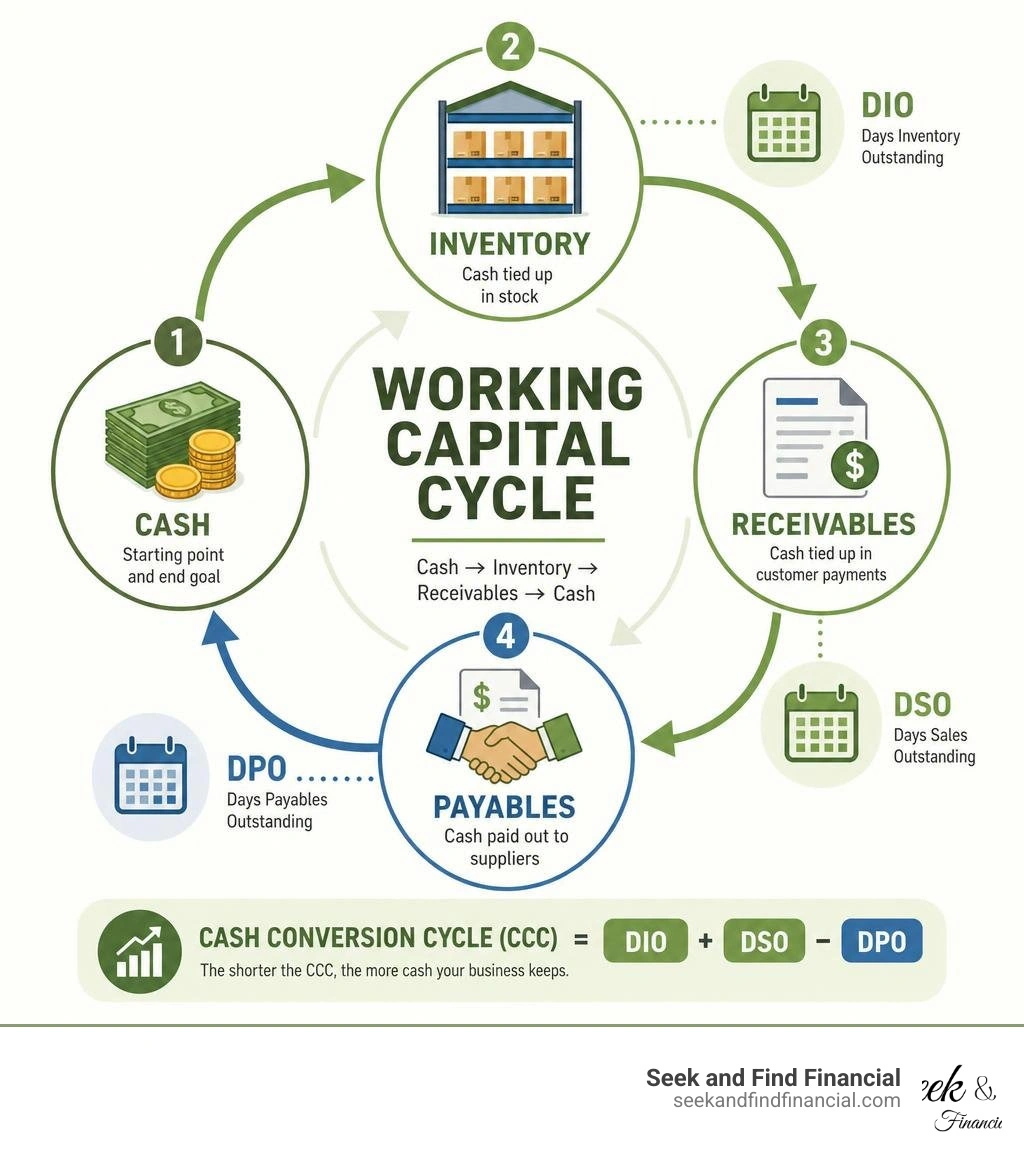
The most important tool for this is the cash conversion cycle (CCC). The CCC measures the number of days it takes to turn cash spent on inventory back into cash received from sales.
To calculate the CCC, you need to track three key metrics:
For a deeper dive into these core formulas and definitions, check out Working Capital Management: Ensuring Cash Flow & Efficiency .
The cash conversion cycle is the ultimate measure of operational efficiency. The formula is:
Cash Conversion Cycle (CCC) = DIO + DSO - DPO
Let us look at how this works in the real world. Imagine you run a manufacturing business in Crown Point, Indiana.
Your CCC is:
45 + 40 - 30 = 55 days
This means your cash is tied up for 55 days. You must find a way to fund your operations for those 55 days before you get paid.
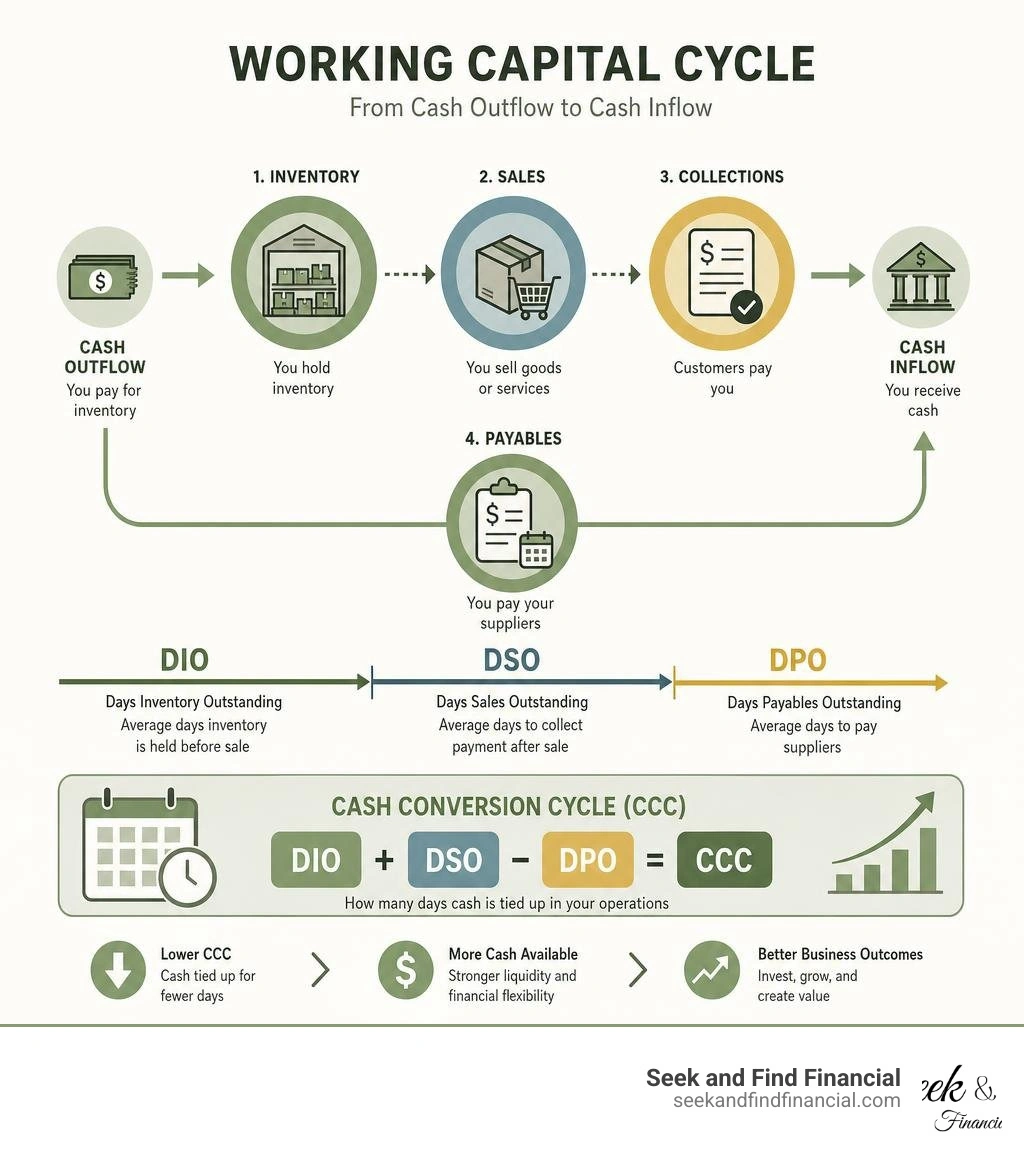
If you can shorten this cycle, you free up cash. For example, if you reduce your DSO to 30 days and increase your DPO to 40 days, your new CCC is:
45 + 30 - 40 = 35 days
You just shaved 20 days off your cash cycle. For a business with $4 million in annual sales, cutting your cycle by just 10 days can free up $40,000 to $60,000 in cash. That is cash you can use to grow without taking out a loan.
To learn more about how these cycles function across different business models, read What is working capital management? | Stripe .
Improving your working capital is not just about changing numbers on a spreadsheet. It requires making daily operational changes. You must look at how you handle your customers, your suppliers, and your inventory.

Many business owners manage working capital with big-picture metrics. However, the real value is found by looking at transaction-level details. You can find excellent insights on this approach in How to improve working capital | KPMG .
The fastest way to improve your cash flow is to get paid faster. Many businesses let invoices sit unpaid for 45 or 60 days. This is like giving your customers interest-free loans.
To accelerate your accounts receivable:
By implementing these steps, you build a stronger foundation. For more tips on building these habits, see our guide on Financial Management for Entrepreneurs.
On the other side of the ledger, you want to keep your cash as long as possible without hurting your supplier relationships.
To optimize your accounts payable:
Inventory is cash sitting in a warehouse. If it sits too long, it can become obsolete or damaged. It also costs money to store.
To streamline inventory:
To explore more comprehensive ways to optimize your cash flows, you can read about Working Capital Optimization Solution | Genpact .
Midsize and growing businesses face unique challenges when trying to manage working capital. Unlike giant corporations, they do not have unlimited resources. Unlike tiny startups, their operations are complex.
One major challenge is fast growth. When your sales skyrocket, you must buy more raw materials and hire more staff before you collect any cash from those new sales. This can cause a severe cash crunch.
Another challenge is seasonal demand. If you run a seasonal business, you might have to build inventory during the winter for summer sales. This requires careful cash planning so you do not run out of money during your slow season.
Supply chain disruptions can also create problems. If a supplier is delayed, you might have to buy from a more expensive source or hold extra safety stock. Both options tie up valuable cash.
To navigate these challenges, you must make Strategic Financial Decisions that balance risk and liquidity.
In 2026, manual spreadsheets are no longer enough to manage complex cash flows. Modern business owners use technology to get real-time visibility into their working capital.

By using automated financial tools, you can build a 13-week rolling cash flow forecast. This forecast helps you see cash shortages before they happen. You can see how a delay in a major customer payment or a sudden supplier bill will affect your bank balance. At Seek & Find Financial, we help business owners integrate these tools into their overall Small Business Owner Financial Planning process.
Sometimes, even with great management, you will face temporary cash gaps. In these cases, short-term financing can help:
Financing is a bridge to cover timing mismatches. It is not a permanent cure for poor operational habits. For a complete look at professional cash management services, you can review Working Capital Management Solutions - The Hackett Group .
If you want to work with a local advisor to align your business cash with your personal wealth goals, you can consult our team at Seek & Find Financial.
A healthy current ratio is generally between 1.20 and 2.00. However, the right ratio depends on your industry. A retail store or grocery store with fast inventory turnover can operate safely with a lower ratio. A manufacturing business with long production cycles needs a higher ratio to stay safe.
Yes. Having too much working capital means you have a lot of cash, inventory, or receivables sitting idle. Cash sitting in a low-interest checking account loses value to inflation. Excess inventory costs money to store and can go bad. You should put that idle cash to work by reinvesting it in the business or distributing it to the owners.
Inflation increases the cost of raw materials, wages, and operating expenses. This means you need more dollar volume in working capital just to maintain the same level of operations. It also makes inventory more expensive to replace, which can drain your cash reserves quickly if you do not adjust your pricing.
Knowing how to manage working capital effectively is the difference between a business that struggles to survive and one that thrives. By understanding your cash cycle, tracking key metrics, and using technology to automate your cash forecasting, you can unlock trapped cash and build a resilient business.
At Seek & Find Financial, we believe that your business is the engine of your personal wealth. We specialize in personalized, technology-driven wealth management and tax strategy for business owners and entrepreneurs earning $400K+. We help you connect your daily business decisions to your long-term wealth goals.
To learn more about how we can help you optimize your business cash and build personal wealth, explore our services in Business Capital Management.
Investing involves risk, including possible loss of principal. No investment strategy can ensure financial success or guarantee against losses. Past performance may not be used to predict future results. Provided content is for overview and informational purposes only, reflect the opinions of the author, and is not intended and should not be relied upon as individualized tax, legal, fiduciary, or investment advice.
This information is being provided only as a general source of information. These views may change as market or other conditions change. This information is not intended and should not be used to provide financial advice and does not address or account for an individual’s circumstances. Past performance does not guarantee future results and no forecast should be considered a guarantee. Please seek the guidance of a financial professional regarding your particular financial concerns.
Investment advisory services offered by duly registered individuals through Seek & find Financial LLC a Registered Investment Adviser. Licensed Insurance Professional.