

How to Minimize Capital Gains Tax Before You Say Goodbye
Discover tax efficient wealth transfer strategies: gifting, trusts, step-up basis & more to minimize estate taxes before 2026 sunset.
Tax efficient wealth transfer is the process of moving your assets to the next generation while legally minimizing what goes to the IRS, state governments, and probate costs.
Here are the most effective ways to do it:
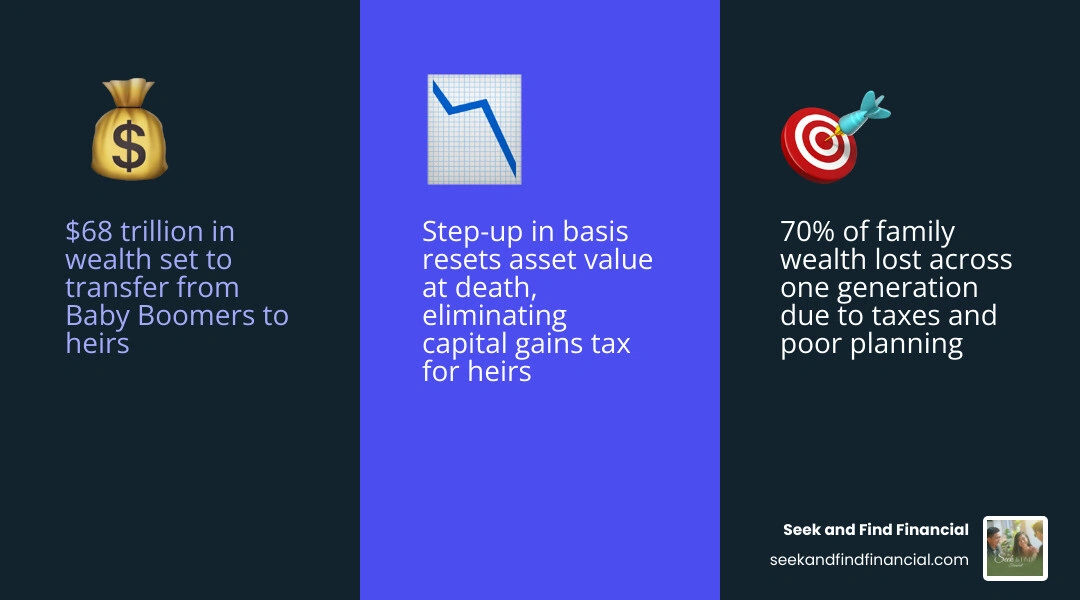
The stakes are real. Baby boomers are on track to pass more than $68 trillion to their children in what's being called the Great Wealth Transfer. But here's the uncomfortable truth: roughly 70% of family assets are lost from one generation to the next.
It's not just taxes that eat away at an estate. Probate costs, state-level taxes, final expenses, and poor planning can quietly erase a quarter of your wealth before heirs see a single dollar.
When you pass away, your assets essentially flow to one of three places: the government, a charity, or your loved ones. Without a clear plan, far more ends up in the first column than most families expect.
I'm Daniel Delaney, Founder of Seek & Find Financial, and throughout my career in financial services I've helped clients navigate the full complexity of tax efficient wealth transfer, from annual gifting strategies to sophisticated trust structures built to protect multigenerational wealth. That hands-on experience across both institutional and independent advisory settings shapes every strategy I bring to clients today.
Investing involves risk, including possible loss of principal. No investment strategy can ensure financial success or guarantee against losses. Past performance may not be used to predict future results. Provided content is for overview and informational purposes only, reflect the opinions of the author, and is not intended and should not be relied upon as individualized tax, legal, fiduciary, or investment advice.
This information is being provided only as a general source of information. These views may change as market or other conditions change. This information is not intended and should not be used to provide financial advice and does not address or account for an individual's circumstances. Past performance does not guarantee future results and no forecast should be considered a guarantee. Please seek the guidance of a financial professional regarding your particular financial concerns.
Investment advisory services offered by duly registered individuals through Seek & Find Financial LLC a Registered Investment Adviser. Licensed Insurance Professional.
Tax efficient wealth transfer vocab explained:
When we talk about tax efficient wealth transfer, we are looking at two main ways to move money: giving it away while you are alive (gifting) or leaving it behind after you pass (inheritance). Both methods have their own sets of rules and tax traps.
If you do nothing, the federal government can take a big bite out of what you leave behind. For estates that exceed certain limits, the federal estate tax rate can go as high as 40%. This is why Tax Efficient Wealth Management is so important. It is not just about growing your money; it is about making sure that growth actually reaches your children and grandchildren.
Imagine a $20 million estate. After you factor in final expenses, probate costs, and both state and federal taxes, that estate could shrink by nearly 25%. That is over $4 million that vanishes before your heirs see a dime. Using tax efficient strategies can help you keep that money in the family.
We are currently living in a very unique time for High Net Worth Tax Planning. As of May 2026, the federal gift and estate tax exemption is at a historic high of approximately $15 million per individual. For a married couple, that means you can shield about $30 million from federal estate taxes.
However, there is a catch. These high limits are part of a "sunset" provision. Unless Congress passes new laws, these exemptions are scheduled to drop significantly. It is estimated they could fall to around $6 or $7 million per person. If your estate is worth more than that, you might want to use that high exemption now before it disappears. This "use it or lose it" moment is a major reason why many families are moving quickly to update their plans.
You do not have to wait until you pass away to help your family. In fact, gifting money now is one of the simplest ways to reduce your future estate tax bill. For 2026, the annual gift tax exclusion is $19,000 per recipient.
This means you can give $19,000 to your son, $19,000 to your daughter, and $19,000 to each of your five grandchildren without even telling the IRS. If you are married, you and your spouse can "split" gifts to give $38,000 per person. Over ten years, a couple with three children could move over $1.1 million out of their estate just by using this simple method.
There are also two "secret" ways to give even more. If you pay for someone's medical bills or college tuition, and you pay the hospital or the school directly, those payments do not count toward your $19,000 limit. You could pay $50,000 for a grandchild's tuition and still give them a $19,000 check for their birthday, all tax-free. Working with a qualified professional can help ensure you document these gifts correctly.
One of the biggest mistakes people make is gifting assets that have grown a lot in value, like stocks or real estate, while they are still alive. While this removes the asset from your estate, it can create a massive capital gains tax bill for the person receiving it. This is where Advanced Tax Strategies come into play.
When you buy a stock for $10 and it grows to $100, you have a $90 gain. If you sell it, you pay tax on that $90. If you gift that stock to your daughter while you are alive, she "carries over" your $10 cost basis. When she sells it, she pays the tax.
But if she inherits that stock after you pass away, she gets a "step-up in basis." The IRS resets the cost basis to the fair market value on the date of your death. In her eyes, the stock is now worth $100 and her cost is $100. She can sell it the next day and pay zero capital gains tax. This is a huge part of Tax Planning for High Income families who own highly appreciated assets.
Upstream gifting is a clever strategy that flips traditional gifting on its head. Instead of giving money to your children, you gift assets to an older relative, like a grandparent, who has a smaller estate.
Here is how it works: You gift a highly appreciated portfolio to a grandparent using your lifetime exemption. When that grandparent passes away, they leave the assets back to your children (their grandchildren). Because the assets passed through the grandparent's estate, the grandchildren receive that "step-up in basis" we just talked about. This wipes out the capital gains tax while keeping the money in the family. According to How to Maximize Tax Savings When Transferring Wealth to Loved Ones, this is becoming a popular way to combine estate tax avoidance with capital gains savings.
For entrepreneurs and business owners, tax efficient wealth transfer often requires more than just simple gifting. You need tools that protect your assets from creditors and let you keep some level of control. This is vital for High Net Worth Wealth protection.
If you own a business that is growing rapidly, you want to "freeze" its value for tax purposes. Two common ways to do this are through GRATs and IDGTs.
Using these Tax Reduction Strategies allows you to move the future appreciation of your business out of your taxable estate today.
If you want your wealth to last for many generations, you have to worry about the Generation-Skipping Transfer Tax (GSTT). This is an extra tax that applies if you leave money directly to grandchildren, skipping your children's generation.
A Dynasty Trust is designed to last for a very long time, sometimes forever, depending on state law. By using your GSTT exemption to fund this trust, the money can grow and support your children, grandchildren, and great-grandchildren without being hit by estate taxes at every death. It also provides excellent protection from creditors or lawsuits. Professional estate planning can help you set these up correctly in Indiana.
Many families find themselves "asset rich but cash poor." They might own a $10 million business but not have the cash to pay a $2 million tax bill. This is why a Tax Efficient Investment Strategy must include a plan for liquidity.
The SECURE Act changed the rules for inherited IRAs. Most non-spouse heirs must now empty an inherited IRA within 10 years. If that is a Traditional IRA, every penny they take out is taxed as ordinary income. This could push your children into the highest tax bracket.
A Roth IRA conversion can be a brilliant move for Tax Effective Investing. You pay the taxes now (ideally at a lower rate in your retirement years), and then the money grows tax-free. When your heirs inherit the Roth IRA, they still have to empty it in 10 years, but the withdrawals are completely tax-free.
Life insurance is often the "missing piece" in a wealth transfer plan. It provides immediate cash to pay taxes or debts so your heirs do not have to sell the family business or home in a "fire sale."
To keep the life insurance payout out of your taxable estate, you can use an Irrevocable Life Insurance Trust (ILIT). The trust owns the policy and receives the death benefit. Because you do not own it, the IRS cannot tax it as part of your estate. Financial professionals often emphasize how this creates "tax-free liquidity" for the next generation.
A revocable trust (or living trust) is like a suitcase you can open and close. You keep control, but the assets are still part of your taxable estate. An irrevocable trust is like a safe you give the key away to. You lose control and access, but the assets are removed from your taxable estate, which saves on taxes.
While Indiana does not have a state inheritance tax, other states do. If you own property in Illinois, for example, you may be subject to the Illinois estate tax, which has a much lower exemption than the federal government. It is important to plan for every state where you own property.
Yes! As long as you pay the college directly, there is no limit. This is one of the most effective ways to move large amounts of money out of your estate while providing a direct benefit to your family.
At Seek & Find Financial, we believe that tax efficient wealth transfer is about more than just numbers on a spreadsheet. It is about protecting the life you have built and ensuring your family is prepared for the future. We specialize in working with business owners in Merrillville, Crown Point, and across Northwest Indiana to create personalized strategies that go beyond generic advice.
The best plan in the world won't work if your heirs aren't ready to handle the responsibility. That is why we focus on heir education and financial literacy alongside tax strategy. If you are ready to start building a clear, structured plan for your legacy, we are here to help.
Investing involves risk, including possible loss of principal. No investment strategy can ensure financial success or guarantee against losses. Past performance may not be used to predict future results. Provided content is for overview and informational purposes only, reflect the opinions of the author, and is not intended and should not be relied upon as individualized tax, legal, fiduciary, or investment advice.
This information is being provided only as a general source of information. These views may change as market or other conditions change. This information is not intended and should not be used to provide financial advice and does not address or account for an individual’s circumstances. Past performance does not guarantee future results and no forecast should be considered a guarantee. Please seek the guidance of a financial professional regarding your particular financial concerns.
Investment advisory services offered by duly registered individuals through Seek & find Financial LLC a Registered Investment Adviser. Licensed Insurance Professional