

A Practical Guide to Tax Planning for High Income
Master tax planning for high income: asset location, Roth tactics, charitable giving, business strategies & 2026 sunset prep.
Tax planning for high income earners is not the same as basic tax filing. At $400K or more in annual income, the rules change fast. Deductions phase out. New surcharges kick in. And generic advice can actually cost you money.
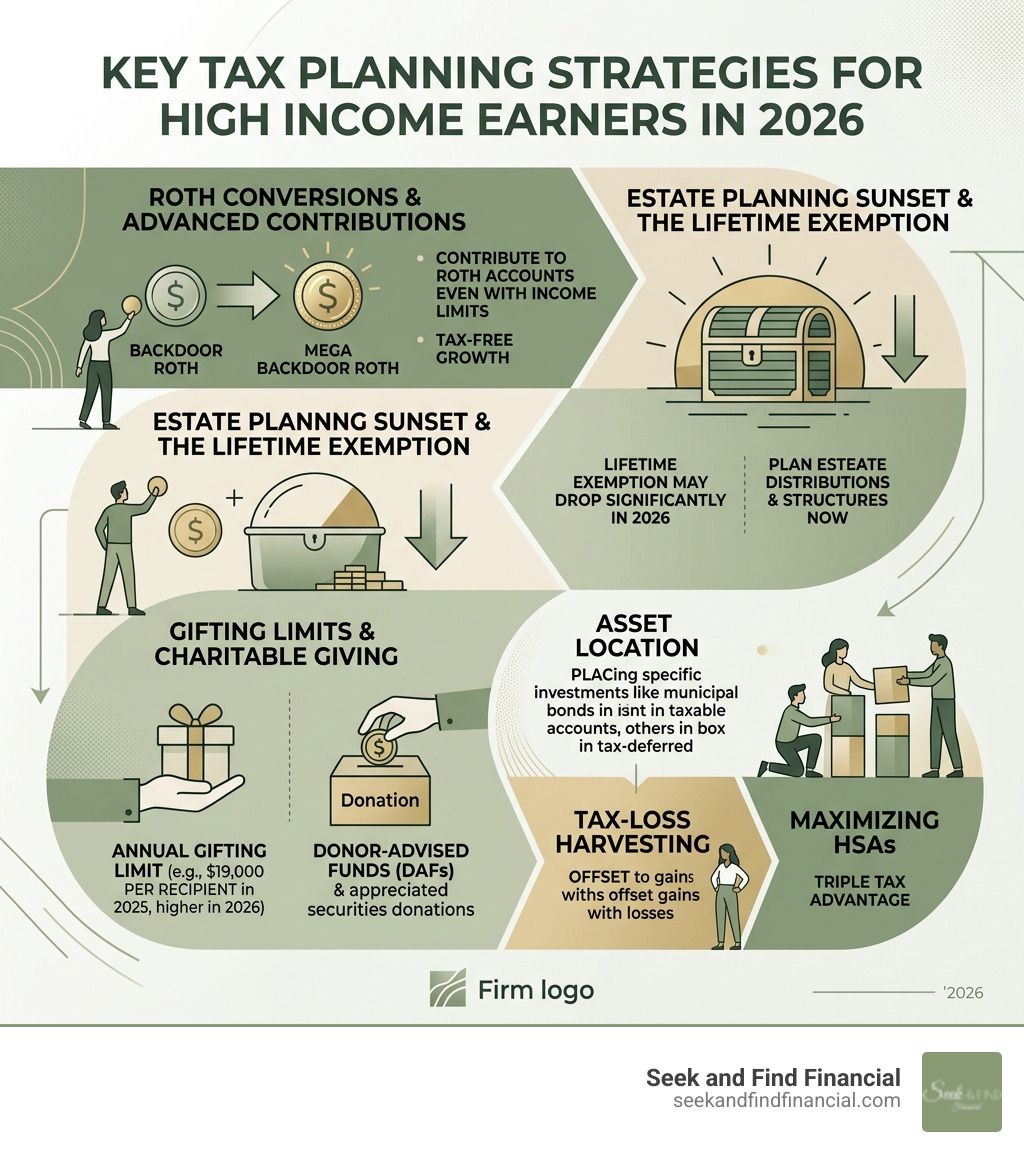
Here are the core strategies that matter most if you're a high earner:
The top 10% of earners pay about 76% of all federal income taxes. That burden does not have to be as heavy as it sounds — but only if you plan before income is earned, not after.
Without a structured plan, six- and seven-figure earners routinely leave tens of thousands of dollars on the table every single year.
I'm Daniel Delaney, founder of Seek & Find Financial, and I've spent my career working within established financial institutions and now independently helping high earners build real, personalized strategies around tax planning for high income. The strategies in this guide reflect what actually works for complex financial lives — not cookie-cutter advice.
Investing involves risk, including possible loss of principal. No investment strategy can ensure financial success or guarantee against losses. Past performance may not be used to predict future results. Provided content is for overview and informational purposes only, reflect the opinions of the author, and is not intended and should not be relied upon as individualized tax, legal, fiduciary, or investment advice.
This information is being provided only as a general source of information. These views may change as market or other conditions change. This information is not intended and should not be used to provide financial advice and does not address or account for an individual's circumstances. Past performance does not guarantee future results and no forecast should be considered a guarantee. Please seek the guidance of a financial professional regarding your particular financial concerns.
Investment advisory services offered by duly registered individuals through Seek & Find Financial LLC a Registered Investment Adviser. Licensed Insurance Professional
Common tax planning for high income vocab:
When you earn a high income, your investment returns face a hidden enemy: tax drag. Tax drag is the reduction in your potential wealth caused by paying taxes on dividends, interest, and capital gains every year. For those in the top federal tax bracket of 37%, this drag can be massive over a decade or two.
Effective tax planning for high income starts with Tax Effective Investing. This means looking at your portfolio not just by what it earns, but by what you keep after Uncle Sam takes his cut. You can find more details on this in Money Moves High Earners Should Make To Reduce Their Tax Burden.
Many people focus on asset allocation (how much stock vs. how much bond). But high earners must master asset location. This is the practice of putting specific types of investments into the right types of accounts to shield them from high tax rates.
For example, bonds pay interest that is usually taxed at your ordinary income rate. If you are in the 37% bracket, you lose more than a third of that interest to taxes. We generally recommend placing these "tax-inefficient" assets inside tax-deferred accounts like a 401(k) or a Traditional IRA.
On the flip side, municipal bonds are often a great choice for taxable brokerage accounts. The interest they pay is usually free from federal taxes. If you live in Indiana or Illinois, you might even find bonds that are free from state taxes too. This helps you build a stream of income that the IRS cannot touch.
Another key tool is tax-loss harvesting. This is when you sell an investment that has dropped in value to "realize" a loss. You can use these losses to offset any capital gains you made during the year. If your losses are more than your gains, you can use up to $3,000 of the extra loss to lower your ordinary taxable income. Any leftover losses can be carried forward to future years.
However, you must be careful with the "wash sale" rule. The IRS will disallow your tax loss if you buy a "substantially identical" security within 30 days before or after the sale. This 61-day window is a common trap. To stay diversified while waiting out the window, some investors use a Tax Efficiency ETF that tracks a similar but not identical index.
Retirement planning for high earners is often restricted by income limits. If you earn too much, you cannot contribute directly to a Roth IRA. But there are "backdoor" ways to get your money into these tax-free growth buckets. These Advanced Tax Strategies are essential for building a tax-free nest egg.
We often tell our clients that a Health Savings Account (HSA) is actually the best retirement account in the tax code. It offers a triple tax advantage:
For 2025, the contribution limits are $4,300 for individuals and $8,550 for families. If you are 55 or older, you can add another $1,000. High-income earners should treat the HSA as a long-term investment account. Pay for your current medical bills out of pocket and let the HSA money grow for decades. This is a core part of High Net Worth Tax Planning.
If your employer's 401(k) plan allows for after-tax contributions and in-plan conversions, you might be able to use the "Mega Backdoor Roth." While the standard employee deferral limit is $23,500 in 2025, the total limit for all contributions (including employer match and after-tax) is $70,000.
This strategy allows you to put tens of thousands of extra dollars into a Roth environment every year. For those aged 60 to 63 in 2025, a new "super catch-up" provision allows even higher contributions, potentially reaching a total of $34,750 in elective deferrals alone.
Charitable giving is a wonderful way to support causes you care about while practicing smart Tax Efficient Wealth Management. Instead of writing a check, consider donating appreciated securities like stocks or ETFs that you have held for more than a year. You get a deduction for the full fair market value, and you never have to pay the capital gains tax on the growth.
If you are age 70.5 or older, you can use a Qualified Charitable Distribution (QCD). This allows you to send up to $108,000 per year directly from your IRA to a qualified charity. The money never shows up as taxable income on your return. This is one of the most powerful Tax Reduction Strategies because it can also satisfy your Required Minimum Distributions (RMDs) without pushing you into a higher tax bracket.
Gifting is a simple way to reduce the size of your taxable estate. In 2025, you can give up to $19,000 to as many people as you want without having to file a gift tax return. A married couple can give $38,000 per recipient.
Beyond the annual limit, you can make unlimited direct payments for someone else’s medical bills or tuition, as long as you pay the institution directly. You can also "front-load" a 529 college savings plan with five years' worth of gifts at once ($95,000 for an individual or $190,000 for a couple) to get that money growing tax-free for your children or grandchildren immediately.
For entrepreneurs in Valparaiso or Chicago, your business is often your biggest tax-saving tool. Using a Tax Strategy for Business Owners can save you far more than individual deductions ever will.
| Strategy Component | S-Corp Advantage | C-Corp Advantage |
|---|---|---|
| Self-Employment Tax | Can reduce by splitting income into salary and distributions. | Not applicable (shareholders pay tax on dividends). |
| Capital Gains | Normal capital gains rates apply. | Potential for 100% exclusion via QSBS (Section 1202). |
| Income Shifting | Income flows to personal return (Pass-through). | Corporate tax rate is a flat 21%. |
| SALT Cap | Can bypass the $10,000 cap using PTE elections. | Not applicable at the individual level. |
If you own a "Qualified Small Business," you might be eligible for the Section 1202 exclusion. This allows you to exclude up to $10 million (or 10 times your basis) in capital gains from federal tax when you sell your stock, provided you held it for at least five years. This is a massive win for Business Owner Tax Planning.
The "SALT" cap limits your deduction for state and local taxes to $10,000 (though some 2026 proposals suggest raising this to $40,000). However, many states, including Indiana and Illinois, allow for a Pass-Through Entity (PTE) tax election. This lets the business pay the state tax at the entity level, effectively making the entire state tax amount deductible against your federal income. This is a great example of How to Reduce Taxable Income with a Side Business.
Estate planning is becoming urgent. We are currently living with historically high lifetime gift and estate tax exemptions. In 2025, an individual can shield $13.99 million from federal estate taxes. But on January 1, 2026, many provisions of the Tax Cuts and Jobs Act are set to "sunset," or expire.
Unless Congress acts, that $13.99 million exemption is expected to be cut roughly in half — down to about $7 million per person. For high-net-worth families in Crown Point or Merrillville, this creates a "use it or lose it" scenario.
Using tools like Grantor Retained Annuity Trusts (GRATs), Spousal Lifetime Access Trusts (SLATs), or Intentionally Defective Grantor Trusts (IDGTs) can help you move wealth out of your estate now while the exemption is high. This is a sophisticated part of High Net Worth Tax Planning that requires careful coordination with your legal and financial team.
The wash sale rule stops you from selling a stock at a loss for a tax break and buying it right back. You must wait at least 30 days before or after the sale to buy a "substantially identical" security, or the IRS will disallow the loss.
A donor-advised fund (DAF) is like a personal charitable savings account. You put money or stocks in and get an immediate tax deduction. You can then choose which charities get the money over time. It is great for "bunching" several years of donations into one high-income year.
In 2025, you can give $19,000 per person per year without any tax consequences. This does not count against your lifetime exemption.
At Seek & Find Financial, we believe that tax planning for high income is not about finding "loopholes." It is about using the rules Congress created to build a more stable financial future. Whether you are an entrepreneur in Portage or a professional in Chesterton, your plan should be as unique as your life.
By focusing on asset location, maximizing your retirement buckets, and planning for the 2026 sunset, you can keep more of what you earn. If you want to see how a personalized, tech-driven strategy can help your family grow, we invite you to learn more about What we do.
Investing involves risk, including possible loss of principal. No investment strategy can ensure financial success or guarantee against losses. Past performance may not be used to predict future results. Provided content is for overview and informational purposes only, reflect the opinions of the author, and is not intended and should not be relied upon as individualized tax, legal, fiduciary, or investment advice.
This information is being provided only as a general source of information. These views may change as market or other conditions change. This information is not intended and should not be used to provide financial advice and does not address or account for an individual’s circumstances. Past performance does not guarantee future results and no forecast should be considered a guarantee. Please seek the guidance of a financial professional regarding your particular financial concerns.
Investment advisory services offered by duly registered individuals through Seek & find Financial LLC a Registered Investment Adviser. Licensed Insurance Professional