

How to Manage Your Millions Without Losing Your Mind
Master wealth management for business owners: Diversify, plan exits, cut taxes, and secure your legacy without stress.
Wealth management for business owners is not the same as standard financial planning, and the gap between the two can cost you millions.
Here is a quick breakdown of what it actually involves:
| Area | What It Means for Business Owners |
|---|---|
| Asset Protection | Shielding personal wealth from business liabilities using legal structures |
| Tax Strategy | Reducing your tax burden before and after a business sale or major event |
| Diversification | Building wealth outside your business to reduce concentration risk |
| Exit Planning | Preparing years in advance to maximize business value and minimize taxes |
| Estate Planning | Ensuring wealth transfers to the right people in the most efficient way |
| Retirement Planning | Using business-specific plans like Solo 401(k)s and cash balance plans |
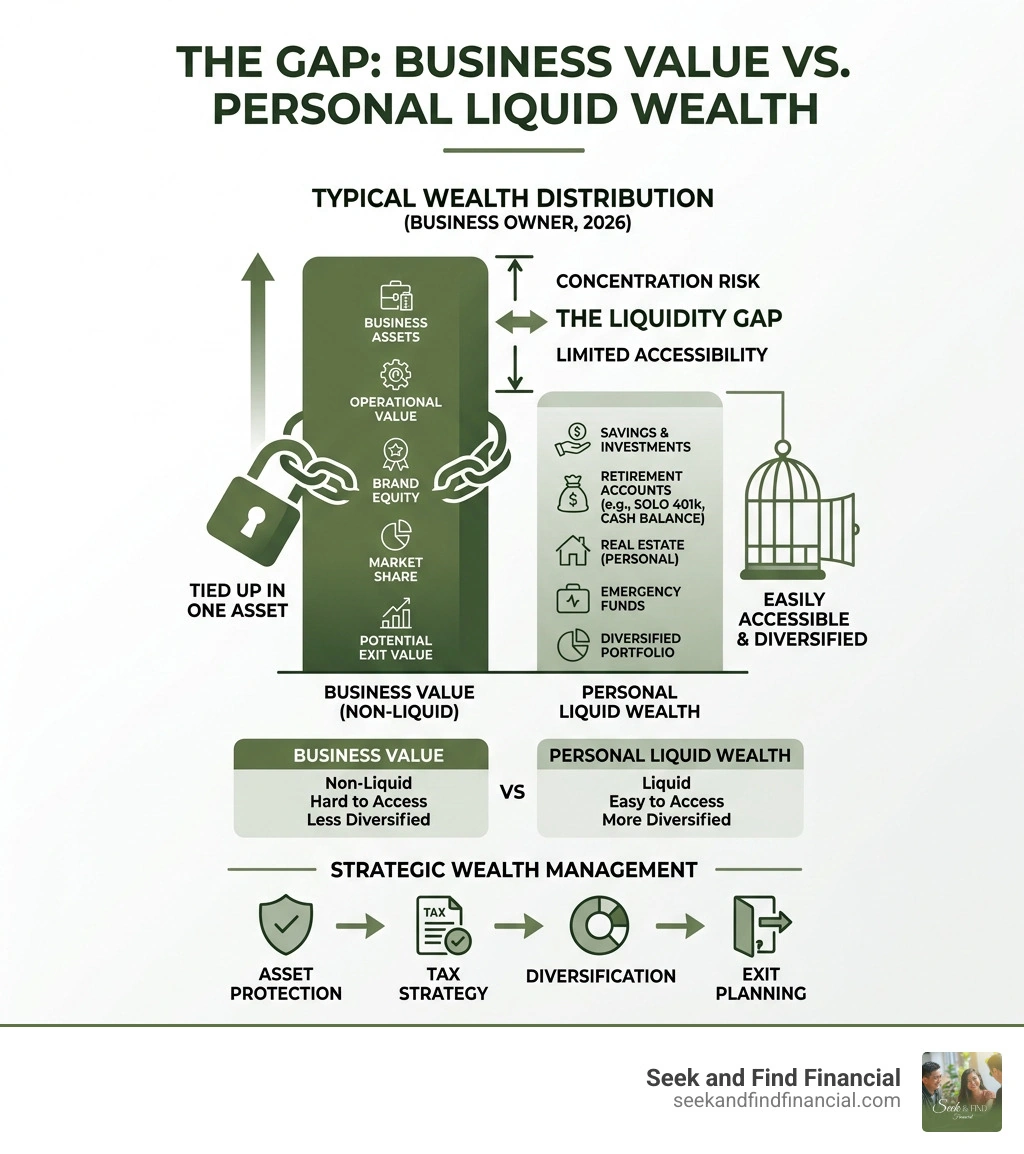
You have built something real. But here is the problem most business owners face: almost all of your wealth is tied up in one asset, your business.
That creates serious risk. If the business struggles, your personal finances do too. And when it comes time to sell, many owners discover they were not financially prepared for what comes next.
Business owners in the U.S. control roughly $22 trillion in financial wealth, about 30% of the national total. Yet many of those same owners have no clear plan for protecting or growing that wealth outside the business itself.
This guide walks you through exactly what to do about that, from protecting assets today to building a plan that lasts long after you exit.
I'm Daniel Delaney, Founder of Seek & Find Financial, and I have spent my career working within established financial institutions and now as an independent advisor helping clients navigate the full complexity of wealth management for business owners. That experience, from portfolio strategy to retirement planning to pre-sale preparation, shapes everything in this guide.
Investing involves risk, including possible loss of principal. No investment strategy can ensure financial success or guarantee against losses. Past performance may not be used to predict future results. Provided content is for overview and informational purposes only, reflect the opinions of the author, and is not intended and should not be relied upon as individualized tax, legal, fiduciary, or investment advice.
This information is being provided only as a general source of information. These views may change as market or other conditions change. This information is not intended and should not be used to provide financial advice and does not address or account for an individual's circumstances. Past performance does not guarantee future results and no forecast should be considered a guarantee. Please seek the guidance of a financial professional regarding your particular financial concerns.
Investment advisory services offered by duly registered individuals through Seek & Find Financial LLC a Registered Investment Adviser. Licensed Insurance Professional.
Common wealth management for business owners vocab:

Most financial advice is built for people with a steady paycheck. But as an entrepreneur in Northwest Indiana or Chicago, your "paycheck" is often tied to the health of your company. This creates a unique financial DNA. Standard advice often fails because it does not account for the fact that your business is likely your largest asset.
Business owners control a massive amount of wealth, roughly 30% of all financial assets in the U.S. However, having $22 trillion in assets across the country doesn't help if your personal bank account is empty because you reinvested everything back into your company. This is called concentration risk. If your business is 90% of your net worth, one bad year or a shift in the market could wipe out your family’s future.
Specialized wealth management for business owners focuses on de-risking your life. We look at Small Business Owner Financial Planning as a way to pull money out of the business safely and put it into assets that don't depend on your company's success. This is a core part of Entrepreneur Wealth Management.
We act as a sounding board for your biggest decisions. Should you buy that new piece of equipment or put that money into a personal brokerage account? Should you hire a new VP or boost your own retirement savings?
A specialized advisor helps you balance these business needs with your personal goals. We provide expert guidance for long-term growth by looking at the big picture. We don't just look at your stocks; we look at your tax returns, your business structure, and your family's needs to ensure everything works together.

If you plan to sell your business one day, the work starts now, not six months before you list it. Effective wealth management for business owners involves "pre-exit" planning that can save you millions in taxes and protect what you’ve built.
Asset protection is the first step. You need to shield your personal wealth from business liabilities. This often involves using legal structures like an LLC or a trust. If a legal issue hits the business, you want to make sure your family home and personal savings are safe.
Lowering your tax bill is the next priority. Strategies like the Qualified Small Business Stock (QSBS) exclusion can sometimes allow owners to exclude a large portion of their gains from federal taxes. However, these rules are complex and require early setup. For more details, see our guide on Business Owner Tax Planning.
Planning for an eventual exit is about more than just finding a buyer. It is about making the business "sellable." This means having clean financials, a strong leadership team, and diversified customers. You can learn more about this process in our article on Exit Planning for Business Owners.
What happens to the business when you are gone? Whether you want a family transfer, a sale to employees, or a transition to key leadership, you need a plan.
Buy-sell agreements are critical if you have partners. They ensure that if one partner leaves, the others have a clear path to buy their shares at a fair price. Without this, a partner's spouse or heir could suddenly become your new, untrained business partner. A solid Business Owner Financial Planning Guide should always include a section on how to pass the torch without burning the house down.
Diversification is the only "free lunch" in investing. For a business owner, this means investing in things that are not your business. While your company might be your best investment, it is also your riskiest.
Global assets under management (AUM) have climbed to $162 trillion, with private equity now accounting for $9.7 trillion and growing at over 12% annually. Many successful owners use their business profits to invest in these alternative areas, such as real estate or private credit. If you are new to the idea, private equity is simply money invested in private companies rather than public stocks.
By building a portfolio of stocks, bonds, and real estate, you create a safety net. If your industry faces a downturn, your personal wealth remains stable. Check out our Investment Strategies for Small Business Owners for a deeper look at how to build this "outside" wealth. The goal is to use Wealth Building Strategies Entrepreneurs that turn business success into permanent family security.
One of the best ways to diversify and save on taxes is through a retirement plan. As an owner, you have options that employees don't.
Managing cash flow also means having the right insurance. Key person insurance can protect the business if a vital employee (or you) can't work. For more on these options, read about Retirement Savings Plans for Small Business Owners.
The day you sell your business is one of the most exciting days of your life. It is also the day your financial life gets much more complicated. Suddenly, you have a large pile of cash and no monthly business income.
The first challenge is tax efficiency. A "liquidity event" usually triggers a large tax bill. We work with owners to use charitable lead trusts, donor-advised funds, or other tools to manage that hit. You can find more tips on how to Prepare Business for Sale to ensure you keep more of what you earned.
Once the cash is in the bank, you need a new plan. This is called an Investment Policy Statement (IPS). It defines how your money will be invested based on your risk tolerance and your need for long-term income.
The goal shifts from growth (building the business) to preservation (making sure the money lasts for the rest of your life). We help you navigate Tax Strategy for Business Owners so that your new portfolio generates the income you need without unnecessary tax drag.
Post-sale is the most critical time to update your estate plan. Your net worth has likely changed, and your old will might not be enough.
Even the smartest entrepreneurs make mistakes when it comes to their own money. The most common one is mixing personal and business funds. This "pierces the corporate veil" and can make you personally liable for business debts.
Another mistake is delaying exit plans. Most owners think they will sell in "five years," but they never start the prep work. Without a plan, you might be forced to sell during a market dip or an illness, which can cost you millions in value.
| Proactive Planning | Reactive Planning |
|---|---|
| Tax strategy starts 3+ years before sale | Taxes are figured out after the deal closes |
| Investments are diversified into real estate/stocks | 95% of wealth is stuck in the business |
| Estate plan is updated annually | Estate plan hasn't been touched in 10 years |
| Business uses a Solo 401(k) or Cash Balance plan | No retirement plan beyond "selling the business" |
Managing millions shouldn't make you lose your mind. At Seek & Find Financial, we specialize in helping business owners in Crown Point, Valparaiso, and across the region navigate these complexities. We use personalized, technology-driven planning through Altruist to give you a clear view of your total wealth, both inside and outside your company.
Our goal is to give you the clarity you need to enjoy the success you’ve worked so hard to build. Whether you are in the growth phase or ready to exit, we can help you create a strategy that fits your real life.
More info about wealth management services
Investing involves risk, including possible loss of principal. No investment strategy can ensure financial success or guarantee against losses. Past performance may not be used to predict future results. Provided content is for overview and informational purposes only, reflect the opinions of the author, and is not intended and should not be relied upon as individualized tax, legal, fiduciary, or investment advice.
This information is being provided only as a general source of information. These views may change as market or other conditions change. This information is not intended and should not be used to provide financial advice and does not address or account for an individual’s circumstances. Past performance does not guarantee future results and no forecast should be considered a guarantee. Please seek the guidance of a financial professional regarding your particular financial concerns.
Investment advisory services offered by duly registered individuals through Seek & find Financial LLC a Registered Investment Adviser. Licensed Insurance Professional.
Local Presence: Seek & Find Financial serves clients across Northwest Indiana and Illinois, with locations in Valparaiso, Chesterton, Portage, Hebron, Merrillville, Crown Point, Hobart, and Chicago.