

How Small Businesses Can Save Big with a Defined Benefit Plan
Discover how a defined benefit plan for small business accelerates retirement savings and cuts taxes—learn setup steps and 2026 limits now.
A defined benefit plan for small business owners is one of the most effective ways to slash your tax bill and accelerate retirement savings — especially if you are in your peak earning years and feel like other retirement accounts are not keeping pace.
Here is a quick summary of what you need to know:
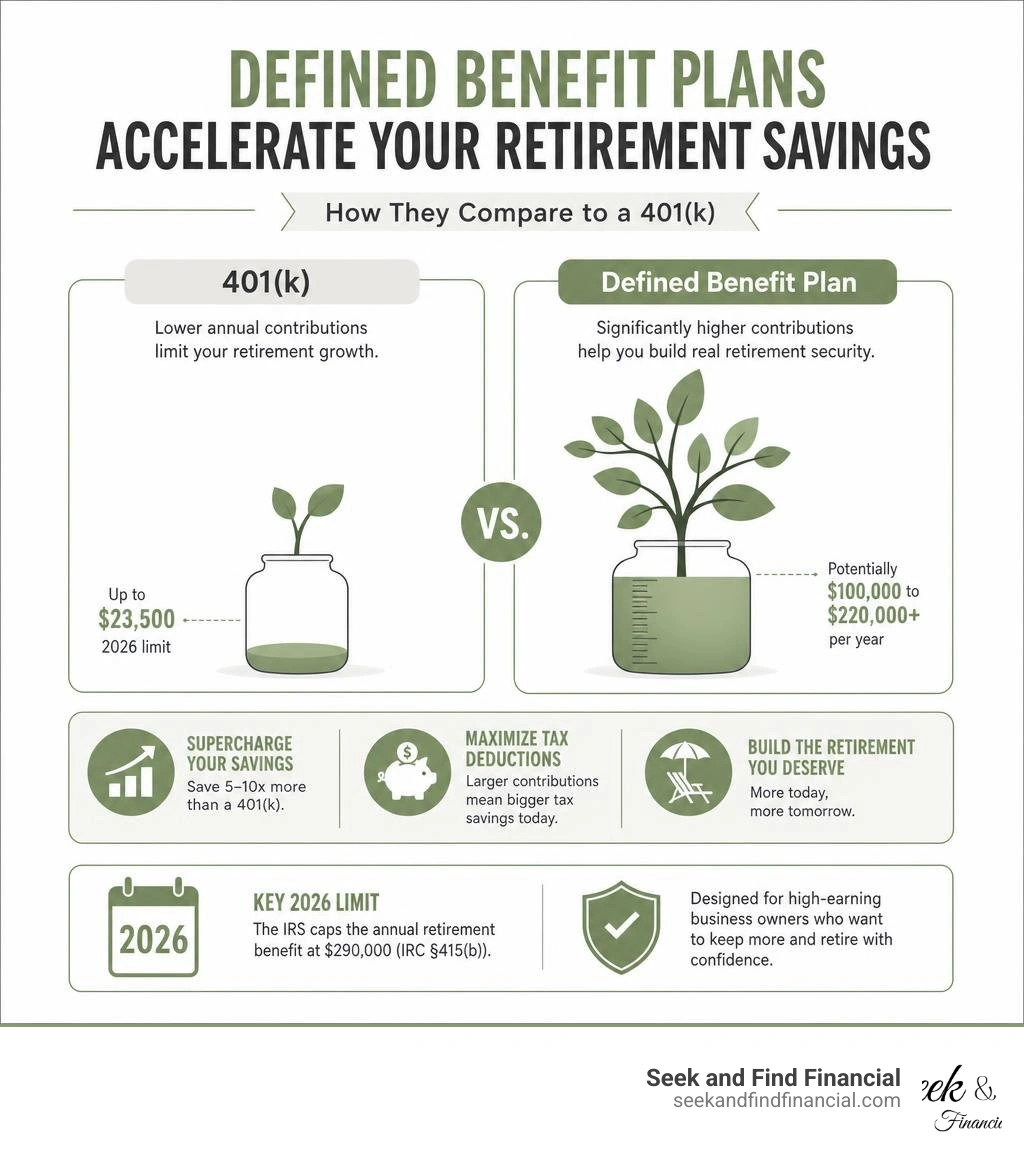
Many high-earning business owners are putting away $23,500 in a 401(k) and calling it a year. Meanwhile, a defined benefit plan can legally shelter five to ten times that amount — all before you pay taxes.
If you are generating $400,000 or more in business income and feel like you are giving too much to the IRS, this guide is for you.
I'm Daniel Delaney, founder of Seek & Find Financial, and throughout my career in financial advisory — from working within established institutions to building my own independent firm — I have seen how a well-structured defined benefit plan for small business owners can transform both a tax strategy and a retirement outlook. In the sections ahead, I will walk you through exactly how these plans work, what they cost, and how to know if one is right for your situation.
A defined benefit plan is a traditional pension plan. Most people think pensions are only for giant corporations or government workers. But small business owners can set up these plans for themselves.
In this plan, the employer promises to pay a specific benefit at retirement. We use a special pension formula to calculate this benefit. The formula usually looks at your salary and how many years you have worked.
With this plan, the business owner takes on all the investment risk. If the stock market goes down, the business must contribute more money to keep the plan funded. If the market goes up, the business might contribute less. The main goal is retirement security. You get a predictable stream of income when you retire. To learn more about how this fits into your overall strategy, see our guide on Defined Benefit Retirement Plans.
A 401(k) is a defined contribution plan. In a 401(k), you define how much money goes into the plan today. But you do not know how much money you will have when you retire. Your retirement balance depends on how your investments perform. The employee bears all the investment risk.
A defined benefit plan is the opposite. You define the exact benefit you will receive at retirement. The contributions you make today are calculated backward from that future goal.
Also, traditional defined benefit plans do not have individual account balances for each employee. Instead, all the money is held in one large trust pool. An actuary looks at this pool every year to make sure there is enough money to pay the promised benefits. For a deeper look at different retirement structures, read about our other Retirement Plans.
Almost any business structure can set up a defined benefit plan. This includes sole proprietors, S-corps, partners, and LLCs.
To qualify, you must have earned income. If you are a sole proprietor, this is your net profit on Schedule C. If you own an S-corp, this is your W-2 salary.
These plans work best for businesses with consistent profits. We serve business owners across Northwest Indiana, including Valparaiso, Chesterton, Portage, Hebron, Merrillville, Crown Point, and Hobart, as well as Chicago, Illinois. If your business is based in these areas and you have high income, you are likely an ideal candidate. You can learn more about these options in our guide on the Entrepreneur Retirement Plan.
The tax advantages of a defined benefit plan are massive. All the money you contribute to the plan is tax-deductible for your business. The money then grows tax-deferred inside the plan trust. You do not pay taxes on the growth until you take the money out in retirement.
The contribution limits for these plans are not flat rates. Instead, they are based on the benefit you want to receive at retirement. For 2026, the tax code sets the annual benefit limit at $290,000 under IRC §415(b). This means your plan can target a maximum annual pension of $290,000.
To calculate how much you can put in today, we also look at the compensation limit. For 2026, the maximum compensation we can use for these calculations is $360,000. If you earn more than this, we still must cap our calculations at $360,000. These limits allow for huge tax deductions that you can read about in our Tax Strategy for Business Owners.
Because the plan targets a large future benefit, your annual contributions can be very high. Many small business owners contribute $100,000 or even $200,000+ each year.
These limits are highly age-based. Older business owners can contribute much more than younger owners. This is because an older owner has fewer years left until retirement. The actuary must build up the required retirement pool in a shorter amount of time.
By contributing six figures to your retirement plan, you dramatically lower your current tax bracket. This is a primary tool for high-income earners who want to reduce their state and federal tax bills. To see how this fits into your larger tax picture, read our guide on Tax Planning for High Income.
You do not have to choose between a defined benefit plan and a 401(k). You can combine them. This is often called a DB/DC combo plan.
By stacking these plans, you can maximize your total savings. You can defer salary into your Solo 401(k) up to the normal limits. For 2026, the 401(k) deferral limit is $24,500 if you are under age 50. If you are age 50 to 59, or 64 and older, the limit is $32,500.
If you are age 60 to 63, you can use the super catch-up contribution. This allows you to defer up to $35,750. When you combine this with the defined benefit plan, your business can also make a profit-sharing contribution to the 401(k). Under IRC §404(a)(7), this profit-sharing contribution is generally capped at 6% of compensation when paired with a defined benefit plan. This stacking strategy is explained in detail in our guide on Retirement Plans for High Earners.
There are many retirement plans available for small businesses. It is important to compare them to see which one fits your cash flow and savings goals.
Here is a simple comparison table:
| Plan Type | 2026 Max Contribution | Setup Cost | Funding Flexibility | Best For |
|---|---|---|---|---|
| Solo 401(k) | Up to $70,000 (plus catch-ups) | Low | High | Under age 50, variable income |
| SEP-IRA | Up to $70,000 | Low | High | Simple administration, sole owners |
| Cash Balance | Age-dependent ($150k - $250k+) | Moderate | Medium | Partners, consistent cash flow |
| Defined Benefit | Age-dependent ($200k - $300k+) | High | Low | Age 50+, very high income |
To explore all these choices, check out our guide on Retirement Savings Plans for Small Business Owners.
A cash balance plan is a specific type of defined benefit plan. It is often called a hybrid plan.
In a traditional defined benefit plan, your benefit is stated as a monthly lifetime payment at retirement. For example, the plan might promise to pay you $10,000 a month for life.
In a cash balance plan, your benefit is shown as a hypothetical account balance. Every year, your business credits your account with a pay credit (like 10% of your salary) and an interest credit (like a flat 4%). This makes the plan easier for employees to understand because it looks like a 401(k) statement. At retirement, you can take the balance as a lump-sum rollover or convert it to an annuity. For more details, see our article on the Cash Balance Plan and explore Defined Benefit Plan Small Business Options.
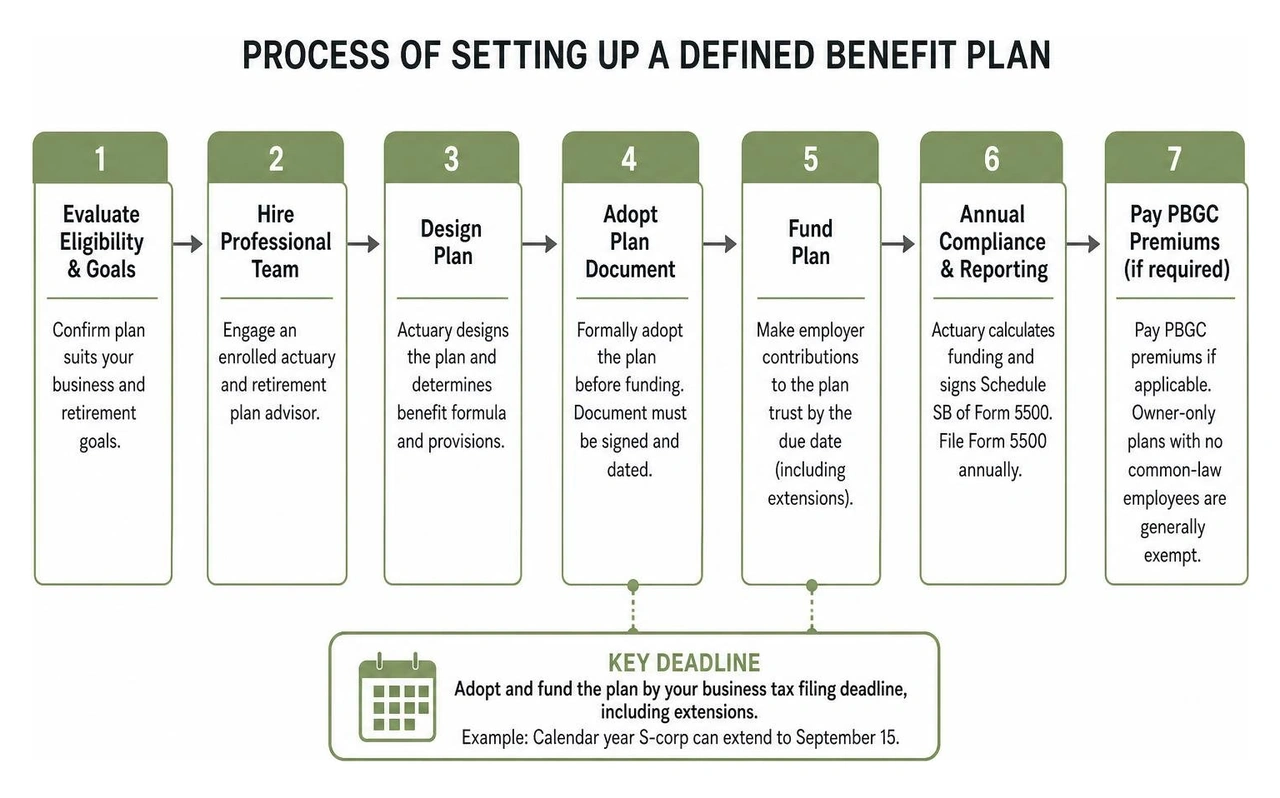
Defined benefit plans are highly regulated. Because of this, they require professional help to manage. You must hire an enrolled actuary. Every year, the actuary must calculate your required funding levels and sign Schedule SB of Form 5500.
Most defined benefit plans must also pay insurance premiums to the Pension Benefit Guaranty Corporation (PBGC). This is a federal agency that protects pensions. For 2026, the PBGC flat-rate premium is $111 per participant. If your plan is underfunded, you may also have to pay a variable-rate premium. This is $52 per $1,000 of unfunded vested benefits. Fortunately, owner-only plans with no common-law employees are generally exempt from PBGC coverage.
Setting up a defined benefit plan requires careful timing. You must adopt the plan document before you can fund it.
Thanks to recent tax law changes, you can adopt a plan retroactively. You have until your business tax filing deadline, including extensions, to set up and fund a plan for the prior tax year. For example, if your business is an S-corp on a calendar year, you can extend your tax return to September 15. This means you have until September 15 to adopt and fund your plan for the previous year.
Before you open a defined benefit plan for small business savings, you must weigh the advantages and disadvantages.
The Pros:
The Cons:
To manage these risks, we recommend keeping a healthy cash reserve. You should also work with an advisor who uses a conservative investment strategy inside the plan trust. This helps prevent large funding spikes. When you retire or close your business, you can terminate the plan and roll the assets into a traditional IRA. This keeps your money growing tax-deferred without the ongoing administrative costs.
Yes, you can. However, you must include your eligible employees in the plan. You must perform annual nondiscrimination testing to ensure the plan does not favor highly compensated owners too much. To pass these tests, you will likely need to make contributions on behalf of your staff. Often, combining a defined benefit plan with a safe harbor 401(k) is the most cost-effective way to cover employees. You can read about employee plans in our guide on the Low Cost 401k for Small Business.
If your business has a bad year, you do have some options. While contributions are mandatory, there is a funding corridor. This is a range between the minimum required contribution and the maximum deductible contribution. Your actuary can help you target the lower end of this range. If cash flow is extremely tight, you can amend the plan to freeze future benefit build-ups. This must be done early in the plan year.
A 55-year-old owner with high earned income can typically contribute between $195,000 and $220,000 in 2026. The exact amount depends on your historical compensation and how many years you have been in business. The actuary will calculate the precise amount needed to reach your maximum §415(b) target benefit by your chosen retirement age. To see how this works, read more about how Small Business Owners Can Benefit from Defined Benefit Plan structures.
A defined benefit plan for small business owners is a premier tool for high earners who want to build wealth and slash taxes. But because these plans are complex, they require a customized approach.
At Seek & Find Financial, we do not believe in generic financial advice. We specialize in working with business owners and entrepreneurs earning $400,000 or more. We use modern, technology-driven planning on the Altruist platform to build personalized wealth strategies. If you want to see how a defined benefit plan fits into your business tax plan, explore our Business Owner Tax Planning services.
Are you ready to take control of your taxes and secure your retirement? Learn more about our retirement planning services today.
Investing involves risk, including possible loss of principal. No investment strategy can ensure financial success or guarantee against losses. Past performance may not be used to predict future results. Provided content is for overview and informational purposes only, reflect the opinions of the author, and is not intended and should not be relied upon as individualized tax, legal, fiduciary, or investment advice.
This information is being provided only as a general source of information. These views may change as market or other conditions change. This information is not intended and should not be used to provide financial advice and does not address or account for an individual’s circumstances. Past performance does not guarantee future results and no forecast should be considered a guarantee. Please seek the guidance of a financial professional regarding your particular financial concerns.
Investment advisory services offered by duly registered individuals through Seek & find Financial LLC a Registered Investment Adviser. Licensed Insurance Professional