

The Ultimate Guide to Finding a Low Cost 401k for Small Business
Discover how to set up a low cost 401k for small business with affordable fees, tax credits, and easy compliance.
Finding a low cost 401k for small business is one of the smartest financial moves you can make as a business owner. It helps you attract and keep good employees, cut your tax bill, and build your own retirement at the same time.
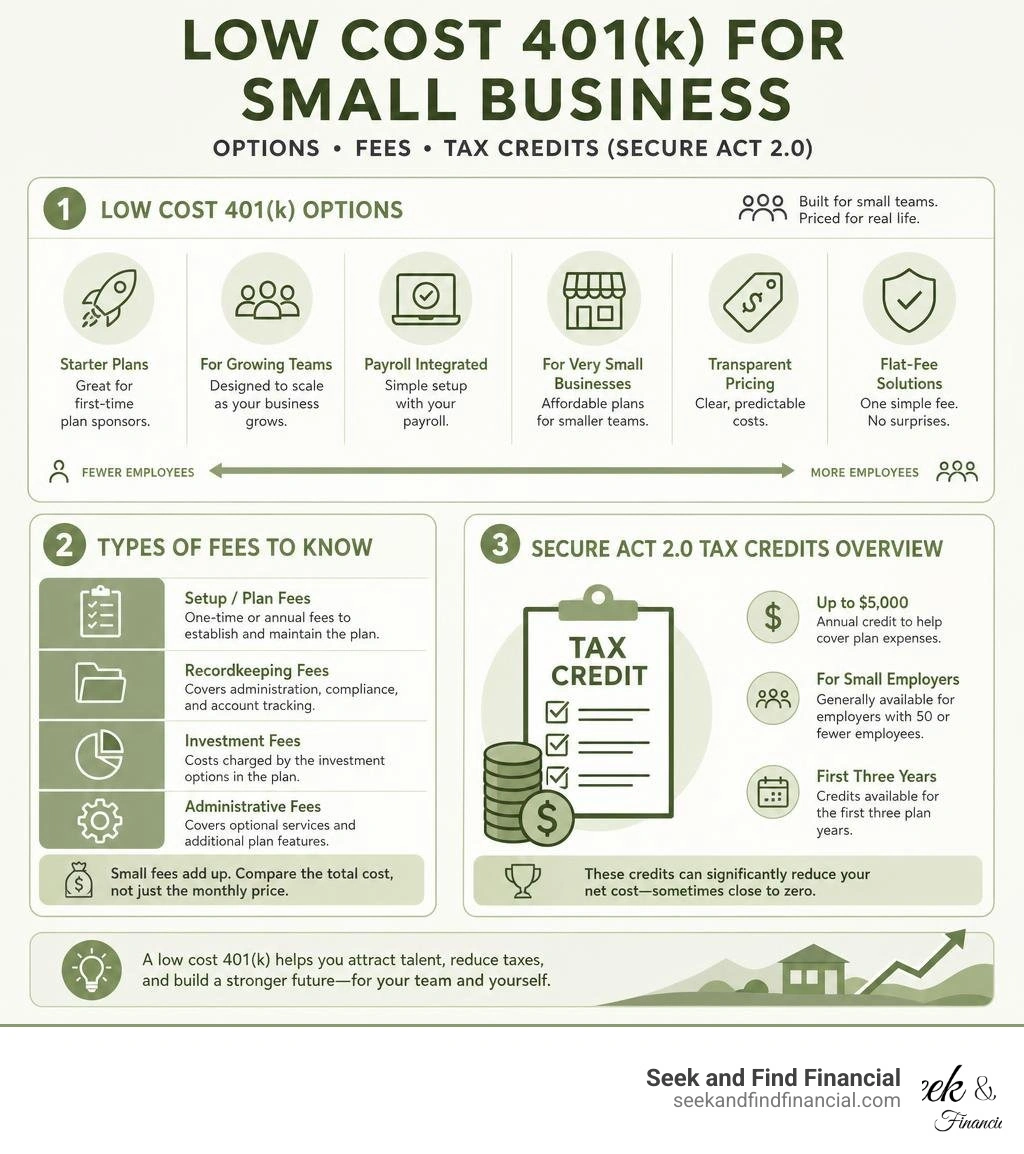
Here are the most affordable 401(k) options available for small businesses right now:
| Provider | Starting Cost | Best For |
|---|---|---|
| Fidelity Advantage 401(k) | $500 setup + $100/month | First-time plan sponsors |
| Human Interest | $80/month + $5/employee | Growing small teams |
| Gusto/Guideline | $49/month + $6/employee | Payroll-integrated simplicity |
| 401GO (GO-Starter) | $25/month + $2/participant | Very small businesses |
| USA 401k | $42/month + $2/participant | Cost-transparent pricing |
| Ubiquity | Flat-fee (custom) | Businesses wanting flat, predictable pricing |
The bottom line: Many small businesses can start a 401(k) for under $100 per month. And thanks to SECURE Act 2.0 tax credits, your net cost for the first three years could be close to zero.
But costs vary a lot depending on the fee model, plan type, and how many employees you have. Picking the wrong plan can mean paying far more than you need to.
Most business owners are surprised to learn that the real cost of a 401(k) is not just the monthly fee. There are investment fees, recordkeeping fees, and sometimes hidden administrative markups that quietly add up. Knowing what to look for before you sign up can save you thousands each year.
I'm Daniel Delaney, Founder of Seek & Find Financial, and throughout my career in financial services I've helped business owners navigate exactly these kinds of decisions, including finding the right low cost 401k for small business that fits their goals without overpaying. In the sections below, I'll walk you through how to compare plans, avoid common fee traps, and make the most of available tax incentives.
Investing involves risk, including possible loss of principal. No investment strategy can ensure financial success or guarantee against losses. Past performance may not be used to predict future results. Provided content is for overview and informational purposes only, reflect the opinions of the author, and is not intended and should not be relied upon as individualized tax, legal, fiduciary, or investment advice.
This information is being provided only as a general source of information. These views may change as market or other conditions change. This information is not intended and should not be used to provide financial advice and does not address or account for an individual's circumstances. Past performance does not guarantee future results and no forecast should be considered a guarantee. Please seek the guidance of a financial professional regarding your particular financial concerns.
Investment advisory services offered by duly registered individuals through Seek & Find Financial LLC a Registered Investment Adviser. Licensed Insurance Professional.
When you look for a retirement plan, you need to understand where the fees go. Setting up a plan is a big step. It is a key part of Retirement Savings Plans for Small Business Owners.
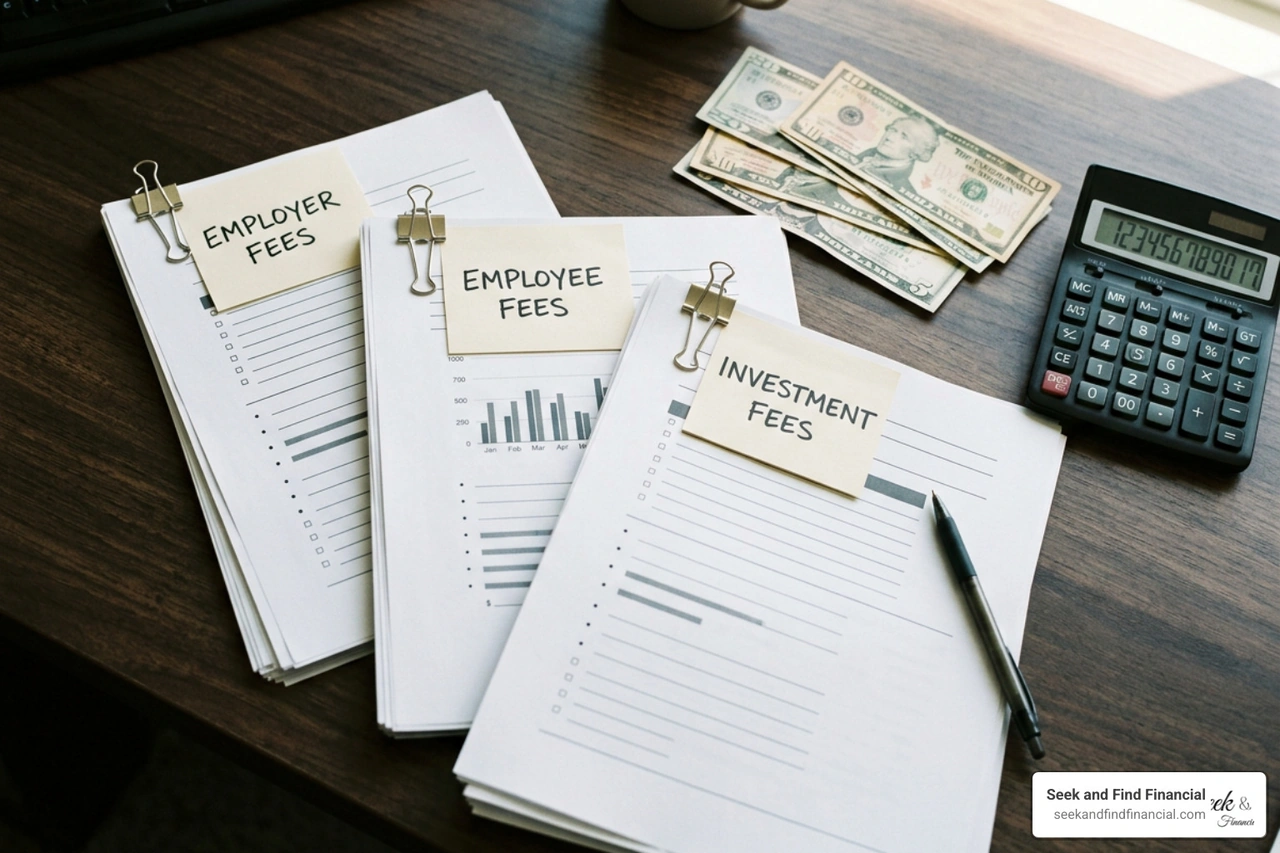
Many business owners only look at the setup fee. This is a mistake. A 401(k) plan has three main types of costs.
First, there are employer administration fees. These are the fees you pay to keep the plan running. They cover recordkeeping, compliance testing, and government reporting.
Second, there are employee participant fees. These are often monthly fees charged to each worker who joins the plan.
Third, there are investment fees. These are also called expense ratios. They are paid out of the money your employees invest. If these fees are too high, they will eat away at your employees' savings over time.
How you pay these fees matters. Providers usually charge you in one of two ways. They use flat fees or asset-based fees.
A flat-fee model means you pay a fixed dollar amount. It does not matter how much money is in the plan. You might pay $100 per month plus $5 per employee. This model is very predictable. As your business grows and your employees save more money, your fees stay the same.
An asset-based fee model is different. The provider takes a percentage of the total money saved in the plan. This is often called an Assets Under Management (AUM) fee. For example, they might charge 0.50% of all plan assets every year.
At first, an asset-based fee looks cheap. If your plan has $50,000 in it, a 0.50% fee is only $250 a year. But what happens when your team saves $1,000,000? That same 0.50% fee becomes $5,000 a year. The provider is not doing any extra work, but you are paying them much more money.
| Fee Model | How It Works | Best For | Pros | Cons |
|---|---|---|---|---|
| Flat-Fee | Fixed monthly or annual charge. | Growing businesses with rising assets. | Predictable costs; does not penalize savers. | Can feel expensive when plan assets are very low. |
| Asset-Based (AUM) | Percentage of total plan assets. | Brand new plans with zero assets. | Very low cost at the very beginning. | Costs rise automatically as savings grow. |
If you want a low cost 401k for small business, flat-fee models are usually the best choice for the long run. They keep your costs predictable.
You must look closely at the fine print. Some providers claim to be low cost but hide fees in other places.
Here are some common hidden fees to watch out for:
To keep your costs low, look for providers that offer transparent pricing. You can learn more about how these plans are managed by reading about the role of a 401k Plan Administrator.
Choosing a plan takes a few steps. You want a plan that fits your business size, budget, and goals. For business owners in Northwest Indiana places like Valparaiso, Chesterton, or Crown Point, as well as Chicago, this choice is a major part of your Small Business Owner Financial Planning.
An affordable plan should still have great features. You do not have to sacrifice quality to get a low price. Look for these key features:
To see how these plans compare to other options, check out our guide on Retirement Plans.
A 401(k) plan offers much higher saving limits than other retirement accounts.
For 2025:
For 2026:
As an employer, you can choose how to match employee savings. You can offer a matching contribution, like matching 100% of what they save up to 3% of their pay. Or you can make a non-elective contribution, where you give every eligible employee a set percentage of their pay, even if they do not save any of their own money.
You can also set a vesting schedule. Vesting determines when employees fully own the matching money you give them. With immediate vesting, they own it right away. With a graded or cliff vesting schedule, they must work for you for a certain number of years before they own the match. This is a great tool to keep your best workers.
The SECURE Act 2.0 makes starting a 401(k) incredibly cheap. The federal government wants small businesses to offer retirement plans, so they are paying for a large portion of the costs. This is highly beneficial for business owners looking at Retirement Plans for High Earners.
Here are the main tax credits available for businesses with 50 or fewer employees:
If you add these up, a small business with ten employees could get up to $16,500 in administrative tax credits over three years, plus thousands more to offset the cost of matching contributions.
Standard 401(k) plans must pass strict IRS nondiscrimination tests every year. These tests make sure that business owners and high earners do not save way more than their everyday employees. If your plan fails these tests, the IRS can force you to return contributions or pay penalties.
A Safe Harbor 401(k) Plans | Simplify Compliance & Save More plan is a fantastic way to avoid this headache.
By offering a mandatory contribution to your employees, your plan automatically passes these annual tests. This allows business owners and high earners to maximize their personal savings up to the full limit without worry.
To get safe harbor status, you must choose one of these contribution options:
All safe harbor contributions must be 100% vested immediately.
If a traditional or safe harbor 401(k) still feels too complex, there are other low-cost options you can consider.
The cheapest option is usually a digital-first 401(k) provider like 401GO or Gusto/Guideline. These platforms use modern technology to automate recordkeeping and compliance. This keeps their costs very low. For example, 401GO's starter plan costs just $25 per month plus $2 per participant. If you have no employees, a Solo 401(k) from a provider like Fidelity is often free of administrative fees.
Under the SECURE Act 2.0, the government offers tax credits that directly reduce the taxes you owe. The startup credit covers 100% of your administrative fees up to $5,000 per year for the first three years. This means if your provider charges you $1,200 a year to run the plan, your tax bill is reduced by $1,200. Your net out-of-pocket cost for running the plan becomes $0.
Yes. As a business owner, you are also an employee of your company. You can make elective deferrals up to the annual limit. You can also receive the same matching contributions that you offer to your team. If you set up a safe harbor plan, you can maximize your personal savings without worrying about nondiscrimination testing.
Setting up a low cost 401k for small business does not have to be difficult or expensive. With modern flat-fee platforms and massive tax credits from the SECURE Act 2.0, offering a high-quality retirement plan is now within reach for almost every small business.
At Seek & Find Financial, we specialize in helping entrepreneurs and business owners build personalized financial plans. We serve clients across Northwest Indiana, including Valparaiso, Chesterton, Portage, Hebron, Merrillville, Crown Point, and Hobart, as well as Chicago. We use advanced technology to help you optimize your tax strategies and grow your wealth.
If you want to design a retirement strategy that protects your wealth and supports your team, we are here to help. Explore our insights on Retirement Plans or reach out to start a conversation.
Investing involves risk, including possible loss of principal. No investment strategy can ensure financial success or guarantee against losses. Past performance may not be used to predict future results. Provided content is for overview and informational purposes only, reflect the opinions of the author, and is not intended and should not be relied upon as individualized tax, legal, fiduciary, or investment advice.
This information is being provided only as a general source of information. These views may change as market or other conditions change. This information is not intended and should not be used to provide financial advice and does not address or account for an individual’s circumstances. Past performance does not guarantee future results and no forecast should be considered a guarantee. Please seek the guidance of a financial professional regarding your particular financial concerns.
Investment advisory services offered by duly registered individuals through Seek & find Financial LLC a Registered Investment Adviser. Licensed Insurance Professional