

Traditional IRA for High Income Earners: Tax Break or Tax Trap?
Discover if traditional ira for high income earners is a tax break or trap. Learn backdoor Roth, pro-rata rule, and better alternatives.
Traditional IRA for high income earners is one of the most misunderstood topics in retirement planning. The short answer: you can always contribute, but you likely can't deduct it — and that difference matters a lot.
Here is what high earners need to know at a glance:

Key facts for 2026:
So if you earn $400K a year, you can still put money into a Traditional IRA. You just won't get a tax break for it — and that changes everything about whether it's worth doing.
Without a clear strategy, a non-deductible Traditional IRA can create more tax headaches than it solves. This guide breaks down exactly when it helps, when it hurts, and what smarter options look like for high earners.
I'm Daniel Delaney, Founder of Seek & Find Financial, and throughout my career — first at established financial institutions and now as an independent advisor — I've helped high-earning clients navigate the specific complexities of using a traditional IRA for high income earners as part of a broader, tax-efficient retirement strategy. Let's walk through what actually works.

Investing involves risk, including possible loss of principal. No investment strategy can ensure financial success or guarantee against losses. Past performance may not be used to predict future results. Provided content is for overview and informational purposes only, reflect the opinions of the author, and is not intended and should not be relied upon as individualized tax, legal, fiduciary, or investment advice.
This information is being provided only as a general source of information. These views may change as market or other conditions change. This information is not intended and should not be used to provide financial advice and does not address or account for an individual's circumstances. Past performance does not guarantee future results and no forecast should be considered a guarantee. Please seek the guidance of a financial professional regarding your particular financial concerns.
Investment advisory services offered by duly registered individuals through Seek & Find Financial LLC a Registered Investment Adviser. Licensed Insurance Professional
Traditional ira for high income earners terms at a glance:
A common myth we hear is that once you reach a certain income level, you are "locked out" of a Traditional IRA. That is not true. According to the Retirement topics - IRA contribution limits | Internal Revenue Service, anyone with earned income can contribute to a Traditional IRA. There is no upper income ceiling for making the contribution itself.
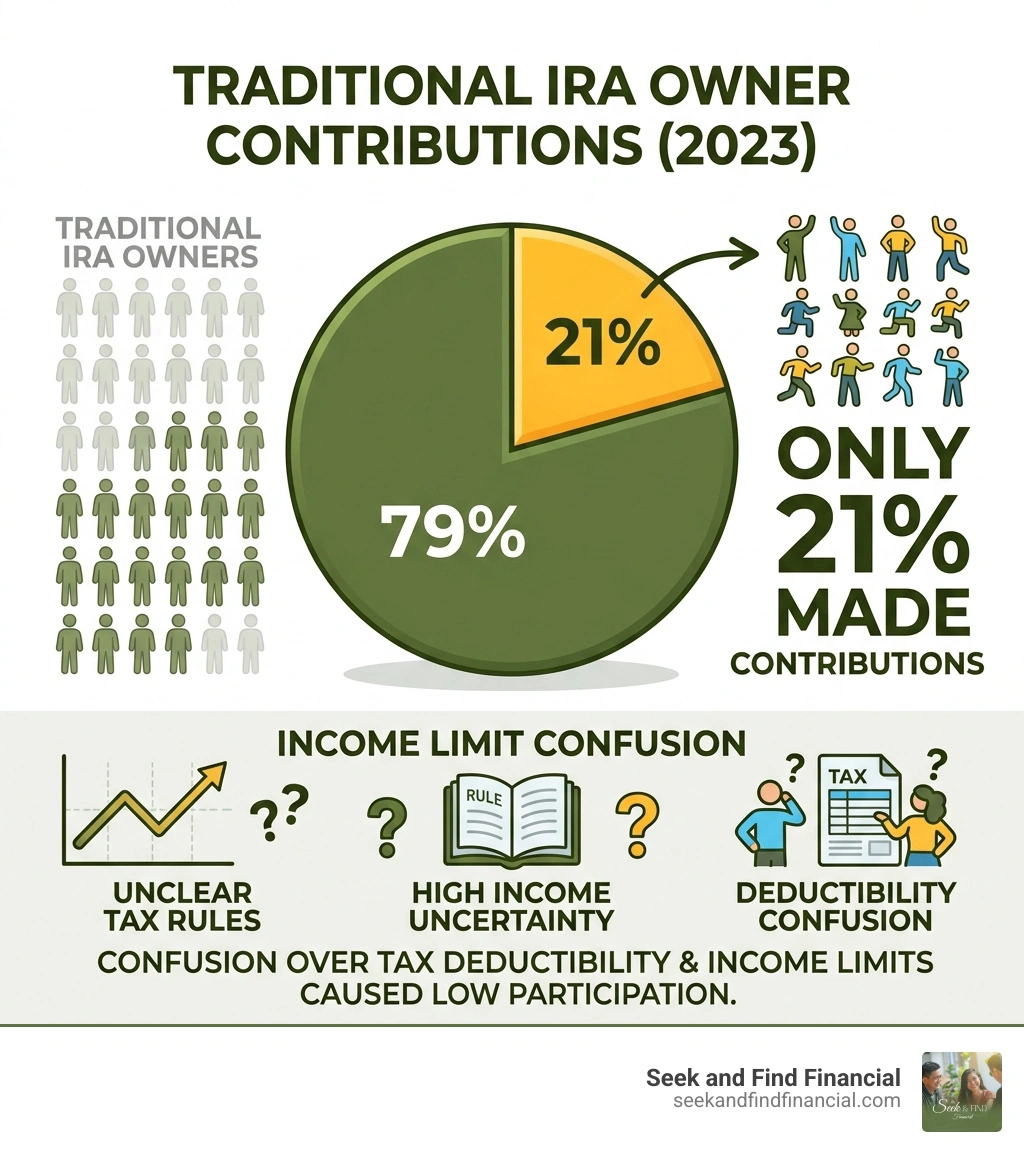
The real question for a traditional ira for high income earners is whether that contribution is deductible. If you or your spouse are covered by a retirement plan at work, the IRS restricts your ability to take a tax deduction as your income rises.
For the 2026 tax year, the contribution limits have seen a slight adjustment for inflation. You can contribute up to $7,500 if you are under age 50. If you are 50 or older, you can add a catch-up contribution of $1,100, bringing your total annual limit to $8,600.
The IRS uses Modified Adjusted Gross Income (MAGI) to determine if you can deduct your IRA contribution. These limits change annually. If you are "covered by a workplace plan" (meaning you have a 401(k), 403(b), or SEP IRA through an employer), the phase-out ranges are quite low for high earners.
For 2025, the phase-out for single filers starts at $77,000. By 2026, those numbers shift slightly:
If your income exceeds these limits and you have a 401(k) at work, your traditional ira for high income earners becomes "non-deductible." You are essentially putting after-tax money into an account where the growth will eventually be taxed as ordinary income. You can find more details on these thresholds at Traditional IRA Income Limits in 2025 and 2026: Can You Contribute? | The Motley Fool.
We often warn our clients that a non-deductible Traditional IRA can be a "tax trap." If you can't take the deduction, you are losing the primary benefit of the account.
When you invest in a standard brokerage account, your long-term gains are taxed at favorable capital gains rates (usually 15% or 20%). However, money coming out of a Traditional IRA is taxed as ordinary income, which can be as high as 37%.
By making non-deductible contributions, you risk "double taxation" on your record-keeping. If you don't properly track your "basis" (the money you already paid taxes on), you might accidentally pay taxes on that same money again when you withdraw it in retirement. For those with significant assets, this requires High Net Worth Tax Planning to avoid unnecessary losses.
If you earn too much to deduct a Traditional IRA contribution and too much to contribute directly to a Roth IRA, you aren't out of luck. This is where the "Backdoor Roth" strategy comes in.
A Backdoor Roth is a legal way to get money into a Roth IRA despite high income. You simply make a non-deductible contribution to a Traditional IRA and then immediately convert those funds to a Roth IRA. Since there are no income limits on conversions, this moves your money into a tax-free growth bucket.
The process is straightforward but requires precision. First, you open a Traditional IRA and fund it with after-tax dollars. Then, you move that money into a Roth IRA.
Because you didn't take a tax deduction on the way in, the conversion itself is generally tax-free, provided you have no other pre-tax IRA assets. This allows your investments to grow tax-free and provides tax-free withdrawals in retirement. It also bypasses Required Minimum Distributions (RMDs), which is a massive benefit for Retirement Plans for High Earners.
The biggest "trap" in the Backdoor Roth strategy is the Pro-Rata Rule. The IRS does not look at your IRAs individually; it looks at all of them as one giant bucket.
If you have $100,000 in an old rollover IRA (pre-tax) and you try to do a $7,500 Backdoor Roth with after-tax money, the IRS will tax your conversion proportionally. You can't just tell the IRS you are only converting the "after-tax" part.
This rule includes SEP IRAs and SIMPLE IRAs, but it luckily excludes workplace 401(k)s. To manage this, you must file IRS Form 8606 every year you make a non-deductible contribution. This form tracks your "basis" so you don't pay taxes twice.
For many of our clients earning $400K+, a traditional ira for high income earners is often the third or fourth priority. Usually, workplace plans offer much higher "bang for your buck."
If you are an employee, maxing out your 401(k) is the first step. For 2026, the employee deferral limit is $24,500. This is a direct reduction of your taxable income, which is far more valuable than a non-deductible IRA. You can read more about these strategies in our guide on Retirement Savings Plans for Small Business Owners.
There are specific times when a Traditional IRA is actually a great move for high earners:
For the entrepreneurs we serve in locations like Crown Point and Chicago, small business retirement plans are often superior.
A SEP IRA allows you to contribute up to 25% of your compensation (or about 20% of net self-employment income), with a cap expected to be around $72,000 for 2026. However, a Solo 401(k) often wins because it allows for both employee deferrals and employer contributions. It also permits the "Mega Backdoor Roth" strategy if the plan is designed correctly, allowing you to move up to $70,000+ into a tax-free Roth environment annually.
The goal of retirement planning isn't just to save money; it's to have the flexibility to spend it without giving half to the government. This is called tax diversification.
If all your money is in a Traditional IRA, you will eventually face Required Minimum Distributions (RMDs). Currently, these start at age 73 (moving to 75 soon). For a high earner with a $2 million IRA, an RMD could easily be $80,000 a year, which might push you into a higher tax bracket and increase your Medicare premiums.
Geography matters. While federal rules are standard, state tax rules vary. For example, some states have different rules for how they treat IRA deductions compared to the federal government.
Also, keep in mind the 10% early withdrawal penalty. If you take money out of a traditional ira for high income earners before age 59.5, you'll owe that penalty plus ordinary income tax. There are exceptions for disability or first-time home purchases, but generally, this money should stay put until you retire.
If you cannot deduct your IRA contribution and you don't plan to do a Backdoor Roth, a taxable brokerage account is often better.
Yes. While Congress discussed ending this strategy in previous years, it remains a perfectly legal and viable strategy for high earners to build tax-free wealth.
If you exceed the annual limit ($7,500 or $8,600), the IRS charges a 6% penalty every year the excess stays in the account. You must withdraw the excess and any earnings on it before you file your tax return to avoid the fee.
It depends on your joint income. If you are not covered by a plan but your spouse is, your deduction phases out at a much higher level (between $242,000 and $252,000 MAGI in 2026).
At Seek & Find Financial, we believe that a traditional ira for high income earners should never be a "default" choice. It should be a calculated part of a larger system. For some, it’s the first step in a Backdoor Roth. For others, it’s a tax trap that’s better replaced by a Solo 401(k) or a well-managed brokerage account.
Building wealth as a high earner in places like Valparaiso or Merrillville requires more than just "saving." It requires a structured plan that looks at your current tax bracket versus your future one. If you want a personalized strategy that uses modern technology like Altruist to track your growth, we are here to help.
More info about our planning services
Investing involves risk, including possible loss of principal. No investment strategy can ensure financial success or guarantee against losses. Past performance may not be used to predict future results. Provided content is for overview and informational purposes only, reflect the opinions of the author, and is not intended and should not be relied upon as individualized tax, legal, fiduciary, or investment advice.
This information is being provided only as a general source of information. These views may change as market or other conditions change. This information is not intended and should not be used to provide financial advice and does not address or account for an individual’s circumstances. Past performance does not guarantee future results and no forecast should be considered a guarantee. Please seek the guidance of a financial professional regarding your particular financial concerns.
Investment advisory services offered by duly registered individuals through Seek & find Financial LLC a Registered Investment Adviser. Licensed Insurance Professional